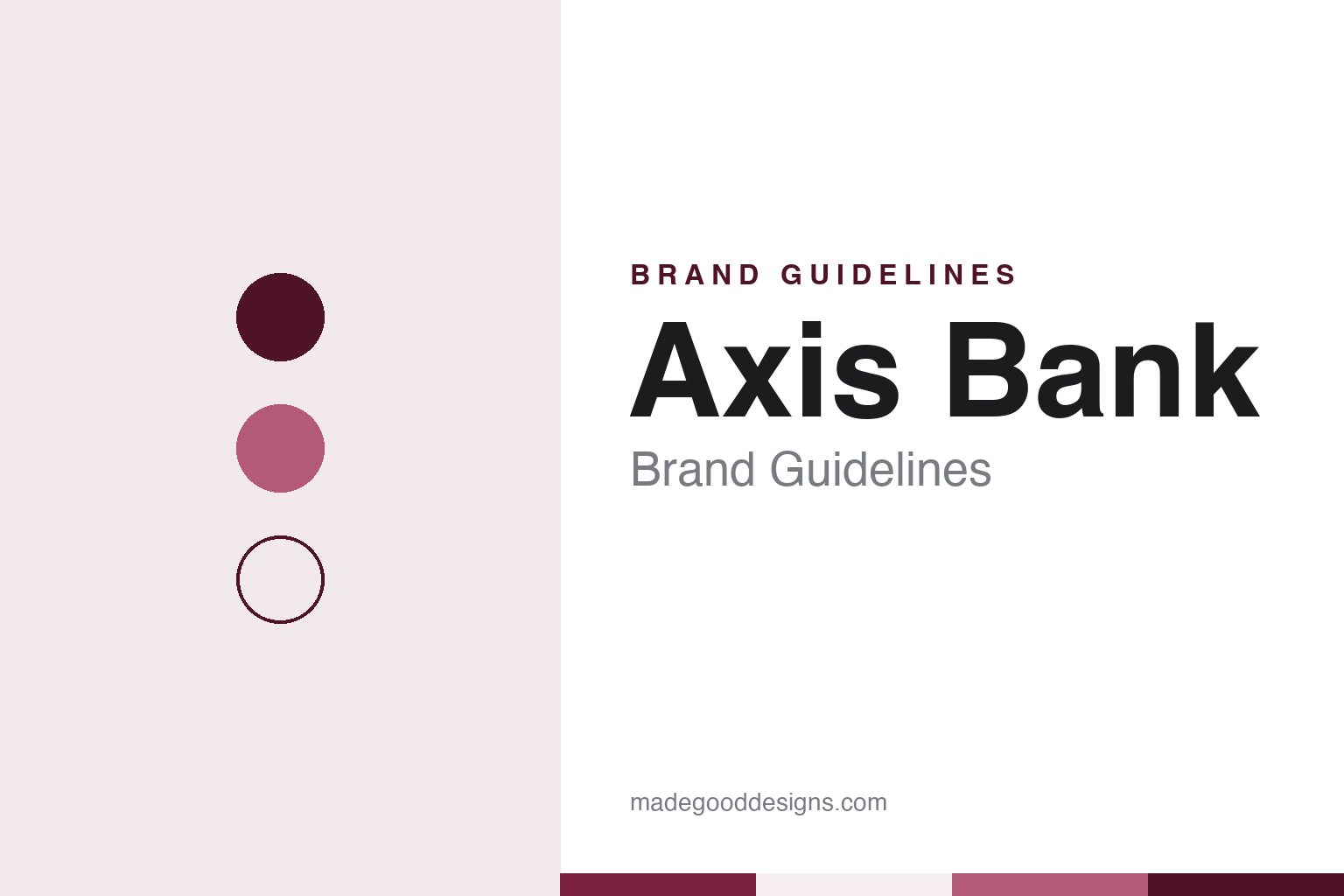
Axis Bank Brand Guidelines
A 1993 bank that changed its name to stand on its own.
Aa
Two constants: a wine, rose and blush palette and a rounded sans register. Abstract homage — not an Axis Bank product or mark; no logo, symbol or lettering is reproduced.
UTI Bank
A new private bank from state institutions.
Axis Bank began as UTI Bank. English Wikipedia dates its founding to 3 December 1993, with a registered office in Ahmedabad and a corporate office in Mumbai, an arrangement the bank’s own profile still lists today. The bank says it began operations in 1994 and was among the first private-sector banks set up under the Reserve Bank of India’s 1993 guidelines, issued as part of the government’s financial-sector reforms.
Its backers were public institutions rather than a family or a single founder. The bank says it was promoted in 1993 jointly by the Unit Trust of India, the Life Insurance Corporation of India (LIC), the General Insurance Corporation of India and four state-owned general insurers: National Insurance, New India Assurance, Oriental Insurance and United India Insurance. The Unit Trust’s holding passed in 2003 to a new entity known as the Specified Undertaking of the Unit Trust of India, and the general insurers were later reclassified from promoters to public shareholders. The bank says LIC is now its only promoter, holding a little under eight per cent at 31 March 2026.
The early years brought expansion abroad. English Wikipedia records that a planned merger with Global Trust Bank, agreed in 2001, did not go ahead after the Reserve Bank withheld approval; that UTI Bank listed on the London Stock Exchange in 2005; and that it opened its first overseas branch, in Singapore, in 2006, followed by an office in Shanghai and branches at the Dubai International Financial Centre and in Hong Kong in 2007. A British subsidiary, Axis Bank UK, began banking operations in 2013, the same source says.
Colour
Why UTI became Axis.
The name changed on 30 July 2007. Mint reported that day that the Registrar of Companies had issued a fresh certificate of incorporation and that the bank had told the Bombay Stock Exchange its name was now Axis Bank Ltd; the board had approved the change on 30 April. The reason was confusion: several unrelated entities used the UTI name, and the UTI brand itself was owned by UTI Asset Management Company, a bank executive had said earlier.
The rename was planned as a full rebrand. Mint reported that the bank had hired the advertising agency O&M to build awareness of the new name across the country, and that it would change both its logo and the colour of its logo. Little else about the design process is documented in the sources used here.
The bank has since built a family of businesses under the Axis name. Its profile describes a “One Axis” umbrella that includes Axis Mutual Fund, Axis Capital, Axis Finance and Axis Securities, alongside the payments app Freecharge, which English Wikipedia says the bank bought in 2017. Axis Bank also holds a stake in Axis Max Life Insurance, a joint venture with Max Financial Services, and its corporate social responsibility work runs partly through the Axis Bank Foundation, set up as a trust in 2006, the bank says.
On its current website, now at an address ending in .bank.in, the bank uses the Hindi phrase “dil se open,” roughly “open from the heart,” across its pages and account-opening offers, and names its wealth-management business Burgundy.
Typography
Indian banks and their public face.
Indian banks tend to present themselves through a short name and a bold symbol. The State Bank of India’s keyhole, drawn at the National Institute of Design in Ahmedabad and adopted in 1971, replaced a banyan tree, The Hindu BusinessLine reported, and in 2017 the bank cut its long name to the letters SBI beside that symbol, The Economic Times reported. Across the sector, blues, reds and oranges are common in bank marks, usually pairing one symbol with a short wordmark.
Language is part of the identity. The keyhole came with matching lettering of the bank’s name in nine Indian languages, according to BusinessLine, and Indian bank signs and websites commonly set Hindi and English names side by side, with regional scripts added in different states. Names change too: UTI Bank became Axis Bank in 2007 because other organisations used the UTI name, Mint reported, and the merger of five associate banks into SBI on 1 April 2017 took their names off branch signboards, The Hindu reported.
Bank websites follow a common pattern. Pages on savings accounts, loans and cards sit beside digital banking apps, branch and cash-machine locators, and photographs of branches and staff. Financial inclusion has a long history in the sector’s self-presentation: BusinessLine dates its start to the nationalisation of fourteen banks in 1969, and government schemes such as the Pradhan Mantri Jan Dhan Yojana appear in the State Bank of India’s website menus. The websites of both the State Bank of India and Axis Bank now sit at addresses ending in .bank.in.
Annual reports and corporate social responsibility programmes complete the picture, setting out branch networks, rural reach and foundation work. This guide sets out what can be checked about each bank — when it was founded, how its name and ownership changed, and what is documented about its symbol — and marks clearly what rests only on the bank’s own word.
Aa
A rounded sans for a name chosen in 2007. (Specimen set in Hind, a sans STAND-IN with Devanagari support; NOT the Axis Bank logo or lettering.)
Axis Bank
Citi’s Indian customers join.
The largest step in the bank’s recent history was a purchase. Business Today reported on 30 March 2022 that Axis Bank had agreed to buy Citigroup’s consumer business in India — credit cards, retail banking, wealth management and consumer loans, plus the consumer arm of Citicorp Finance — subject to regulatory approval. Axis Bank announced on 1 March 2023 that the acquisition was complete, about seven months after approval from the Competition Commission of India, with around 3,200 Citi consumer staff joining that day. The deal brought 21 Citi branches into the network, and the bank said customers would keep using existing Citibank branches, cash machines, phone and online banking while systems were combined; its profile says that transition was finished in 2024.
The record also includes regulatory action. On 10 June 2013 the Reserve Bank of India announced monetary penalties on Axis Bank, HDFC Bank and ICICI Bank after a scrutiny in March and April that year found non-adherence to parts of its know-your-customer and anti-money-laundering instructions.
Today the bank calls itself the third-largest private-sector bank in India. At 31 March 2026 it reported 6,275 branches, close to half of them in rural and semi-urban areas, and international offices including branches in Singapore and at the Dubai International Financial Centre, with representative offices in Dhaka, Dubai, Abu Dhabi and Sharjah.
For a design guide, Axis Bank shows how a young bank can trade an inherited name for one of its own and then grow it through subsidiaries and acquisition. Compare ICICI Bank, another large Indian private-sector lender, and Kotak Mahindra Bank, another Indian private-sector bank. For this guide we use a wine red, a dusty rose and a blush white with a sans, an unofficial interpretation; no product or logo is reproduced.
Explore & save
Keep Axis Bank’s identity on hand — save it to a board in the Made Good inspiration library.
Axis Bank identity set
Pin the Axis Bank wine, rose and blush palette and the rounded sans register to your own board.