China Merchants Bank Brand Guidelines
A Shenzhen bank built on cards, apps and a merchant group’s name.
Aa
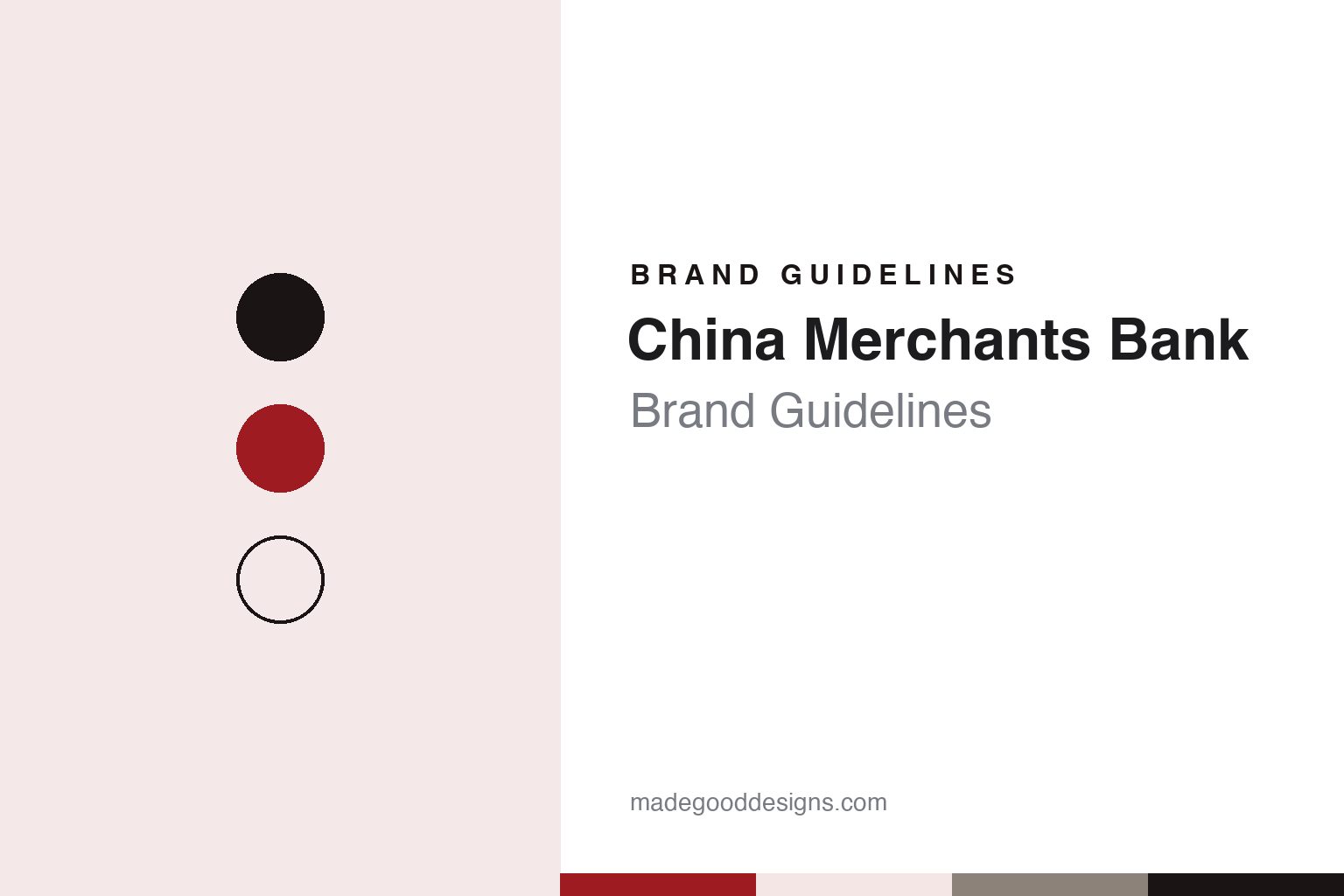
Two constants: a lantern red and warm grey palette and a Modern sans register. Abstract homage — not a China Merchants Bank product or mark; no logo, card or app screen is reproduced.
A merchant group’s bank
Founded by China Merchants Group in 1987.
China Merchants Bank was founded in 1987 by China Merchants Group, English Wikipedia says. The group began in Shanghai on 16 December 1872 as the China Merchants Steam Navigation Company, a shipping line, and from 1979 developed the Shekou Industrial Zone in Shenzhen; in 1987, English Wikipedia says, it founded the bank, which it describes as the first joint-stock bank in the People’s Republic. The bank’s own Wikipedia entry calls it the first share-holding commercial bank in China wholly owned by corporate legal entities.
The bank ties itself to that moment. Its 2018 annual report calls it “a brainchild of the reform and opening-up policy,” gives its head office as Shenzhen and records a board meeting held at its Shekou Training Center in March 2019. English Wikipedia places the head office in Futian District, Shenzhen.
The name links bank and group. Its Chinese name, Zhaoshang Yinhang, shares the “Zhaoshang” of the parent, whose early Chinese name English Wikipedia translates as “Merchants Bureau.” The short form CMB appears in the names of its apps and its Hong Kong subsidiary.
Ownership has stayed linked to the group. In its order of 8 November 2007 approving a New York branch, the US Federal Reserve Board said China Merchants Group indirectly owned about 17.6 percent of the bank and was considered to control it, and that two other state-owned shipping groups, China Ocean Shipping and China Shipping, held about 6.4 and 5.4 percent. The same order described the bank as indirectly controlled by the Chinese government through a number of wholly owned companies. At the time, the order said, the bank worked mainly in corporate and retail banking and treasury operations across China, ran a branch and an investment adviser in Hong Kong, and had a representative office in New York.
Colour
Cards first, then apps.
The bank became a listed company in two steps. Its 2018 annual report says it was listed on the Shanghai Stock Exchange in April 2002 and on the Stock Exchange of Hong Kong in September 2006; English Wikipedia gives the same years.
Its brand has been built mainly on named retail products. The annual report lists the “All-in-one Card”, a multi-function debit card, the “All-in-one Net” online banking platform, credit cards and “Sunflower Wealth Management” among services it says are widely recognised. The bank’s president wrote in the same report that the All-in-one Card had been launched 24 years earlier, in response to customer needs, and that it did away with passbooks; in 2018, he wrote, the bank moved its outlets to card-free service and began a campaign to shift customers from bank cards to apps. English Wikipedia says that by 2017 about 80 million credit cards had been issued, making it one of the largest card issuers in the country.
The app became the new front door. The report says the CMB APP and CMB Life APP together had 148 million users at the end of 2018, and describes services built around them for subways, buses and parking. It frames the change as a move from bank cards to apps and from a trading mindset to the customer journey. The same year, the report says, the board raised the bank’s Financial Technology Innovation Project Fund from 1% of the previous year’s pre-tax profit to 1% of the previous year’s operating income. Its branch network, the report says, is concentrated in the Yangtze River Delta, the Pearl River Delta and the Bohai Rim, with correspondent banks in 106 countries and regions at the end of 2018.
Its technology work has outside recognition. On 7 September 2026 the Cloud Native Computing Foundation named China Merchants Bank, which it called one of China’s leading commercial banks, as winner of its End User Case Study Contest for KubeCon China 2026, for a platform that lets AI model training and online inference share nearly 10,000 accelerator cards on Kubernetes, according to the foundation’s announcement.
Typography
Banking in China.
China’s large banks present themselves to two audiences at once. Most carry a Chinese name and an English one, and many shorten the English to initials, so a single identity has to work in Chinese characters, in Latin letters and in a short acronym on cards, apps and branch fronts. Red and blue dominate the sector’s colours, and marks are often built around Chinese characters or around round forms that recall coins and seals, though the meaning of a particular mark should be checked against the bank’s own account rather than assumed.
Much of the visual record comes from the banks’ own channels. Their websites set out a mission, a motto and a list of values, usually in both languages, and divide services into retail or personal banking, corporate banking, inclusive finance for small businesses and wealth management. Branch photography, with signage over glass frontages and service halls, is a staple of annual reports and investor pages.
The phone has become a second front door. The big banks run mobile-banking apps and, in several cases, separate lifestyle or payments apps, and they report online user numbers alongside branch counts. Many also link their cards to UnionPay, the national card network.
The paper trail is long and dated. Banks listed in Shanghai and Hong Kong publish annual reports, interim results and ESG reports in Chinese and English, and several issue green bonds or publish separate green-finance reports. For design research, those documents give dated, citable evidence of how an identity is applied, from cover design to typography and photography, and they are the most reliable place to check a claim about a bank’s name, history or scale.
Aa
A modern sans for a bank of cards and apps. (Specimen set in Inter Tight, a sans STAND-IN; NOT the China Merchants Bank logo.)
CMB
From Shenzhen to New York, London and Hong Kong.
The bank expanded abroad through branches and one acquisition. The Federal Reserve Board approved its New York branch in November 2007, and English Wikipedia says it opened in 2008; English Wikipedia also records a London branch opened on 19 January 2016. In Hong Kong it bought 53.12% of Wing Lung Bank, founded in 1933, in 2008 and the remaining shares in 2009. Wing Lung was delisted in January 2009 and in May 2009 adopted China Merchants Bank’s corporate identity, according to English Wikipedia; it operates as CMB Wing Lung Bank.
Regulators class it as systemically important at home. In October 2021 the People’s Bank of China and the banking regulator placed it in the third group of 19 domestic systemically important banks, alongside Bank of Communications and Industrial Bank, Sina Finance reported. The palette below is our own interpretation.
For a design guide, China Merchants Bank shows a bank whose identity is carried by named retail products and apps as much as by its mark. Compare Ping An, another financial group that began in Shekou, and Bank of Communications, which shares its domestic regulatory group. For this guide we use a lantern red and a warm grey with a sans, an unofficial interpretation; no product or logo is reproduced.
Explore & save
Keep China Merchants Bank’s identity on hand — save it to a board in the Made Good inspiration library.
China Merchants Bank identity set
Pin the lantern red and warm grey palette and the Modern sans register to your own board.