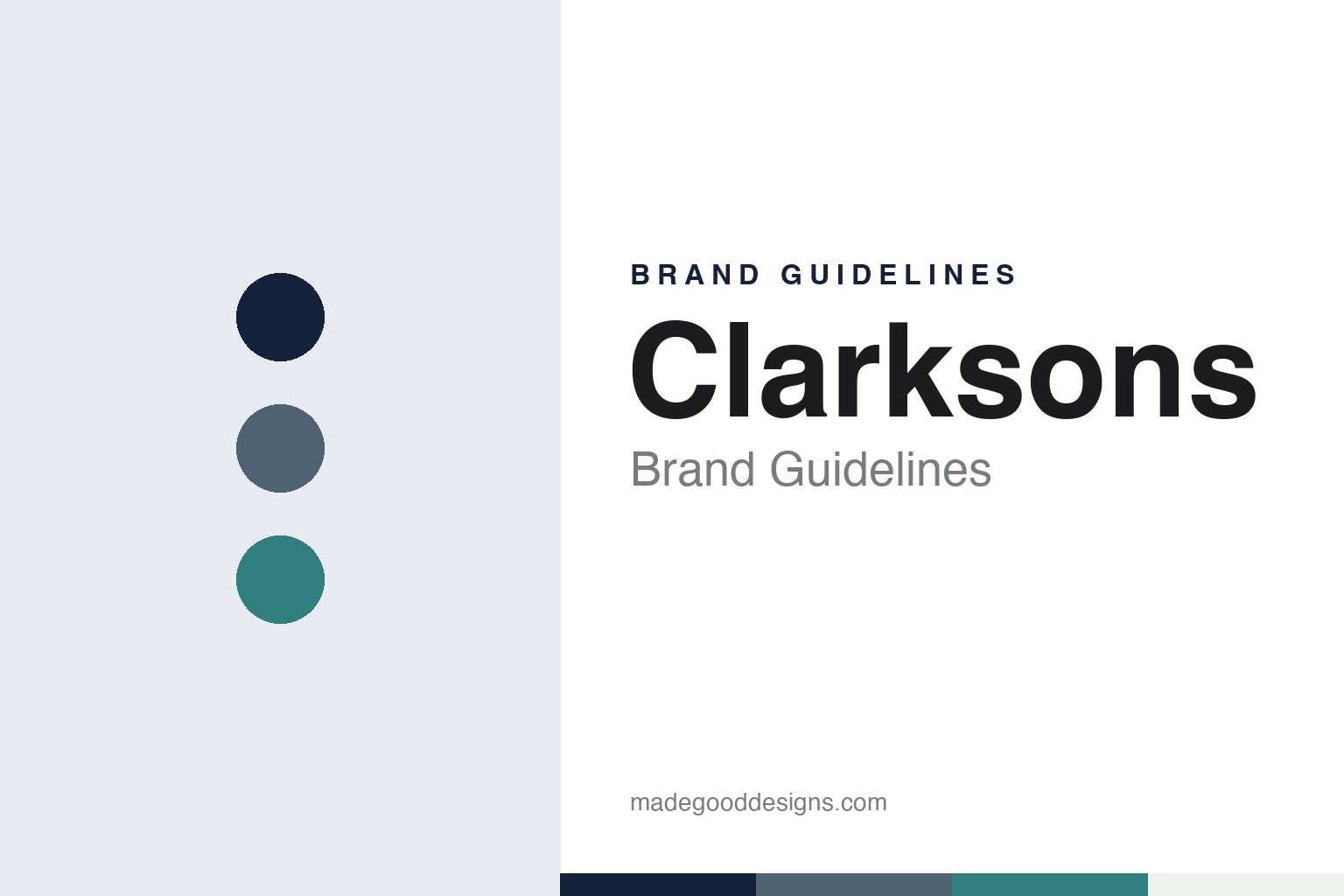
Clarksons Brand Guidelines
Horace Clarkson’s 1852 London shipbroker and its research arm.
Aa
Two constants: a Clarksons navy, slate and sea teal palette and a corporate sans register. Abstract homage — not a Clarksons product or mark; no logo or wordmark is reproduced.
Horace Clarkson’s London Firm
Sailing ships, steamships and an oil company’s broker.
Clarksons began in London in 1852, when Horace Anderton Clarkson set up in business as a shipbroker, according to English Wikipedia. It describes him as the son of a prosperous lawyer who invited a former colleague, Leon Benham, to join him in partnership; Benham’s son Henry soon joined the firm as well. In the 1850s the business dealt in sailing ships, and by the 1860s it was chartering steamships. In 1872 Clarksons became a shipowner too, buying three schooners.
The next landmark involved oil. English Wikipedia says Clarksons became the largest tanker broker in 1929, when Esso appointed it as its exclusive shipbroker. The network then spread abroad. The first overseas office opened in New York in 1954, followed by offices in France, Australia and Germany, and in the 1960s in South Africa and Greece. Expansion in East Asia began in the 1990s, when companies were set up in Hong Kong, Shanghai and Singapore.
English Wikipedia singles out Carron Greig, who became joint managing director in 1962, chaired the shipbroking division from 1972 to 1985 and then chaired the whole group, at that time known as Horace Clarkson, until 1993, and credits him with turning it into a leader in its field and with bringing in business from Brazil, Norway and the Far East. In 1974 the company spun off various diversified assets as a separate business, Shipping Industrial Holdings.
Colour
Five business lines and a research arm.
The parent company is Clarkson PLC, which trades as Clarksons. English Wikipedia says it is headquartered in London, is listed on the London Stock Exchange and is a constituent of the FTSE 250 index. In 2011 Lloyd’s List described its shipbroking business as the “undisputed heavyweight of the shipbroking market,” Wikipedia notes. Andi Case has been chief executive since 2008, and Laurence Hollingworth was appointed chair in March 2022. gCaptain, reporting on its half-year results in August 2026, called Clarksons a “shipbroker and maritime services giant” and a London-listed company.
The company now presents itself as one group with five integrated business lines: broking, financial, research, port services and technology. Its broking pages are arranged by market, with chartering desks for deep-sea tankers, dry cargo, gases and containers, among others, alongside sale and purchase, offshore and renewables teams and a derivatives desk that trades freight futures for dry and wet cargoes. The company says it has more than 70 offices in 26 countries and a network of more than 2,250 specialists.
The financial line is broader than broking. Clarksons lists securities work covering investment banking, sales and trading, equity and credit research and shipping project finance, together with structured asset finance, real estate project finance and fund management. Port services run from port agency and voyage agency to crew change, bunkering, customs and terminal handling, with a separate shortsea broking business. A technology line completes the set, and the company says its research underpins the work of its broking, financial and technology teams.
Research is a business of its own. English Wikipedia describes Clarkson Research Services as focused on the collection, validation, analysis and management of data about the merchant shipping and offshore markets, and says the economist Martin Stopford headed the research arm and sat on the board until March 2012. Clarksons Research says it has more than 170 experts and 15,000 platform users, and sells subscriptions to the Shipping Intelligence Network, the World Fleet Register, the Offshore Intelligence Network and the Renewables Intelligence Network, plus an API portal, along with valuations, market studies and consultancy. gCaptain reported in August 2026 that the research business had kept growing as customers sought data and analysis.
Typography
How shipbroking houses present themselves.
Shipbrokers arrange charters and ship sales rather than make products, and their websites lean on age, reach and research. Many London houses put a long founding date close to the name: Clarksons traces its business to 1852, and Braemar counts more than fifty years since its 1971 start. This guide reads the category through a sober register of navy, deep red and stone with plain wordmarks, an unofficial interpretation rather than any firm’s own colours.
The websites tend to be organised by market. Clarksons and Braemar both split their chartering pages into desks for tankers, dry cargo, gas and containers, with sale and purchase alongside, and both run derivatives teams that trade freight futures. At Clarksons, offshore and renewables appear as further desks, so a visitor can go straight to the market they trade.
Research is the second pillar. Clarksons runs Clarksons Research as its own business line, with data platforms sold by subscription, while Braemar keeps a research team next to its broking desks and a news and insights section. Market reports, forecasts and conference talks give these firms a public voice between deals, and trade publications such as gCaptain and The Maritime Executive have reported their outlooks and results.
Office maps and careers pages complete the picture. Clarksons says it has more than 70 offices in 26 countries, and Braemar lists tanker desks from London and Madrid to Houston, Geneva and Singapore. Both publish trainee broker programmes for graduates and newcomers, and Clarksons adds summer internships in London and Oslo. The guides that follow look at how each house presents its history, its markets and its people.
Aa
A clean corporate sans for a London broking group. (Specimen set in IBM Plex Sans, a sans STAND-IN; NOT the Clarksons logo.)
Clarksons
Acquisitions, trainees and a green transition section.
Clarksons has also grown by acquisition. English Wikipedia says it bought Gibb Tools, a North Sea oil engineering tools supplier, in 2013, and in 2015 acquired RS Platou, a Norwegian shipbroking and investment banking group. Gibb Group still appears among the company’s port services, next to port agency, project logistics and freight forwarding. The company says its purchase of Euro-America Shipping & Trade, Inc. in March 2025, since renamed Clarksons EAST LLC, broadened its integrated offer.
The company’s own pages set out its message. The about page opens with the line “Smarter, cleaner, greener,” says the company keeps world trade moving, and says that anticipating change has earned it its place “at the heart of global shipping.” A Green Transition section and a Carbon Intensity Indicator page sit beside the investor pages. The careers pages offer a Global Trainee Broker Programme and summer internships in London and Oslo, with guides titled “A career in shipbroking” and “Is shipbroking right for you?”, and the site links to the Clarkson Foundation.
For a design guide, Clarksons shows how a house founded in 1852 can present broking, research and finance as one connected group, with each market given its own desk and its own page. Compare Braemar, another London-listed shipbroker built through mergers, and SSY, another London shipbroking house. For this guide we use a deep navy, a harbour slate and a sea teal with a sans, an unofficial interpretation; no product or logo is reproduced.
Explore & save
Keep Clarksons’s identity on hand — save it to a board in the Made Good inspiration library.
Clarksons identity set
Pin the Clarksons navy, slate and sea teal palette and the corporate sans register to your own board.