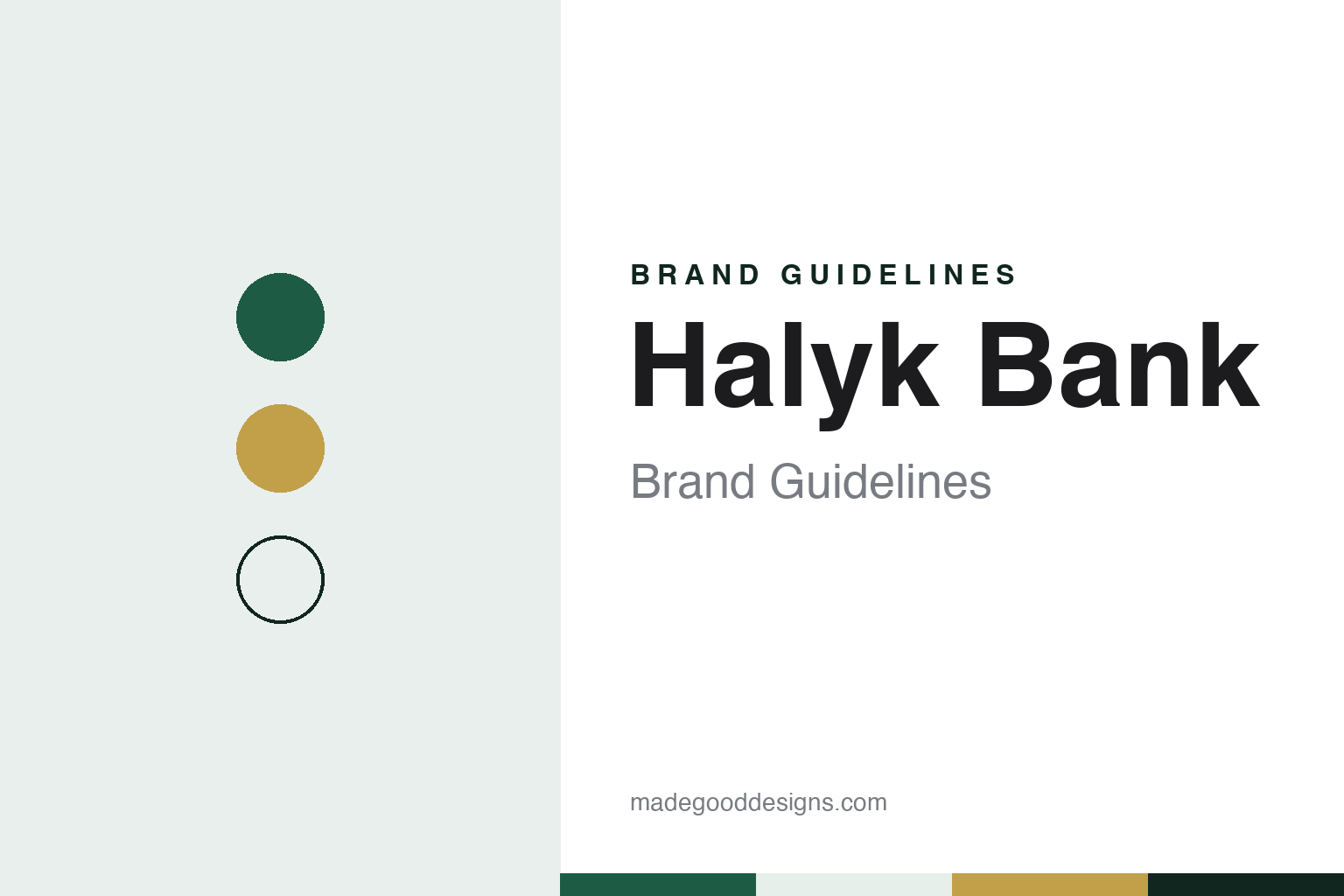
Halyk Bank Brand Guidelines
Kazakhstan’s people’s savings bank, from a 1923 savings office to a SuperApp.
Aa
Two constants: a deep green, mint and wheat-gold palette and a geometric sans register. Abstract homage — not a Halyk Bank asset or mark; no logo, card or app screen is reproduced.
A savings office in Aktobe
A people’s savings bank with Soviet roots.
Halyk Bank traces its history to August 1923, when, the bank says, the first savings office in Kazakhstan opened in Aktyubinsk, the town now called Aktobe. The bank treats that date as the starting point of its story, and Russian-language Wikipedia gives the same year and place. Through the Soviet decades the network was part of the state savings system: the bank’s own timeline counts 1,515 savings offices in Kazakhstan on 1 January 1941 and 2,805 by the beginning of 1961, and English Wikipedia describes Halyk as the legal successor of the Savings Bank of the USSR in Kazakhstan, the counterpart of Sberbank in Russia.
The name explains the brand. The bank’s full Kazakh name, Қазақстан Халық Банкі, appears beside the Russian form, Народный банк Казахстана, and the English “Halyk Bank of Kazakhstan,” Russian Wikipedia says. English Wikipedia translates an earlier form of the name as “People’s Savings Bank of Kazakhstan.” That three-language naming — Kazakh, Russian and English, in Cyrillic and Latin letters — is part of how the bank presents itself today.
Independence brought a new legal shape. Russian Wikipedia says the bank is the legal successor of the Savings Bank of the Republic of Kazakhstan, created in 1992; it became a separate legal entity in 1993 and a closed joint-stock company in 1995. In 1990, the bank’s timeline says, it issued the Irtysh payment cards together with the ferroalloy plant at Yermak, and by 1994 its structure ran to some 2,400 branches and savings offices. In July 1998, according to the bank, its shareholders voted to turn it from a closed joint-stock company wholly owned by the state into an open joint-stock company, Halyk Savings Bank of Kazakhstan. Russian Wikipedia says its shares have been listed on the Kazakhstan Stock Exchange since 1998, on the London Stock Exchange since 2006 and on the Astana International Exchange since 2019, and describes it today as a private bank.
Colour
HSBC Kazakhstan, Kazkommertsbank and a regional group.
Halyk grew in the 2010s by buying other banks. On 26 February 2014, the bank says, it agreed to buy HSBC Bank Kazakhstan from HSBC Bank plc, and the purchase of the whole subsidiary was completed on 3 December 2014. In November 2016 it agreed to sell 60% of another subsidiary, Altyn Bank, to China CITIC Bank, a sale completed in April 2018.
The largest step was Kazkommertsbank. The bank says it completed the purchase of 96.81% of Kazkommertsbank’s ordinary shares in June 2017 and finished the merger in July 2018, when all of Kazkommertsbank’s property, rights and obligations passed to Halyk; English Wikipedia dates the merger to 27 July 2018.
The result is a group rather than a single bank. Halyk Group, as the bank calls it, covers banking, insurance, leasing, brokerage and asset management: its subsidiaries include Halyk Bank Georgia in Tbilisi, Tenge Bank in Tashkent, Halyk Insurance, Halyk Life, Halyk Finance and Halyk-Leasing. The Central Bank of Uzbekistan licensed Tenge Bank on 24 May 2019, according to the bank. Russian Wikipedia says that in 2022 the bank sold its subsidiaries in Tajikistan and Russia, keeping its banks in Georgia and Uzbekistan.
The bank describes itself as the largest universal commercial bank in Kazakhstan. Russian Wikipedia puts its network at 24 regional and 120 district branches and 428 cash and settlement centres at the end of 2022. Those figures change, and this guide keeps them to a minimum.
Typography
Super-apps, scripts and savings books.
Many banks in Central Asia and the Caucasus now present themselves through their apps. In Kazakhstan, Kaspi.kz describes a single “Super App” that joins bill payments, an online marketplace, consumer credit, transfers and QR payments in shops, while Halyk Bank, the former state savings bank, sells its retail services through the Halyk SuperApp and its business services through Onlinebank. In the apps these two banks describe, loans, deposits, cards and transfers sit beside shopping, travel and government services.
Names are usually shown in more than one language and script. Halyk Bank’s full name appears in Kazakh as Қазақстан Халық Банкі, in Russian as Народный банк Казахстана and in English as Halyk Bank of Kazakhstan; Kaspi Bank was registered for years under the Russian name Банк Каспийский before it took its Latin-letter brand in 2008. Across the region, Kazakh, Uzbek, Georgian, Armenian and Azerbaijani names may appear beside Latin and Cyrillic forms, so a wordmark has to work in several alphabets at once.
Many of these banks now operate across borders. Halyk Group runs subsidiaries in Georgia and Uzbekistan, and Kaspi.kz has bought classified-advert sites in Azerbaijan and businesses in Turkey. Halyk’s website lists loans, deposits, cards and transfers, and both groups, as listed companies, publish investor-relations sections with financial results for shareholders.
Colour and type vary from bank to bank. The palettes in this series of guides — reds, greens, blues and teals among them — are our own unofficial interpretations, set beside a Google Fonts stand-in for each brand. This guide sets out what can be checked about each bank — when it was founded, how its name changed, who owns it and how it presents its services — and keeps figures such as customer numbers to a minimum, attributed to the source and date that gave them.
Aa
A geometric sans that sets Kazakh, Russian and English with the same weight. (Specimen set in Montserrat, a sans STAND-IN; NOT the Halyk Bank logo.)
Halyk Bank
From a savings book to a SuperApp.
The modern Halyk is presented through its apps. The bank’s timeline records internet banking from 2000, its millionth payment card in June 2002, the myHalyk application in October 2015 and Apple Pay for its Visa and Mastercard holders in November 2018. Russian Wikipedia describes the online portal Halyk Homebank, used for utility, tax and phone payments, transfers between cards and accounts, and government services, and Onlinebank, the round-the-clock portal for business accounts and payments.
Today the retail app is called the Halyk SuperApp. In an interview with the Baku news agency Trend, published in January 2025, a deputy chief executive described it as an ecosystem in which customers manage banking, government services, education and entertainment in one place, and said the bank had built its digital platform without relying on older systems. In October 2026 Tengrinews reported that Halyk and the start-up platform Plug and Play were setting up a joint artificial-intelligence centre in Almaty; a deputy chairman told the site the bank had about 11.5 million retail customers and that more than 340,000 business users opened Onlinebank each month.
The bank’s website groups its services under loans, deposits, cards and transfers, alongside a separate Halyk Club. It notes that some images and texts on its website and app are made with artificial intelligence. The about page carries the Kazakh line “100 жыл халықпен бірге” — a hundred years together with the people — marking the centenary of the 1923 savings office.
For a design guide, Halyk Bank shows how a savings bank with a century of history can carry the same name across three languages, two scripts and a regional group. Compare HSBC, whose Kazakh subsidiary Halyk bought in 2014, and Kaspi.kz, another Almaty bank built around a single app. For this guide we use a deep green, a pale mint and a wheat gold with a sans, an unofficial interpretation; no product or logo is reproduced.
Explore & save
Keep Halyk Bank’s identity on hand — save it to a board in the Made Good inspiration library.
Halyk Bank identity set
Pin the Halyk Bank green, mint and gold palette and the geometric sans register to your own board.