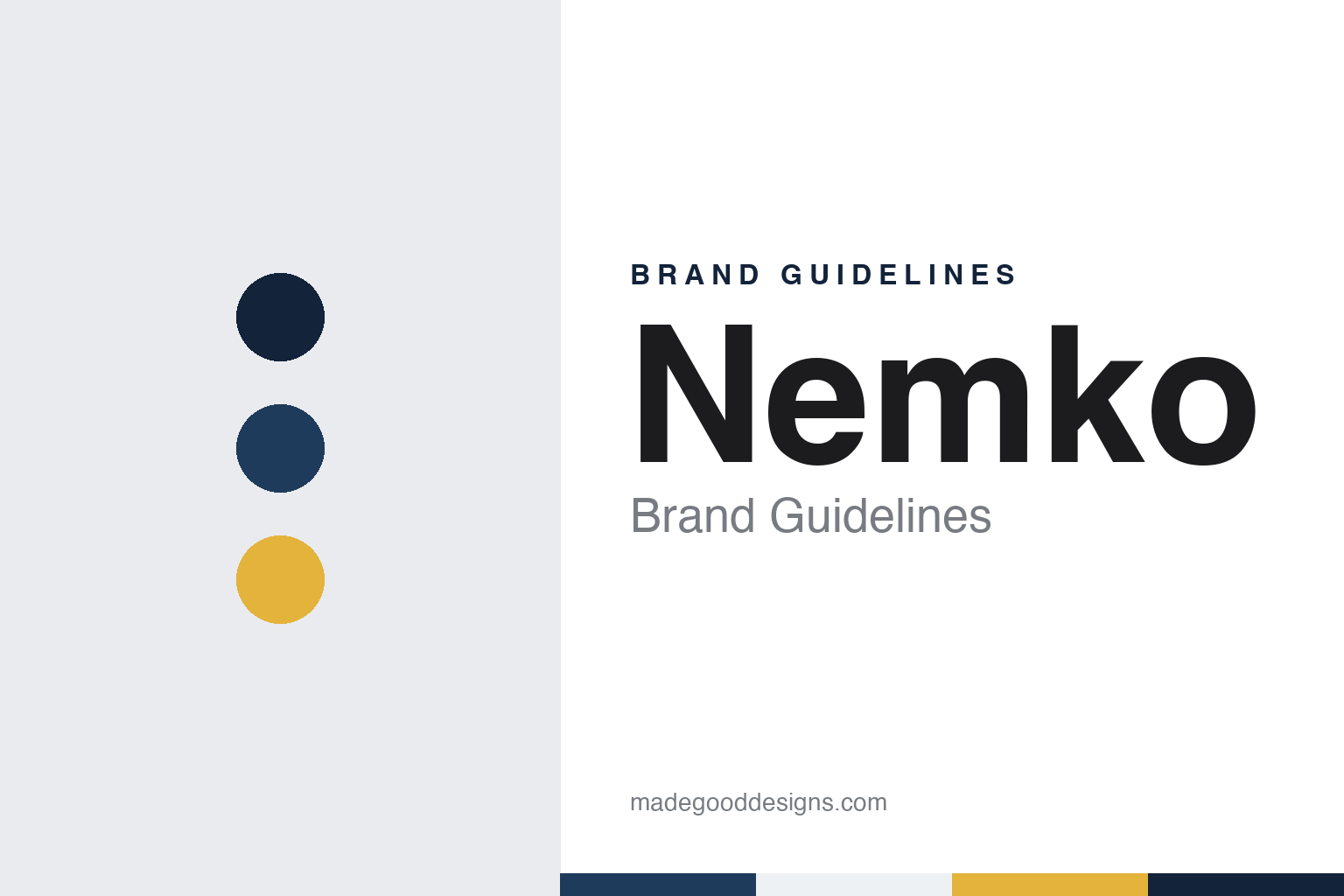
Nemko Brand Guidelines
A 1933 Norwegian test house, the N-mark and a foundation owner.
Aa
Two constants: a Nemko blue, grey and amber palette and an engineering sans register. Abstract homage — not a Nemko mark or certificate; no logo or N-mark is reproduced.
NEMKO
A national approval body for the grid.
Nemko began in Norway in 1933 as Norges Elektriske Materiellkontroll, which translates roughly as “Norwegian electrical equipment control.” English and Norwegian Wikipedia both describe it as an institution set up for the mandatory testing and national approval of electrical equipment that was to be marketed and sold in Norway and connected to the public power grid. The company’s own history page uses the same founding date and calls the original body a foundation.
For most of the twentieth century the approval was not optional. Store norske leksikon, the Norwegian national encyclopedia, says that until 1990/1991 NEMKO was the compulsory test body for electrical material used on the Norwegian network, and that all such material and equipment had to carry the NEMKO mark. Later, Norwegian Wikipedia adds, testing against requirements for radio interference became part of the same approval regime.
The company has written about what that mark covered. In a note dated July 2024, Nemko says that when its approval was mandatory, compliance with Norway’s radio-interference rules was included in the requirements and so in the N-mark, which it says was not the case in the other Nordic countries. The interference requirement was later replaced by proof of compliance with the European EMC directive; from 1 June 2024, the company says, EMC was removed as a criterion, and the Nemko certificate and N-mark now cover compliance with the relevant European and Norwegian standards for electrical safety only.
The sources used for this guide do not say how NEMKO operated during the occupation of 1940–1945.
Colour
From state scheme to private company.
The mandatory scheme ended at the start of the 1990s. Store norske leksikon ties the change to Norway’s entry into the European Economic Area and the adoption of European safety directives, after which the requirement to carry the NEMKO mark was lifted. English Wikipedia says that NEMKO was then turned into an independent, self-owned foundation, with a council of representatives from industry and trade organisations, consumer associations and utility companies as its highest supervising body. The foundation set up Nemko AS as the operating company and became its sole owner.
Nemko tells the next part of the story in a series of history videos. It says that in January 1991 it made a new start as a private company with half the staff and half the capital it had before, and that being a private business meant having to sell to customers for the first time. In 1992, the company says, its first engineer was stationed in San Diego, the beginning of its expansion outside Scandinavia.
The same series says Nemko was among the founding members of a run of international certification schemes: the Nordic Emko scheme, the CENELEC Certification Agreement and then the IEC’s international CB scheme, under which a test report from one member body can be used to seek certification in other countries. It also says its global market-access service, Nemko Direct, took its name from a request by the computer maker Compaq. Both are the company’s own accounts.
Today the company describes its work as testing, inspection and certification of products and systems, with market-access help for customers in more than 150 countries. Its services include product testing, product certification, field evaluation, functional safety, management-system certification, cyber assurance and work on artificial-intelligence assurance. Its industry pages list household appliances, lighting equipment, batteries and industrial machinery among the product groups it works with. Store norske leksikon says it is present in 20 countries; Norwegian Wikipedia gives 20 offices in 12 countries as of 2023.
Typography
Testing and certification.
Testing, inspection and certification companies sell work that customers rarely see in full: a laboratory report, an inspector’s visit, a certificate. Their websites lean on a small set of visual and verbal devices to make that work visible. Service catalogues are often organised by industry rather than by technique, so a visitor looking for vehicle inspection, battery testing or management-system certification finds it under automotive, energy or certification headings, as the Applus+ and Element sites show.
Accreditation pages carry much of the weight. Firms list the standards their laboratories and certification bodies are accredited to, such as ISO/IEC 17025 for testing and calibration laboratories, and some publish counts of their accreditations and approvals; Element’s website, for example, gives a figure of more than 1,000. Certification marks and logos appear as the companies publish them, usually beside the scheme or standard they belong to.
Photography on these sites commonly shows people at work: technicians at laboratory benches, inspectors on site, engineers beside test rigs and proving grounds. Corporate pages add brand promises and value statements, such as the “Together beyond standards” promise Applus+ publishes, and history pages that trace how a group was assembled, often through long runs of acquisitions.
Investor and sustainability pages complete the picture. Applus+ keeps the records of its shareholder meetings online, including those of 2024, the year it left the stock market, and both Applus+ and Element publish sustainability or ESG sections beside their codes of ethics and corporate responsibility policies. The guides in this set describe each brand from those published materials and from dated independent sources; the colours and typefaces shown here are unofficial interpretations, not the companies’ own.
Aa
An engineering sans for a test house. (Specimen set in IBM Plex Sans, a sans STAND-IN; NOT the Nemko logo or N-mark.)
Nemko
A foundation, an N-mark and new labs.
Growth since 2020 has come partly through purchases. In March 2020 the Nemko Group bought System Sikkerhet, an information-security assessment firm in Arendal, in southern Norway, Help Net Security reported; the trade site described it as founded in 1986, accredited to ISO 17025 and carrying out Common Criteria evaluations. In June 2022 the group announced that SINTEF Norlab, a laboratory group for environmental monitoring, chemical analyses and microbiology, had joined it and would be renamed Nemko Norlab. The company said the combined business had about 240 employees in Norway and 750 worldwide at the time.
The group’s headquarters, Nemko Group AS, is at Lysaker, just west of Oslo, according to its locations page. The same page lists Norwegian sites at Kjeller, Arendal and Mo i Rana, and offices or laboratories in Denmark, Sweden, Germany, Italy, Canada, the United States, India, Japan, South Korea, Hong Kong and Taiwan. Its American headquarters is in the San Diego area, where the company says its international expansion began in 1992.
The ownership has stayed with the foundation set up in 1990, according to English Wikipedia and the company.
Nemko’s name also changed shape over time. The company says it soon became a trusted name in Scandinavia and “became known as Nemko,” the short form of its Norwegian title. The capitalised NEMKO of the state era survives in encyclopedia entries, while the company now writes Nemko. Documented facts about its logo, typeface or brand colours are not public.
For a design guide, Nemko shows how a mark that began as a national requirement can carry on as a voluntary certificate. Compare DNV, another Norwegian name in assurance, and UL Solutions, whose UL Mark also grew out of electrical testing. For this guide we use a deep blue, a granite grey and an amber with a sans, an unofficial interpretation; no product or logo is reproduced.
Explore & save
Keep Nemko’s identity on hand — save it to a board in the Made Good inspiration library.
Nemko identity set
Pin the Nemko blue, grey and amber palette and the engineering sans register to your own board.