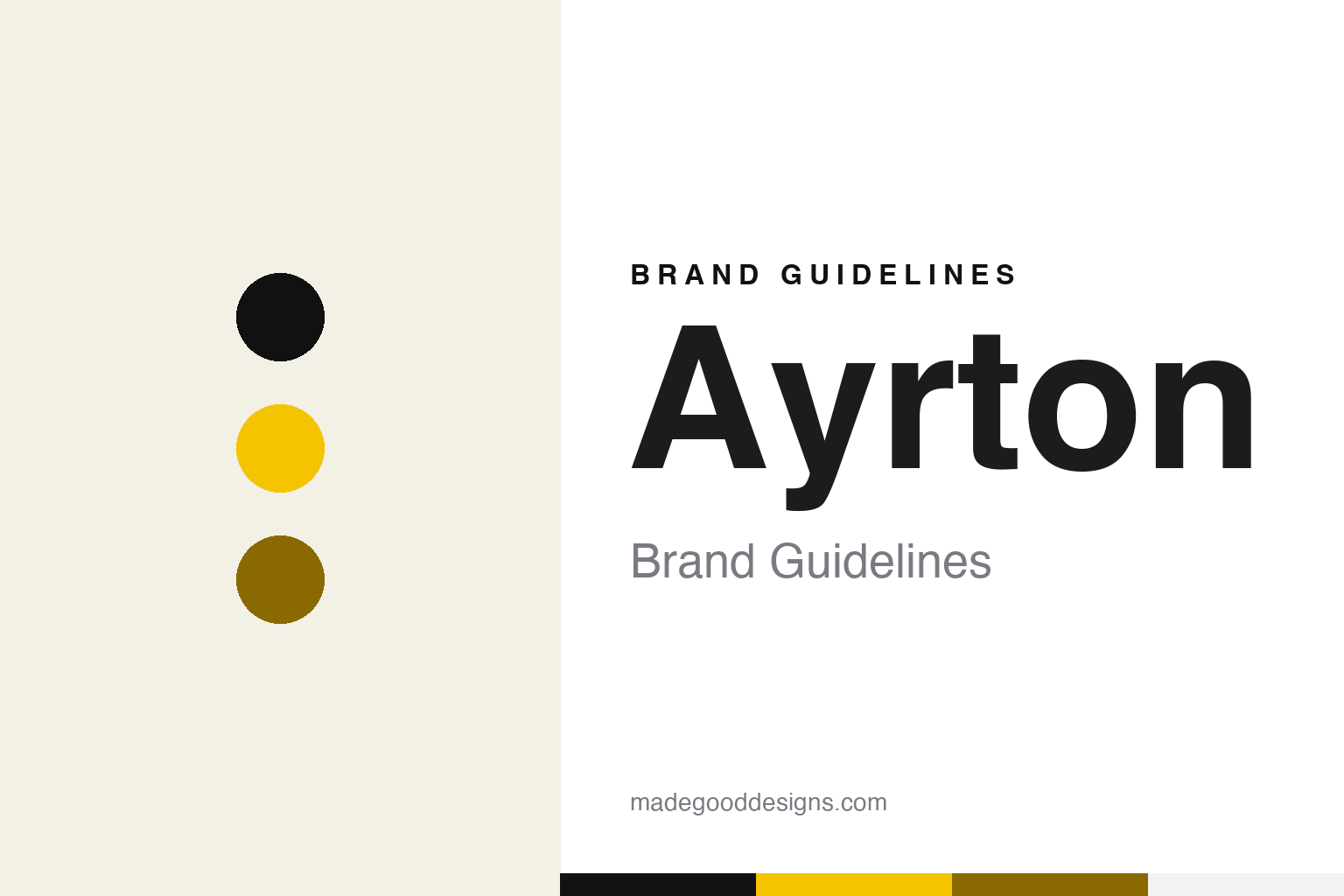
Ayrton Brand Guidelines
The French LED moving-light maker named after a racing driver.
Aa
Two constants: an Ayrton black and yellow palette and a condensed sans register. Abstract homage — not an Ayrton product or mark; no fixture, logo or nameplate is reproduced.
A Tribute in Yellow
A designer, a racing driver and an LED moving head.
Ayrton is a French maker of automated stage lighting, based in Villebon-sur-Yvette, in the Essonne south of Paris. The company says the brand “was born in 2001 out of a passionate collaboration between professionals in lighting, technology and industrial design,” and that it specialises in intelligent LED lighting for the entertainment and architecture industries. Its website carries the copyright line “2001–2026 Ayrton SAS.”
The trade magazine PLSN, in a long history of the company published in April 2020, names the founder as Yvan Péard. It says he chose both the name and the colour yellow as a tribute to the Brazilian racing driver Ayrton Senna, whose attention to detail Péard admired, and that Péard had earlier left a collaboration with Josef Valchar of the Czech maker Robe so that he could design and build his own fixtures from start to finish.
According to PLSN, Péard introduced the brand at the 2003 Prolight + Sound fair in Frankfurt with the EyeColor, which the magazine calls the first professional LED-based moving head. It used 192 small LEDs to mix saturated colours without a mechanical colour system, but its output was modest, and PLSN describes it as only a medium success. A static modular LED fixture, the ModuLED 318 in the EasyColor line, followed at the PLASA show in London in 2004.
The turning point, in PLSN’s account, was the WildSun 500C, an LED wash light with a zoom that imitated a Fresnel beam. The lighting designer Jeff Ravitz chose it for Bruce Springsteen and the E Street Band’s Wrecking Ball world tour, which the magazine calls the springboard for the company’s next phase.
Colour
Pixels, panels and the wind series.
PLSN divides Ayrton’s history into phases. Between 2010 and 2016 the company, then fewer than ten people according to the magazine, made LED effects fixtures that had little precedent before the LED era: the RollaPix, the MagicPanel 602, and a “Radical” range including the MagicBlade R and the MagicRing R9, which PLSN says may have been the first moving head to use 260 DMX channels. Many of them combined continuous pan and tilt rotation with pixel mapping and video.
Awards followed. PLSN reports that the MagicDot R, described as the first professional LED moving head with a single optical collimator, won a Live Design Product of the Year award in 2016; that the MagicBurst strobe won a PIPA award at Prolight + Sound in Frankfurt in 2017; and that the Diablo profile received the ESTA Members’ Choice award in the equipment category in 2020.
After 2017 the company moved into the conventional spot and profile market without giving up LED sources. The Merak and the Ghibli came first; a 2019 company text published by the French trade site SoundLightUp dates the Ghibli’s launch to December 2017. Later fixtures took their names from winds — Mistral, Khamsin, Bora and others — and from fast cars, such as the Huracán. PLSN says the Perseo was the company’s first fixture rated IP65 for outdoor use, followed by the 1,000-watt Domino.
Ayrton’s own history page now presents these products as a numbered timeline, and its range is grouped into numbered series by size, with families of profiles, washes, multi-source effects and laser-source fixtures. The company says the Cobra was its first factory-standard phosphor laser-source luminaire, based on a concept first shown at Prolight + Sound in 2016.
Typography
Light, control and the trade show.
Stage and entertainment lighting is sold to a small, technical audience — lighting designers, programmers, rental companies and venue technicians — and its makers present themselves accordingly. The product is the picture: moving heads, LED washes and profile fixtures photographed against black, often with a single beam cutting through haze, so that the shape and colour of the light carry the message rather than the housing.
Much of that presentation happens on the show floor. Fixture makers routinely launch new products at trade shows such as Prolight + Sound in Frankfurt, PLASA in London and LDI in Las Vegas, and their stands are built as small productions, with timed light shows and rigs of their own fixtures. Robe, for instance, marked its twentieth anniversary at PLASA in 2014, and Claypaky first showed its one-word logo at LDI in 2016, according to trade reports and the company.
Ranges are usually split by use. Touring fixtures are sold on output, speed and weight; theatre fixtures on quiet running, framing and colour rendering; architectural lines on outdoor ratings and long-term installation. Control is its own category, and several fixture makers now also own console or data brands, so screenshots of control-desk interfaces sit beside photographs of the lights themselves.
The visual language that results is consistent across the sector: dark backgrounds, saturated beams, and colour-temperature scales running from warm to cool white. This guide sets out what can be checked about each company — who founded it, who owns it and where it says its fixtures are made — and attributes to the company anything that rests on its own word.
Aa
A condensed sans for a yellow-and-black brand. (Specimen set in Barlow Condensed, a sans STAND-IN; NOT the Ayrton logo.)
Ayrton
A French brand inside a Chinese group.
Ayrton is no longer independent. PLSN reports that the lighting manufacturer Golden Sea came in to back Péard and that the acquisition gave him the resources to develop the Merak and the Ghibli; a company text published by SoundLightUp in September 2019 said it had been two years since Golden Sea acquired Ayrton, which places the deal around 2017. The trade site inside.lighting reported in September 2024 that Golden Sea, formally Guangzhou Haoyang Electronic Co., Ltd., is listed on the Shenzhen Stock Exchange and owns Ayrton alongside other brands, including the truss maker WTC; that month it also agreed to acquire the business of the Danish fixture maker SGM.
The management has changed with the ownership. Chris Agius Ferrante, a vice president of Golden Sea, was Ayrton’s chief executive from 2017; a company announcement published in July 2026 said Michael Althaus, who had led global sales since 2017, became chief executive in September 2025, and that Ferrante now leads Golden Sea Holdings, which oversees the group’s foreign brands. Péard remains founder and chief technology officer. The company says its research and development team, near Paris, covers mechanical, electronic and software engineering.
Ayrton’s own news pages publish a steady run of tour, television and event credits, from concert tours to national celebrations.
For a design guide, Ayrton shows how a single tribute — a name and a colour — can carry a technical brand through a change of ownership. Compare Claypaky, another European moving-light maker that changed hands, and Robe. For this guide we use stage black, a tribute yellow and a dark ochre with a condensed sans, an unofficial interpretation; no product or logo is reproduced.
Explore & save
Keep Ayrton’s identity on hand — save it to a board in the Made Good inspiration library.
Ayrton identity set
Pin the Ayrton black and yellow palette and the condensed sans register to your own board.