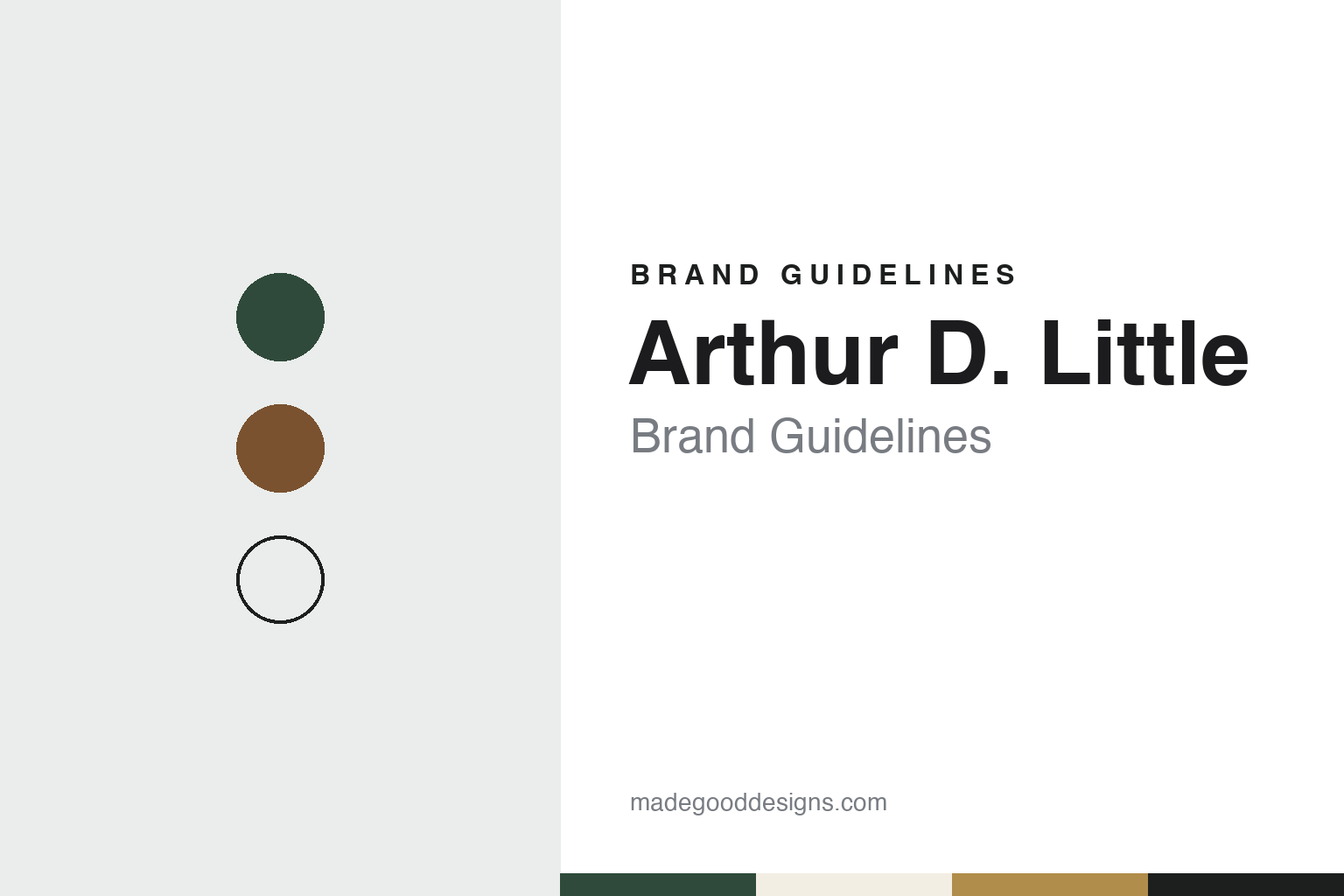
Arthur D. Little Brand Guidelines
From a Boston chemists’ laboratory to a partner-owned consultancy.
Aa
Two constants: an oak green, acorn brown and parchment palette and a laboratory serif register. Abstract homage — not an Arthur D. Little asset or mark; no logo or publication is reproduced.
Griffin & Little
Two chemists and a paper problem.
Arthur D. Little began as a laboratory, not a strategy house. In 1886 two chemists, Arthur Dehon Little and Roger Griffin, set up a consulting partnership in Boston; the International Directory of Company Histories and German Wikipedia give its name as Griffin & Little, Chemical Engineers, while English Wikipedia gives it as Little & Griffin. Its first speciality was papermaking, and in 1893 the partners published The Chemistry of Papermaking, which the Directory describes as a reference work.
Little carried the business on alone after 1893. In 1900, the Directory says, the firm patented an acetate fibre known as “artificial silk,” and its work with cellulose led towards non-flammable film. From 1900 to 1905 it traded as Little & Walker, a partnership with the MIT chemist William Hultz Walker, who left to run a new applied-chemistry laboratory at MIT, according to English Wikipedia. In 1909 the firm was incorporated as Arthur D. Little, Inc., the name it has carried ever since.
Its home moved with MIT. In 1917, English Wikipedia says, the firm moved from Milk Street in Boston into its own building on Memorial Drive in Cambridge, next to MIT’s new campus; the building was added to the National Register of Historic Places in 1976. In November 1953 it opened a 40-acre laboratory site in west Cambridge called Acorn Park, named after the company motto, Glandes Sparge Ut Quercus Crescant, “Scatter acorns that oaks may grow.”
Colour
Laboratories, then consulting.
The firm’s reputation was built on applied science sold as a service. In 1911, according to both the Directory and English Wikipedia, it set up General Motors’ first research and development laboratory; English Wikipedia links that work to the start of the firm’s management consulting division. Other early clients named by the Directory include Great Southern Lumber and the Canadian Pacific Railway, for which English Wikipedia dates a survey of Canada’s natural resources to 1916.
Some projects were deliberate demonstrations. In 1921 the firm made a silk purse from sows’ ears, an object that later joined the Smithsonian’s collection, both sources say. The Directory also credits it with an early odour classification system, a 1930 patent for blown glass fibres and, in 1936, the Kleinschmidt vapour compression still, which turned sea water into fresh water and was used extensively by the US Navy during the Second World War. In the 1940s it worked on “Operation Bootstrap,” a technical and economic plan for the industrialisation of Puerto Rico, and with MIT on a low-pressure system for liquefying helium.
Ownership shifted in the 1950s. By the early part of the decade MIT owned 55 percent of the firm, the Directory says; Royal Little, the founder’s nephew, set up the Memorial Drive Trust, an employee profit-sharing trust, in 1953 and moved MIT’s shares into it. The firm took up operations research, worked with IBM on the SABRE airline reservation system for American Airlines, and in 1969 sold 30 percent of its shares to the public. English Wikipedia adds that it built the laser-ranging retro-reflector experiment left on the Moon by Apollo 11 in 1969.
It also founded a school. Hult International Business School’s history page says Arthur D. Little formed the Management Education Institute in Boston in 1964 to run a one-year master’s programme; English Wikipedia gives 1961. The school, later the Arthur D. Little School of Management, was renamed Hult International Business School in 2003, Hult says.
Typography
Design and documentation.
Management consultancies sell advice, so their brands have to stand in for something a client cannot hold. Most begin with a name — often a founder’s surname, a set of initials or a coined word — set as a confident wordmark, and pair it with one signature colour that runs from the website to the cover of every report. The visual system is usually restrained, leaving the work itself to carry the message.
Much of that work is published. Firms put out thought-leadership articles, surveys and recurring indexes, along with yearly outlooks on trends in a sector; many also run podcasts and newsletters. Their websites are organised around industry pages and capability pages, so that a hospital chief, a utility executive or a private-equity partner can find the team that speaks to them.
Case studies are a staple, but clients are often anonymised: a “global insurer” or a “regional health system” rather than a named company, with the results stated as outcomes. Alongside them sit the signals of scale and standing that firms like to show — office maps, rankings and awards from business magazines, and partnerships with technology companies.
The people side is just as visible. Large consultancies keep alumni networks for former staff, many of whom go on to become clients, and their careers pages explain the hiring process in detail, often with guides to the case interview. Many also publish annual impact or responsibility reports. The guides that follow look at how individual firms handle these conventions, and where their own stories — origins, owners and names — set them apart.
Aa
A laboratory serif — for a firm whose motto is about acorns. (Specimen set in Source Serif 4, a serif STAND-IN; NOT the Arthur D. Little logo.)
Arthur D. Little
A bankruptcy, a sale and a buyout.
The later decades were harder. The Directory describes slow growth in the 1970s and 1980s, an unsolicited takeover approach from Plenum Publishing in 1987 that the board rejected, and a 1988 move back into private hands when the Memorial Drive Trust bought the 30 percent it did not own. Through the 1990s the firm concentrated on management consulting, environmental, health and safety work, and technology and product development, and in 2000 it merged its Epyx fuel-cell unit with De Nora Fuel Cells to form Nuvera Fuel Cells.
The original company did not survive. After the dot-com downturn, German Wikipedia says, Arthur D. Little, Inc. filed for Chapter 11 bankruptcy protection in the United States in 2002. Its parts were sold separately: at an auction that year, English Wikipedia says, TIAX LLC, a company formed by Kenan Sahin, acquired the US Technology & Innovation business, its assets, contracts and staff; TIAX dates its own formation to April 4, 2002. The Paris-based engineering group Altran Technologies bought the non-US assets and the Arthur D. Little brand name.
The name then changed hands once more. A group of partners led a management buyout from Altran, completed on 30 December 2011, according to English Wikipedia; German Wikipedia says the firm has been run as a worldwide partnership since 1 January 2012, with its head office in Brussels. English Wikipedia says it was re-established in the United States in 2016. Some national units run with their own management: Arthur D. Little Austria, for example, said in a July 2020 press release that it had been run as an independent and autonomous office for two years. The firm publishes a corporate magazine, Prism, twice a year, according to English Wikipedia.
The Arthur D. Little trading today is therefore the partner-owned successor to the non-US business and the name of the 1886 firm; Arthur D. Little, Inc. itself went into Chapter 11 in 2002. For a design guide, Arthur D. Little shows how a name, a founding date and an acorn motto can carry a brand through bankruptcy and two changes of owner. Compare Booz Allen Hamilton and McKinsey & Company, both listed by the Directory among Arthur D. Little’s principal competitors around 2000. For this guide we use oak green, acorn brown and parchment with a serif, an unofficial interpretation; no product or logo is reproduced.
Explore & save
Keep Arthur D. Little’s identity on hand — save it to a board in the Made Good inspiration library.
Arthur D. Little identity set
Pin the Arthur D. Little oak green, acorn brown and parchment palette and the laboratory serif register to your own board.