FirstBank Brand Guidelines
An 1894 bank, from Liverpool trading house to elephant and gold.
Aa
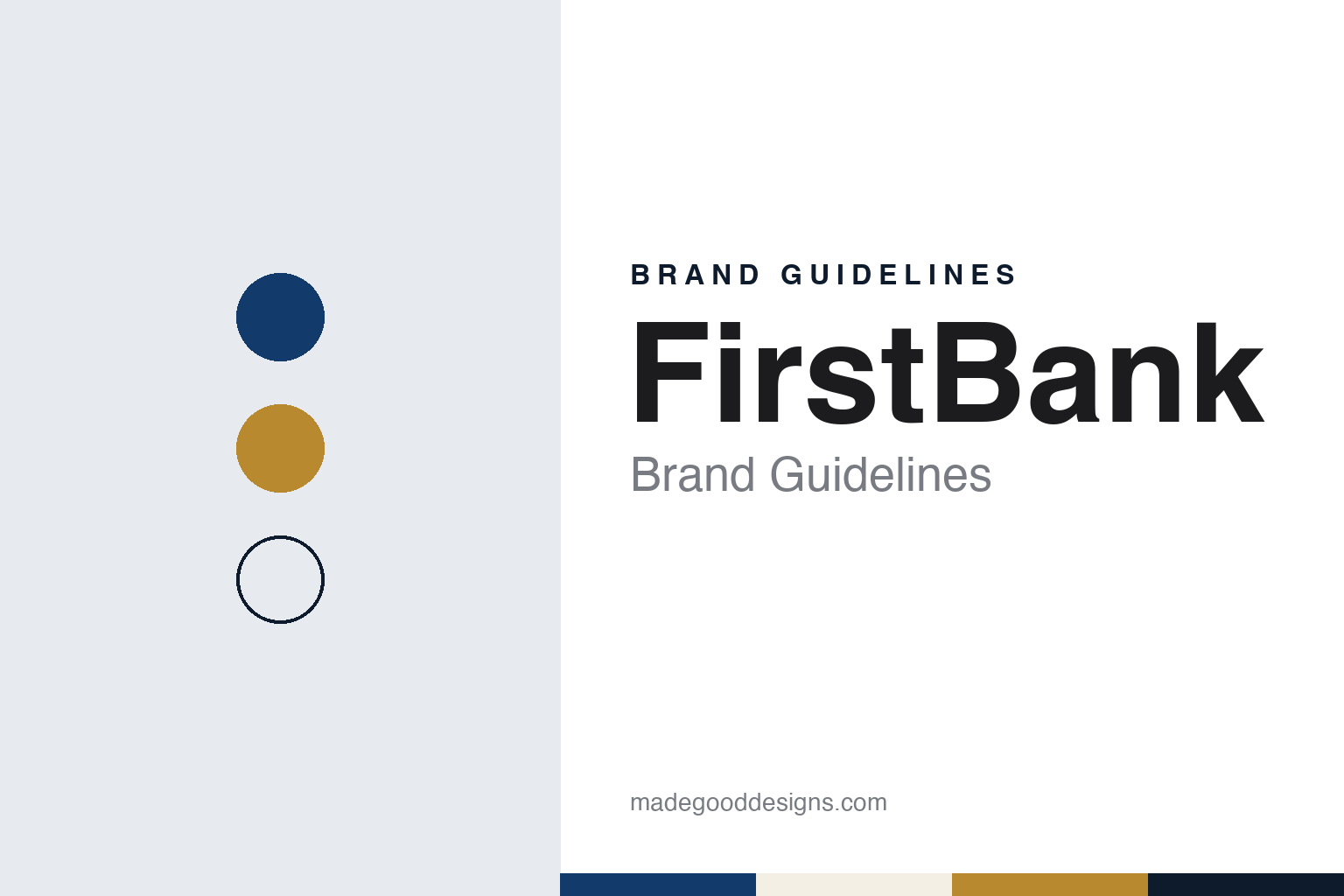
Two constants: a deep blue and gold palette and a steady geometric sans register. Abstract homage — not a FirstBank asset or mark; no elephant, logo or card design is reproduced.
Bank of British West Africa
A Liverpool shipping owner and a Lagos counter.
FirstBank began in 1894 as the Bank of British West Africa. Its founder was Sir Alfred Jones, a Liverpool shipping magnate, and its head office was first in Liverpool while business started on a modest scale in Lagos, the bank’s own history says; Nairametrics repeated the same account in a December 2025 survey of Nigeria’s oldest surviving companies. English Wikipedia adds that Jones ran the Elder Dempster shipping line and that the early bank served British shipping and trading agencies.
Growth came through purchase and new branches. In 1912 the bank bought its first competitor, the Bank of Nigeria, which the Royal Niger Company had set up in 1899 as the Anglo-African Bank, according to the bank. The same year, English Wikipedia’s milestone list says, it opened a branch in Calabar, its second in Nigeria, and one in Zaria, its first in the north.
The name then changed several times. It became the Bank of West Africa in 1957. After a merger with Standard Bank of the United Kingdom it was renamed Standard Bank of West Africa — in 1966, according to the bank and Nairametrics, or 1965, according to English Wikipedia — and in 1969 its Nigerian business was incorporated locally as Standard Bank of Nigeria. Shares were listed on the Nigerian Stock Exchange in 1971.
In 1979 the bank took the name First Bank of Nigeria Limited. English Wikipedia links the change to the reduction of Standard Chartered’s holding to a minority stake of 38 per cent. In 1991 it became First Bank of Nigeria Plc.
Colour
A holding company, a West African network and a new group name.
The modern group took shape after a change in the rules. In 2010 the Central Bank of Nigeria ended the universal-banking model, and banks had to sell non-banking businesses or adopt a holding-company structure, English Wikipedia explains. FirstBank chose the second route. Its shareholders, listing and global depositary receipt programme moved to the new FBN Holdings Plc in December 2012, and the bank itself became FirstBank of Nigeria Limited, the bank says.
The network reaches beyond Nigeria. The bank opened a London branch in 1982 and turned it into a subsidiary, FBN Bank (UK), in 2002, with a branch in Paris, according to English Wikipedia. It also lists banks in the Democratic Republic of the Congo, where the former Banque Internationale de Crédit took the FirstBank name in 2014, and in Ghana, Guinea, Sierra Leone, the Gambia and Senegal, several of them added through the purchase of ICB assets completed in 2013.
The group has also been through regulatory intervention. In 2021 the Central Bank of Nigeria replaced the boards of FBN Holdings and First Bank, citing corporate-governance failings and imposing corrective measures; the executive management team was unchanged, Nairametrics reported in May 2021, quoting a statement by Fitch Ratings.
The holding company then changed its own name. At its twelfth annual general meeting on 14 November 2024, FBN Holdings proposed becoming First HoldCo Plc, and on 13 February 2025 it announced the transition in a disclosure to the Nigerian Exchange, Nairametrics reported. The plan kept the First Bank of Nigeria Limited name for the flagship bank and gave the other subsidiaries — asset management, capital markets, securities, trusteeship and insurance brokerage — new unified names, subject to regulatory approval.
Typography
Design and documentation.
Banks in East and West Africa tend to present themselves through short, bold names. Many trade under abbreviations or compact wordmarks, often set in strong single colours such as orange, green, red or blue, and the same mark has to work on a branch fascia, a cash machine, a mobile banking app and a sponsored event banner. Some groups operate in many countries at once, so one identity has to read clearly in English, in French and in local languages.
Language is part of the voice. Many bank websites in the region are written mainly in English, with French in francophone markets, while taglines, product names and campaign lines can borrow from Swahili, Yoruba, Hausa, Amharic or other local languages; Guaranty Trust, for example, named its online entertainment channel NdaniTV after the Swahili word for “inside,” the company says. Photography on bank websites usually leans on branches, city skylines and customers at work rather than abstract imagery.
Bank websites in the region tend to follow a common structure. Pages on current and savings accounts sit beside pages on loans for small and medium-sized businesses, mobile money, short USSD codes for banking from a basic phone, and agent banking through shops and kiosks. Investor sections carry annual reports and sustainability reports, often designed with as much care as the consumer pages.
Sponsorship and community programmes carry much of the brand work. Banks fund fashion and food festivals, arts programmes, school essay competitions, sports tournaments and foundations, and announce them through the national press. For a designer, the useful lesson is how a short name, one strong colour and a consistent tone hold together across branches, apps, reports and events in many markets.
Aa
A steady geometric sans for a bank that leans on its elephant. (Specimen set in Manrope, a sans STAND-IN; NOT the FirstBank logo or its corporate typeface.)
FirstBank
An elephant with its head raised.
FirstBank’s symbol is an African elephant, which the bank calls the respected and instantly recognisable icon of its identity and a sign of strength, trust and stability. English Wikipedia records a new brand identity in 2004, and on 27 January 2014, after the move to a holding-company structure, the bank unveiled a refreshed corporate identity for itself and all its subsidiaries.
The bank explains the 2014 changes in detail. The elephant was kept but redrawn with its head raised, a promise that customers can face financial challenges with their heads held high, and with a raised foot, a pledge to put its strongest effort forward for each customer. The deep blue stands for momentum, innovation and evolution, and the update moved the bank’s trademark blue to a richer tone alongside new partner colours. Gold was added to the logo as a precious metal linked with value and durability, the basis of the bank’s “gold standard” promise.
The words carry the same message. The bank sums up its positioning as “You First”, rests it on four values it abbreviates as EPIC — entrepreneurship, professionalism, innovation and customer-centricity — and states a brand vision “to be the first partner choice in building your future.” It describes its brand language as the combination of logo, images, fonts, pattern, icons, colours, symbols and words. The bank also says The Banker named it the most valuable banking brand in Nigeria in each year from 2011 to 2016.
For a design guide, FirstBank shows how a single animal symbol can carry a bank through a century of name changes, with each refresh adjusting posture and colour rather than replacing the mark. Compare Zenith Bank, another Lagos lender, and Standard Chartered, which held a minority stake in the bank when it took the First Bank of Nigeria name in 1979, according to English Wikipedia. For this guide we use a deep blue, an old gold and ivory with a sans, an unofficial interpretation; no product or logo is reproduced.
Explore & save
Keep FirstBank’s identity on hand — save it to a board in the Made Good inspiration library.
FirstBank identity set
Save the FirstBank deep blue and gold palette and the steady geometric sans register to your own board.