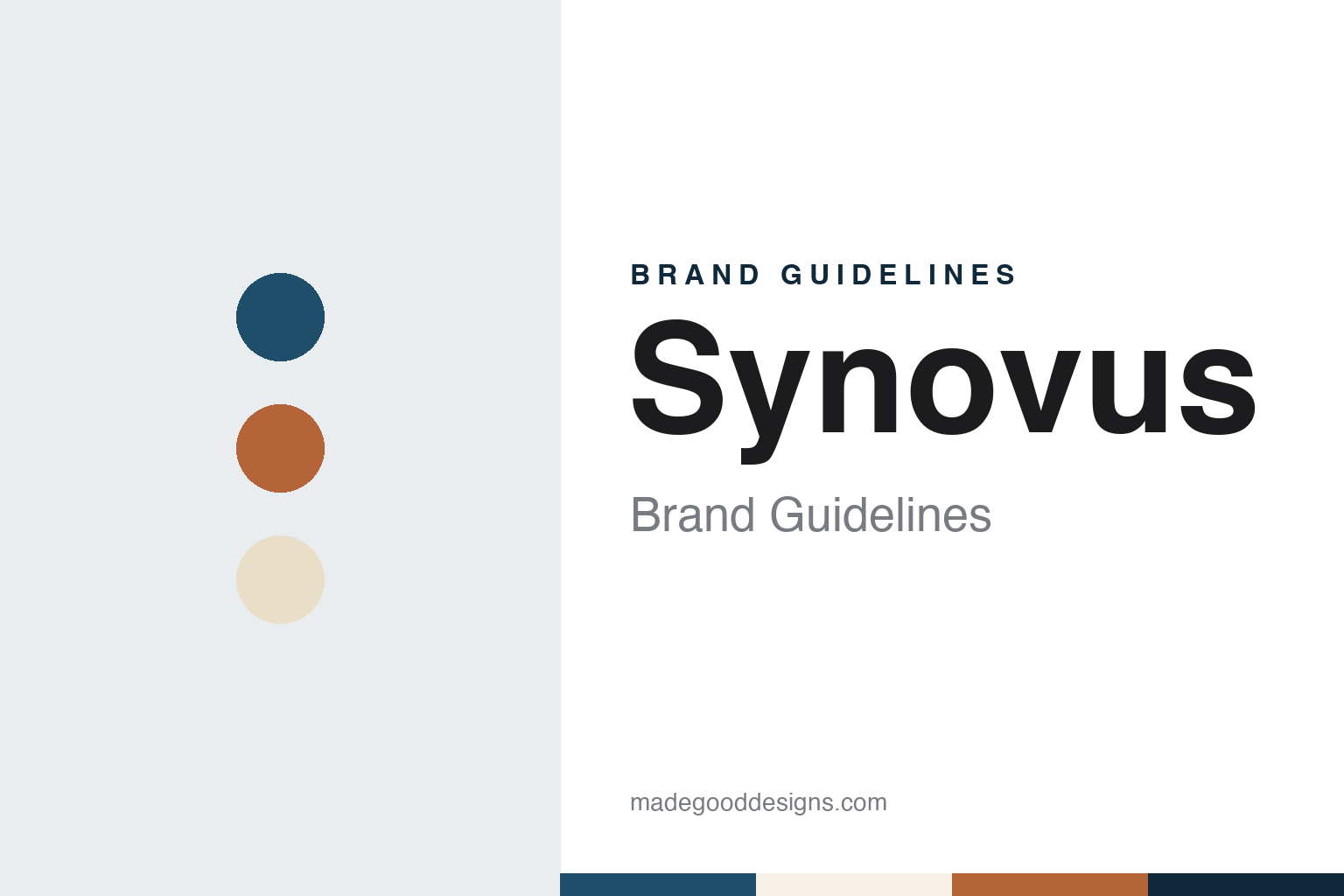
Synovus Brand Guidelines
An 1888 Columbus bank now moving to the Pinnacle name.
Aa
Two constants: a river blue, clay and sand palette and a steady bank serif register. Abstract homage — not a Synovus asset or mark; no logo, card or sign is reproduced.
A mill and two banks
Columbus, Georgia, 1888.
Synovus traces its history to Columbus, Georgia, in 1888. The company tells its origin as a story from the Eagle & Phenix Mill on the Chattahoochee: a mill worker’s dress caught in the machinery and money she had sewn into its hem scattered across the floor. She had kept her savings there because she trusted it more than anywhere else. G. Gunby Jordan, the mill’s secretary and treasurer, offered to keep her money in the mill safe and pay her interest, then made the same offer to all the workers, the company says. Those deposits, in its account, led Jordan to found the institution that became Synovus.
The New Georgia Encyclopedia, in an entry written in 2005 by an author from Synovus and last edited in 2019, gives the formal start: the Third National Bank of Columbus and the Columbus Savings Bank, both incorporated in 1888 by W. C. Bradley and Jordan. Jordan led both banks until 1921; Bradley followed him, and in 1930 the two merged as Columbus Bank and Trust, known as CB&T.
CB&T moved early into cards. The company says it was one of the first US banks to offer charge cards, in 1959, and the encyclopedia places its card business ahead of the national networks that became Visa and Mastercard. In 1974 CB&T began processing card transactions for other banks with software it called The Total System; that business was spun off in 1983 as Total System Services, or TSYS, a public company in which CB&T kept a majority, and it became fully separate at the end of 2007, according to the company and English Wikipedia.
Colour
Many local banks, then one name.
The holding company grew by state law as much as by ambition. CB&T Bancshares was formed in 1972, and in 1976 it became the first Georgia company to act on the state’s new multi-bank holding company law, buying banks in Thomasville and Troup County, the company says; the New Georgia Encyclopedia likewise calls it the first bank holding company in the state. Its banks crossed into Florida and Alabama in 1988, and in 1989 CB&T Bancshares took the name Synovus Financial Corp. and listed on the New York Stock Exchange. South Carolina followed in 1995 and Tennessee, with the Bank of Nashville, in 2002.
For most of that time Synovus was a federation. The encyclopedia describes a decentralised structure in which each bank kept its own local chief executive and board, and Wikipedia lists dozens of community names acquired since 1888, from the Bank of Tuscaloosa to Sea Island Bank in Statesboro and Trust One Bank in Memphis. In 2004 the company opened its first single-branded bank, Synovus Bank of Jacksonville.
The shift to one brand came in stages. Wikipedia records that in August 2009, during the financial crisis, Synovus was listed among more than 150 US lenders with high levels of non-performing loans; in 2010 it merged 30 bank charters into one Georgia charter, and in July 2013 it repaid the funds it had received under the federal Troubled Asset Relief Program. In 2014 the company launched its “Bank of Here” campaign, and in 2018 it completed moving 26 separately branded banks to the Synovus name, the company says. It completed its purchase of Florida Community Bank on January 1, 2019, and in 2021 set up a charitable fund under the name Here Matters.
Typography
How regional banks present themselves.
US regional banks tend to present themselves through place. Many carry a state, a city or a region in their names, or keep the name of the town where they were founded long after they have spread across several states. Their identities usually rest on a short wordmark in blue, green or red, set beside photographs of local streets, branch staff, small-business owners and families buying homes. Founding years matter too: several of the banks in this guide trace their roots to the nineteenth century, and their histories are told through the names they have carried since.
Their websites follow a familiar pattern. Pages for checking and savings accounts, mortgages and personal loans sit alongside sections for commercial lending, treasury services and wealth management, so that one brand speaks both to households and to companies. Several of the banks in this guide also run more than one name: local brands kept after a merger, or a single brand carried into new states.
Visibility outside the branch often comes through sponsorship. Ballparks, arenas, theatres and arts seasons have carried bank names, and those names change when banks merge. Annual reports, community reports and investor presentations form a second public record, setting out where a bank operates, which brands it uses and how it describes its history.
This guide sets out what can be checked about each bank — when and where it was founded, which mergers shaped it, and what has happened to its name — and keeps the bank’s own claims separate from what dated sources report. The palettes and typefaces shown are unofficial interpretations, not the banks’ own.
Aa
A steady, bookish serif — a register for a bank that tells its story from 1888. (Specimen set in Source Serif 4, a serif STAND-IN; NOT the Synovus logo.)
Synovus
From Synovus to Pinnacle.
The single Synovus name is now itself on the way out. Pinnacle Financial Partners of Nashville and Synovus agreed to merge in July 2025. The merger was completed on January 1–2, 2026, according to a company announcement summarised by TipRanks on January 3, 2026: the two combined under a new Georgia-based holding company that took the Pinnacle Financial Partners name, with its holding company headquarters in Atlanta and its bank headquarters in Nashville. The combined bank runs under both the Pinnacle and Synovus names until a planned move to the Pinnacle brand in early 2027.
The change is already visible in Columbus. In September 2026 the Ledger-Enquirer reported that Synovus Park — the city’s historic ballpark, called Golden Park for 98 years until Synovus bought the naming rights in 2024 for the arrival of the Columbus Clingstones, a Class AA affiliate of the Atlanta Braves — will be renamed Pinnacle Park from 2027. In October 2026 the Columbus television station WRBL reported that Pinnacle signs were being installed at local branches but kept covered with temporary Synovus branding until the brand conversion next year.
Until that conversion, the Synovus name stays in use alongside Pinnacle’s in the five states where Wikipedia lists its branches: Georgia, Alabama, South Carolina, Florida and Tennessee. The company’s history page still opens with the 1888 story of the mill, the safe and the dress hem, and its 2014 “Bank of Here” campaign leaned on the same local note.
For a design guide, Synovus shows how a bank can spend decades turning many local names into one, and then fold that one name into a partner’s. Compare Truist, a Southeast bank made from a merger with a new name of its own, and Regions Bank, which grew from Alabama banks. For this guide we use a river blue, a Georgia clay and a cotton sand on mill paper with a serif, an unofficial interpretation; no product or logo is reproduced.
Explore & save
Keep Synovus’s identity on hand — save it to a board in the Made Good inspiration library.
Synovus identity set
Pin the Synovus river blue, clay and sand palette and the steady bank serif register to your own board.