Bank of Africa Brand Guidelines
From a 1959 foreign-trade bank to a name that covers a continent.
Aa
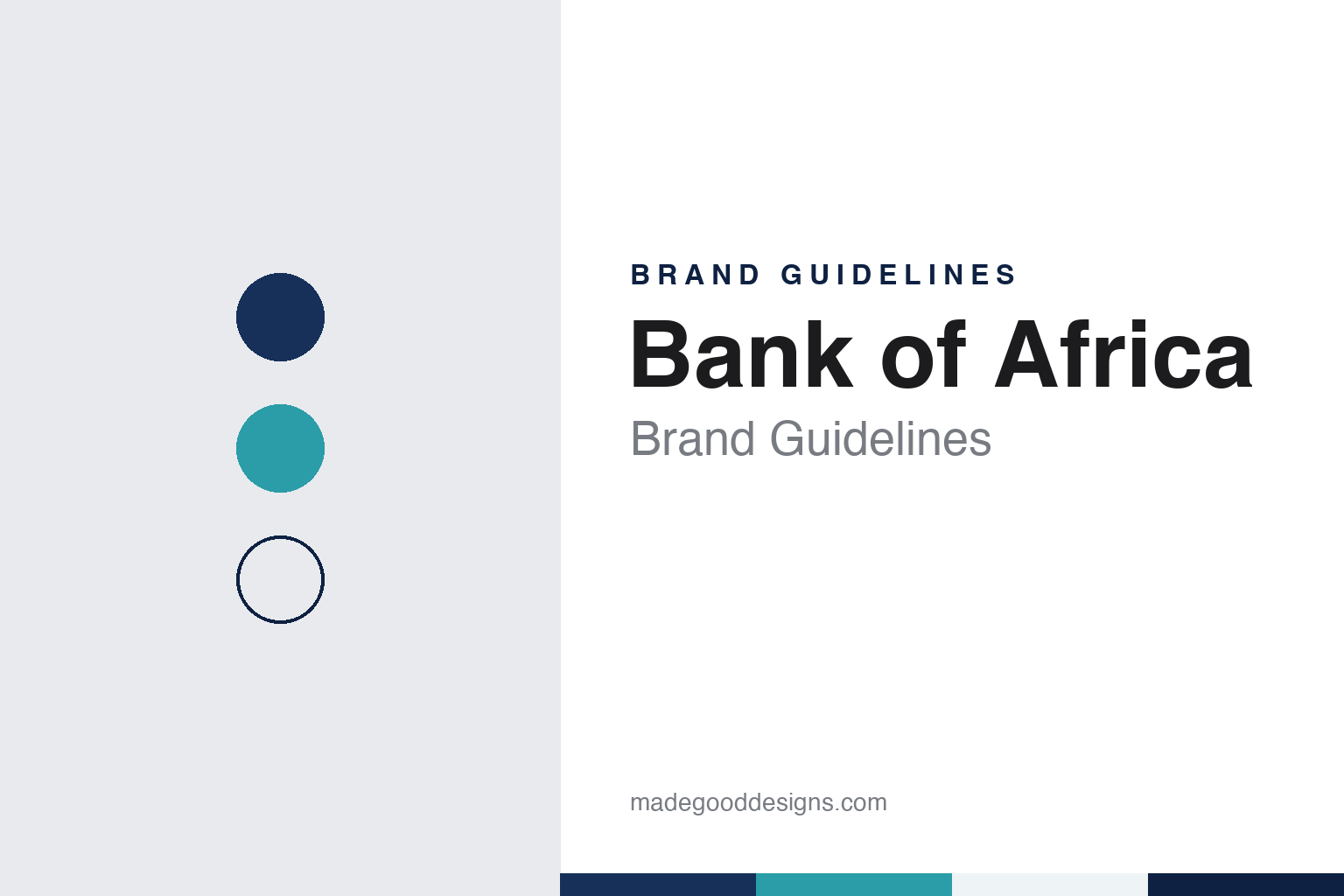
Two constants: a navy and teal palette and a geometric sans register. Abstract homage — not a Bank of Africa asset; no logo, symbol or card is reproduced.
BMCE
A state bank for foreign trade.
Bank of Africa began in 1959 as the Banque Marocaine du Commerce Extérieur, or BMCE. French Wikipedia describes it as a public institution set up by the Moroccan government to finance the country’s foreign trade, and English Wikipedia places its creation at the start of what was known locally as marocanisation: the gradual reduction of the French banks’ hold on the newly independent country’s banking system.
The bank soon took on outside partners. In 1962, English Wikipedia says, BMCE opened its capital to foreign investors, chief among them Banca Commerciale Italiana, which had been in Morocco since 1928 and brought its branch network with it, while the state kept half the shares. Branches followed by transfer and takeover: a Tangier branch in 1965, most of the Société de Banque du Maghreb in 1971 and the Tétouan-based Banco Español en Marruecos in 1975.
In 1972 BMCE opened a branch in Paris, which French Wikipedia records as the first foreign branch of any Moroccan bank. It joined the Casablanca Stock Exchange soon after: English Wikipedia gives 1974 and the bank’s own timeline 1975. In 1989 it opened BMCE International in Madrid and took a minority stake in Mali’s public development bank, which English Wikipedia calls the first move by a Moroccan bank into sub-Saharan Africa.
In 1995 the state privatised BMCE, and control passed to the insurer RMA (Royale Marocaine d’Assurance), controlled by the financier Othman Benjelloun, according to both Wikipedia editions. The bank then added specialist arms, among them the consumer lender Salafin and the investment bank BMCE Capital, founded in 1998.
Colour
A Bamako network joins a Casablanca bank.
The name Bank of Africa comes from a different institution. English Wikipedia says the original Bank of Africa was set up in late 1982 in Bamako, Mali, by local businesspeople, to serve companies and households short of banking services. In 1988 a Luxembourg holding company, African Financial Holdings, was created to carry the Malian bank and new subsidiaries, and development investors including Proparco and the Dutch FMO joined its capital.
The network spread through new banks and acquisitions. English Wikipedia lists operations in Benin from 1990, Niger from 1994, Côte d’Ivoire from 1996 and Madagascar from 1999, then Kenya in 2004 — its first step outside French-speaking Africa — followed by Uganda, Tanzania, Burundi, Djibouti, Ghana and Rwanda.
BMCE took its first large stake in the late 2000s. French Wikipedia dates the 35% holding to 2007, while the bank’s own timeline gives 2008. BMCE became the majority owner in 2010, English Wikipedia says, and held 72.6% by 2013. In 2015 the Moroccan parent renamed itself BMCE Bank of Africa, a change its timeline says reinforced the group’s African dimension.
The final step came in 2020. The Moroccan site Le360 reported on 10 March 2020 that shareholders had approved the new name, Bank of Africa, at an extraordinary general meeting on 5 March. The group’s statement, quoted by Le360, described the change as the next stage in its move from a foreign-trade specialist to a universal bank and then a continental group, and said the new logo put the Bank of Africa name forward while noting the group’s BMCE origins. French Wikipedia describes the change as part of a plan to unify the brand internationally. In 2021, the bank says, its Madrid and London subsidiaries became BANK OF AFRICA Europe and BANK OF AFRICA United Kingdom.
Typography
Banks in North Africa and the Levant.
Banks across North Africa and the Levant often present themselves in more than one language at once. A single bank may carry an Arabic name, a French or English name and a set of initials, and use each in a different setting: Morocco’s Banque Populaire, for example, is also known as Chaabi and as BCP Group, while BMCE kept its initials as a byline after taking the name Bank of Africa in 2020. Websites in the region commonly offer Arabic, French and English versions side by side.
Colour does much of the work in these identities. Wordmarks in the region are frequently set in greens, blues and reds, and some banks explain their choices: Bank of Africa says its dark blue stands for the institution and its turquoise for modernity. The palettes in this guide are our own unofficial interpretations, not the banks’ specifications.
Product ranges tend to sit side by side. Many banks run Islamic or participative banking windows or subsidiaries beside their conventional ranges, as Bank of Africa does through Bank Al Karam, and their websites usually give separate pages to current accounts, cards, mobile apps and remittances, with sections aimed at nationals living abroad. Branch photography, city skylines and head-office towers are common on home pages and in reports.
Annual and sustainability reports are a large part of how these banks speak to investors, and several groups are listed on their national stock exchanges. This guide sets out what can be checked about each bank — when and where it was founded, who owns it, how its name has changed — and marks clearly what rests only on the bank’s own word.
Aa
A clean geometric sans for a group that writes its name in capitals. (Specimen set in Sora, a sans STAND-IN; NOT the Bank of Africa logo or typeface.)
Bank of Africa
A continent, a diamond and a globe.
The bank explains its own symbol in some detail. On its group website, Bank of Africa says the mark takes the shape of the African continent, drawn with clean lines that suggest a diamond, a reference to the strength of the brand and the range of its businesses. The circle around it represents the globe, and its irregular outline is meant to give a sense of momentum and a fresh start. The bank says its two colours balance the institution, shown by a dark blue, with modernity, shown by a turquoise blue. Its signature line is “Our Continent, Our Future.”
The same page describes a branded house: subsidiaries share the parent’s icon and typography and carry an endorsement from the mother brand, so that the group’s names keep what the bank calls a strong family resemblance. Its website writes the name in capitals, BANK OF AFRICA, and names three values: trust, progress and responsibility. A brand-tools page offers logo files for download.
The group presents itself as a universal bank. Its website lists commercial and investment banking, leasing, factoring, consumer credit and participative banking, and says it operates in 32 countries. Its participative arm began as BTI Bank, launched in December 2017, according to French Wikipedia; the bank’s timeline says it became Bank Al Karam in 2023.
Ownership remains Moroccan-led with a French partner. English Wikipedia names RMA and the French cooperative group Crédit Mutuel Alliance Fédérale as the major shareholders, and says Bank of Africa S.A., the Luxembourg holding for the sub-Saharan banks, remained an internal holding company of the group at the end of 2023. The shares are listed in Casablanca.
For a design guide, Bank of Africa shows how a bank can borrow a name from an acquired network and turn it into a symbol for a whole continent, while keeping its founding initials in a byline. Compare Attijariwafa Bank, another Casablanca group with a sub-Saharan network, and Banque Populaire, Morocco’s cooperative-rooted group. For this guide we use a navy and a teal with a sans, an unofficial interpretation; no product or logo is reproduced.
Explore & save
Keep Bank of Africa’s identity on hand — save it to a board in the Made Good inspiration library.
Bank of Africa identity set
Pin the Bank of Africa navy and teal palette and the geometric sans register to your own board.