CIH Bank Brand Guidelines
A Casablanca lender of 1920 that renamed itself for tomorrow.
Aa
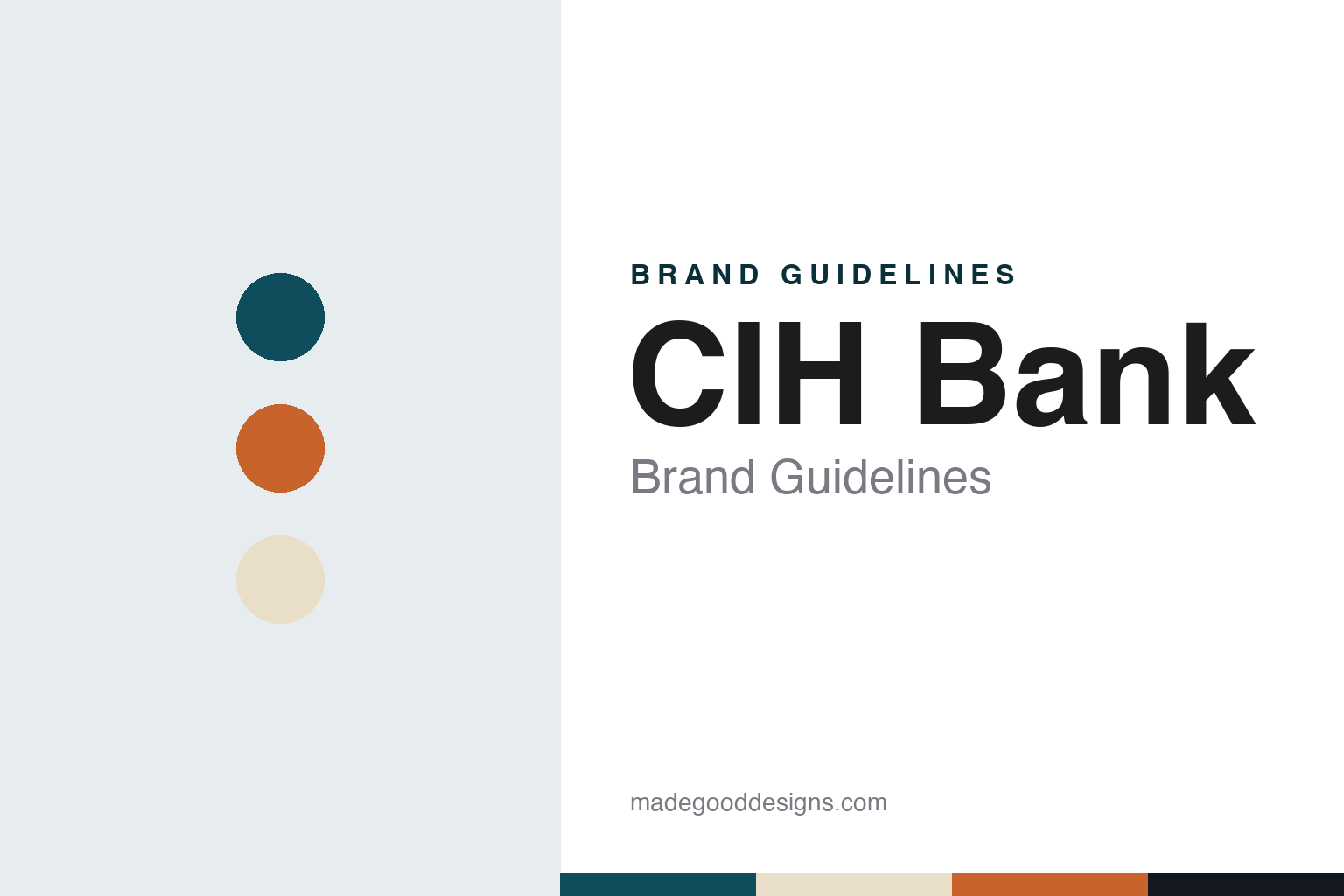
Two constants: a deep teal, sand and clay orange palette and a geometric sans register. Abstract homage — not a CIH Bank asset or mark; no logo, card or app screen is reproduced.
From CPIM to CIH
A property lender of 1920, then the hotel trade.
CIH Bank began in 1920, while Morocco was under French rule, as the Caisse de prêts immobiliers du Maroc (CPIM), a lender for property. English and French Wikipedia both give that founding name and year, and both say the institution took the name Crédit Immobilier et Hôtelier in 1967, when it extended its lending to the hotel trade. The initials CIH come from that second name, and they have outlived it: the bank is based in Casablanca and now trades simply as CIH Bank.
The sources used for this guide do not say how the Caisse operated during the Second World War.
For several decades the bank was closely tied to tourism. Wikipedia says Morocco’s hotel sector had little capital of its own and relied heavily on CIH loans, and that hotels which fell behind on repayments passed into the bank’s ownership. That model came under strain in the late 1990s. Wikipedia describes what became known as the “CIH affair”: the bank was close to failure, about half of its loan book was classed as non-performing, and the legal proceedings that followed lasted nearly two decades.
Colour
A universal bank and a new name in 2014.
The recovery came over the following decade. Wikipedia says that between 2009 and 2019 the bank withdrew from the hotel business, selling seven hotel properties, and repositioned itself as a universal bank for individuals and companies. Wikipedia names the Caisse de Dépôt et de Gestion (CDG) group, chiefly through its subsidiary Massira Capital Management, as the controlling shareholder, with the rest of the shares including a free float on the Casablanca Stock Exchange.
The name changed with the strategy. At a press conference in Casablanca on 5 May 2014, Aujourd’hui le Maroc reported two days later, the chief executive of Crédit Immobilier et Hôtelier unveiled a new brand identity under the name CIH Bank, framed around the ambition of becoming “the bank of tomorrow.” The paper said the launch followed more than a year of work modernising the bank’s systems, so that a customer could treat any branch as their own and see balances and pending operations updated in real time. According to the report, a single application now gathered all of a client’s operations and served as the meeting point for every contact channel, from the branch to the phone. The bank also announced a free online service and said interest on passbook savings would count from the day of deposit.
In February 2015 the same paper reported the slogan “la banque de demain dès aujourd’hui,” the bank of tomorrow, today, alongside multiservice cards, cheque deposits and certification at any branch without extra charges, and updated CIH Online and CIH Mobile apps that could locate branches on a smartphone. The bank then moved into Islamic finance through a partnership: in February 2017 the Gulf Times reported that the joint venture set up by CIH and Qatar’s QIIB would be called Umnia Bank, with a licence issued by Morocco’s central bank.
Typography
Design and documentation.
Banks across North Africa and the Levant often present themselves in more than one language at once. A single bank may carry an Arabic name, a French or English name and a set of initials, and use each in a different setting: Morocco’s Banque Populaire, for example, is also known as Chaabi and as BCP Group, while BMCE kept its initials as a byline after taking the name Bank of Africa in 2020. Websites in the region commonly offer Arabic, French and English versions side by side.
Colour does much of the work in these identities. Wordmarks in the region are frequently set in greens, blues and reds, and some banks explain their choices: Bank of Africa says its dark blue stands for the institution and its turquoise for modernity. The palettes in this guide are our own unofficial interpretations, not the banks’ specifications.
Product ranges tend to sit side by side. Many banks run Islamic or participative banking windows or subsidiaries beside their conventional ranges, as Bank of Africa does through Bank Al Karam, and their websites usually give separate pages to current accounts, cards, mobile apps and remittances, with sections aimed at nationals living abroad. Branch photography, city skylines and head-office towers are common on home pages and in reports.
Annual and sustainability reports are a large part of how these banks speak to investors, and several groups are listed on their national stock exchanges. This guide sets out what can be checked about each bank — when and where it was founded, who owns it, how its name has changed — and marks clearly what rests only on the bank’s own word.
Aa
A geometric sans for a bank that leads with its initials. (Specimen set in Outfit, a sans STAND-IN; NOT the CIH Bank logo or its typeface.)
CIH Bank
Initials, codes and a phone in the hand.
Payments have kept the brand in the news. English Wikipedia records CIH PAY, a phone-payment service launched with Mastercard in 2022. In March 2024 Aujourd’hui le Maroc reported that CIH Bank had launched Google Pay for its Mastercard cardholders, on Android phones and Wear OS watches. On 5 November 2026 Le Nouvelliste reported that CIH Bank was among the launch partners of Samsung Wallet in Morocco, presented in Casablanca on 3 November alongside Mastercard and Visa. The paper said owners of compatible Galaxy phones and watches could register eligible cards in the Samsung Wallet app and pay contactless at compatible terminals, without the physical card.
The bank’s own website shows how the brand is organised today. It runs in French, Arabic and English and divides its pages between individuals, professionals, companies and Moroccans living abroad, the last grouped under the initials MDM. Its personal offers carry short, code-style names such as Code 18, Code 30 and Code 60, with CODE 212 among the offers for customers abroad, while digital services sit under the CIH prefix, from CIH Online and CIH Mobile to CIH Express. Other services follow the same pattern, including CIH Géoassist and, for professionals, CIH E-Trade and CIH FX Trading, while another offer runs under the name Club Sayidati. The effect is a family of names that reads consistently across three languages and keeps the three initials, rather than the old full name, at the front.
For a design guide, CIH Bank shows how a century-old lender can be re-presented through its services: a short set of initials, a promise about tomorrow, and product names built like codes. The 2014 renaming kept the old initials rather than inventing a new word, so customers who knew the bank by its letters did not have to learn a new name. Compare Attijariwafa Bank, another Casablanca banking group, and Bank of Africa, formerly BMCE Bank. For this guide we use a deep teal, sand and a clay orange with a geometric sans, an unofficial interpretation; no product or logo is reproduced.
Explore & save
Keep CIH Bank’s identity on hand — save it to a board in the Made Good inspiration library.
CIH Bank identity set
Pin the CIH Bank deep teal, sand and clay orange palette and the geometric sans register to your own board.