Banque Populaire Brand Guidelines
A cooperative network of regional banks, with a central bank of its own.
Aa
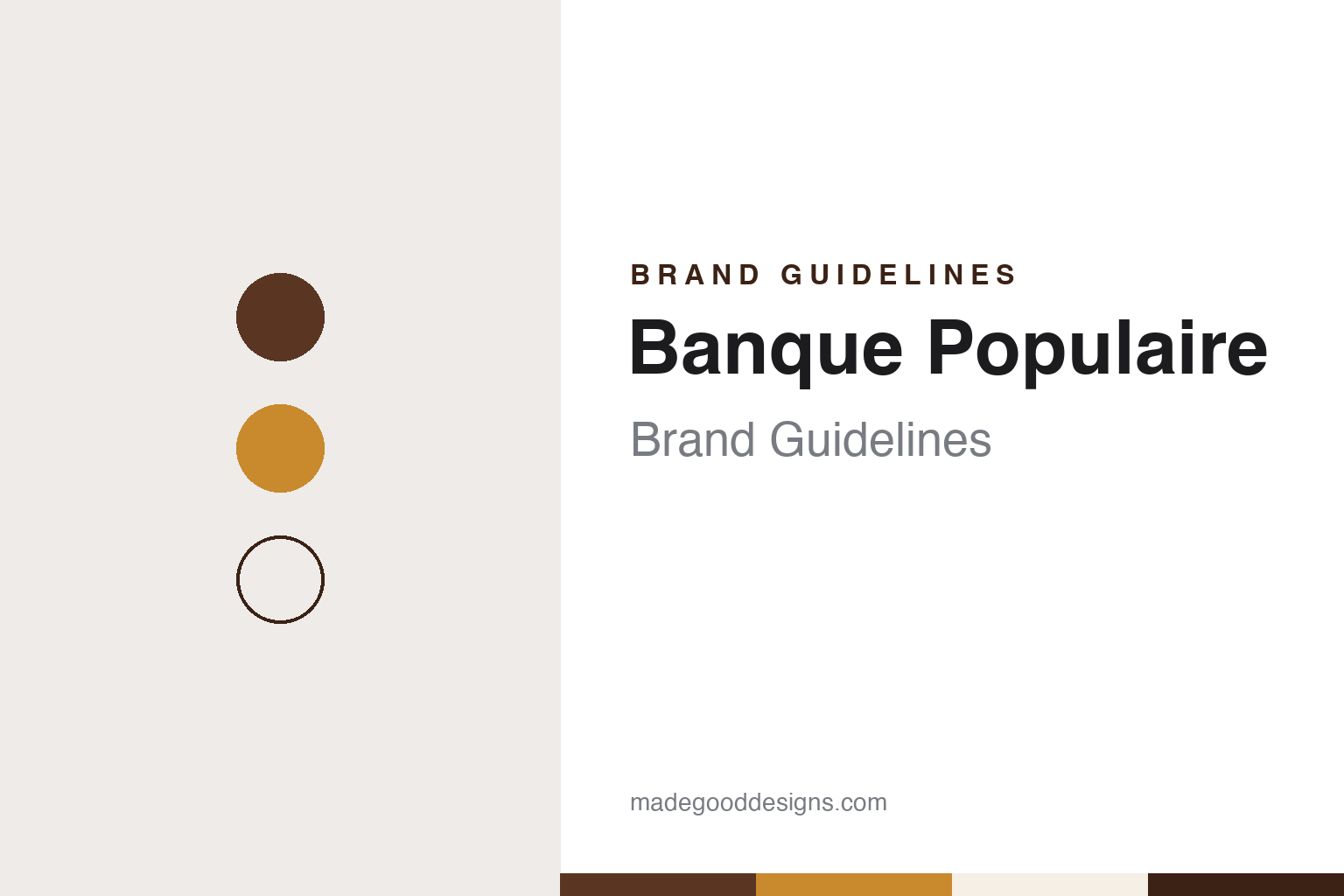
Two constants: a brown and saffron palette and a text serif register. Abstract homage — not a Banque Populaire asset; no logo, emblem or card is reproduced.
Crédit Populaire
A cooperative model, introduced by decree.
The Moroccan Banque Populaire is a different organisation from the French cooperative network of the same name, although the two are linked by history. English Wikipedia traces the Moroccan group’s origins to a royal decree, or dahir, issued on 25 May 1926 in the name of Sultan Mulay Yusef by the French-run administration of the time. The decree allowed cooperative banks to be created and, English Wikipedia says, was inspired by the French law of 1917 that organised the Banque Populaire system in France.
The group’s own history page says its model was based from the start on mutuality and cooperation, and that the first regional cooperative Banques Populaires opened in the main cities from the end of the 1920s. English Wikipedia dates these local banks to between 1931 and 1952, and says they later ran into serious management difficulties.
After independence the network was rebuilt. A decree of February 1961 — dated 28 February by the group and by French Wikipedia, and 2 February by English Wikipedia — recast the Crédit Populaire du Maroc and, according to the group, dedicated it to crafts and small and medium-sized businesses. It set out the structure the group still describes: regional Banques Populaires Régionales, a central body, the Banque Centrale Populaire, and a federating management committee. English Wikipedia says the central bank was created at that time with the status of a government agency.
English Wikipedia says the network’s deposits grew quickly in the following decade, and that by 1974 it had become Morocco’s largest bank by deposits. In 1972 it set up a European subsidiary in Paris under the Chaabi Bank brand, and French Wikipedia records a Brussels branch in 1976.
Colour
From government agency to listed group.
The central bank changed form over three decades. French Wikipedia says the Banque Centrale Populaire became a public limited company with a board of directors in 2000, and it has been listed on the Casablanca Stock Exchange since 2004, which English Wikipedia describes as a partial privatisation. In May 2012 the French group BPCE took a 5% stake, both Wikipedia editions say.
The cooperative structure was then turned the other way round. English Wikipedia says that by 2014 the Moroccan state had sold its remaining holding in the central bank to the regional banks, and that a 2015 restructuring raised the central bank’s holdings in each regional bank to 52%, with the rest held by cooperative members. The regional banks, in turn, collectively own a majority of the central bank. French Wikipedia describes the regional banks as cooperatives with variable capital. Two regional banks were absorbed along the way, Casablanca’s in 2010 and El Jadida’s in 2016, and English Wikipedia lists eight today, among them Tangier-Tétouan, Fez-Meknes, Oujda and Laayoune.
Expansion into Africa began with government agreements. The group says it has been in sub-Saharan Africa since the late 1980s through two banks set up under agreements between Morocco and the host countries: the Banque Populaire Maroco-Centrafricaine in Bangui, which English Wikipedia says opened in July 1990, and the Banque Populaire Maroco-Guinéenne in Conakry.
The larger step came in 2012 with control of the Banque Atlantique network, which, the group says, took it into Côte d’Ivoire, Benin, Burkina Faso, Mali, Niger, Senegal and Togo at once. A branch in Guinea-Bissau followed in 2016, which the group says completed its coverage of the West African Economic and Monetary Union. Banks in Madagascar and Mauritius followed, and the group says it reached 17 countries at the end of 2019 after buying BPCE’s holdings in banks in Cameroon, the Republic of the Congo and Madagascar.
Typography
Banks in North Africa and the Levant.
Banks across North Africa and the Levant often present themselves in more than one language at once. A single bank may carry an Arabic name, a French or English name and a set of initials, and use each in a different setting: Morocco’s Banque Populaire, for example, is also known as Chaabi and as BCP Group, while BMCE kept its initials as a byline after taking the name Bank of Africa in 2020. Websites in the region commonly offer Arabic, French and English versions side by side.
Colour does much of the work in these identities. Wordmarks in the region are frequently set in greens, blues and reds, and some banks explain their choices: Bank of Africa says its dark blue stands for the institution and its turquoise for modernity. The palettes in this guide are our own unofficial interpretations, not the banks’ specifications.
Product ranges tend to sit side by side. Many banks run Islamic or participative banking windows or subsidiaries beside their conventional ranges, as Bank of Africa does through Bank Al Karam, and their websites usually give separate pages to current accounts, cards, mobile apps and remittances, with sections aimed at nationals living abroad. Branch photography, city skylines and head-office towers are common on home pages and in reports.
Annual and sustainability reports are a large part of how these banks speak to investors, and several groups are listed on their national stock exchanges. This guide sets out what can be checked about each bank — when and where it was founded, who owns it, how its name has changed — and marks clearly what rests only on the bank’s own word.
Aa
A sober text serif for a group with a century of decrees behind it. (Specimen set in Source Serif 4, a serif STAND-IN; NOT the Banque Populaire logo or typeface.)
Banque Populaire
Three names for one group.
The group answers to several names. English Wikipedia calls it BCP Group, after the Banque Centrale Populaire, and notes that it is also known as Banque Populaire or Chaabi; the group’s own website signs itself Groupe Banque Populaire. French Wikipedia adds that the Crédit Populaire du Maroc, the Groupe Banque Populaire and the central bank itself can all be called “Banque Populaire,” and warns of the risk of confusion. Abroad, the group uses Chaabi Bank in France, Banque Atlantique in West Africa and names such as BICEC in Cameroon and BMOI in Madagascar, according to English Wikipedia.
Its customer pages are arranged by audience rather than by product. The group’s website sorts its personal offers into young people, young professionals, civil servants and the liberal professions, and gives a separate section to Moroccans abroad, divided into those born abroad, recent migrants, settled migrants and seniors. French Wikipedia describes the group as an important lender to small and medium-sized businesses, local authorities and Moroccans living abroad, and the group says it is a reference bank for the savings Moroccans abroad send home.
Payments are a growing part of the offer. In March 2023, English Wikipedia says, the group signed a long-term partnership with Mastercard to develop digital payment services. The group’s website also names a Fondation Banque Populaire, which it says helps people with business projects through every stage of starting a company.
English Wikipedia ranks it as Morocco’s second-largest banking group as of 2024, behind Attijariwafa Bank and ahead of Bank of Africa. The group’s website says it has the largest branch network in the country.
For a design guide, Banque Populaire shows how a single French name can sit over a cooperative network, a listed central bank and a family of foreign subsidiaries, each with a name of its own. Compare Attijariwafa Bank and Bank of Africa, its two large Casablanca peers. For this guide we use a cedar brown and a saffron with a serif, an unofficial interpretation; no product or logo is reproduced.
Explore & save
Keep Banque Populaire’s identity on hand — save it to a board in the Made Good inspiration library.
Banque Populaire identity set
Pin the Banque Populaire brown and saffron palette and the text serif register to your own board.