Banco Pichincha Brand Guidelines
A Quito note-issuing bank of 1906 that grew into an Andean and Spanish network.
Aa
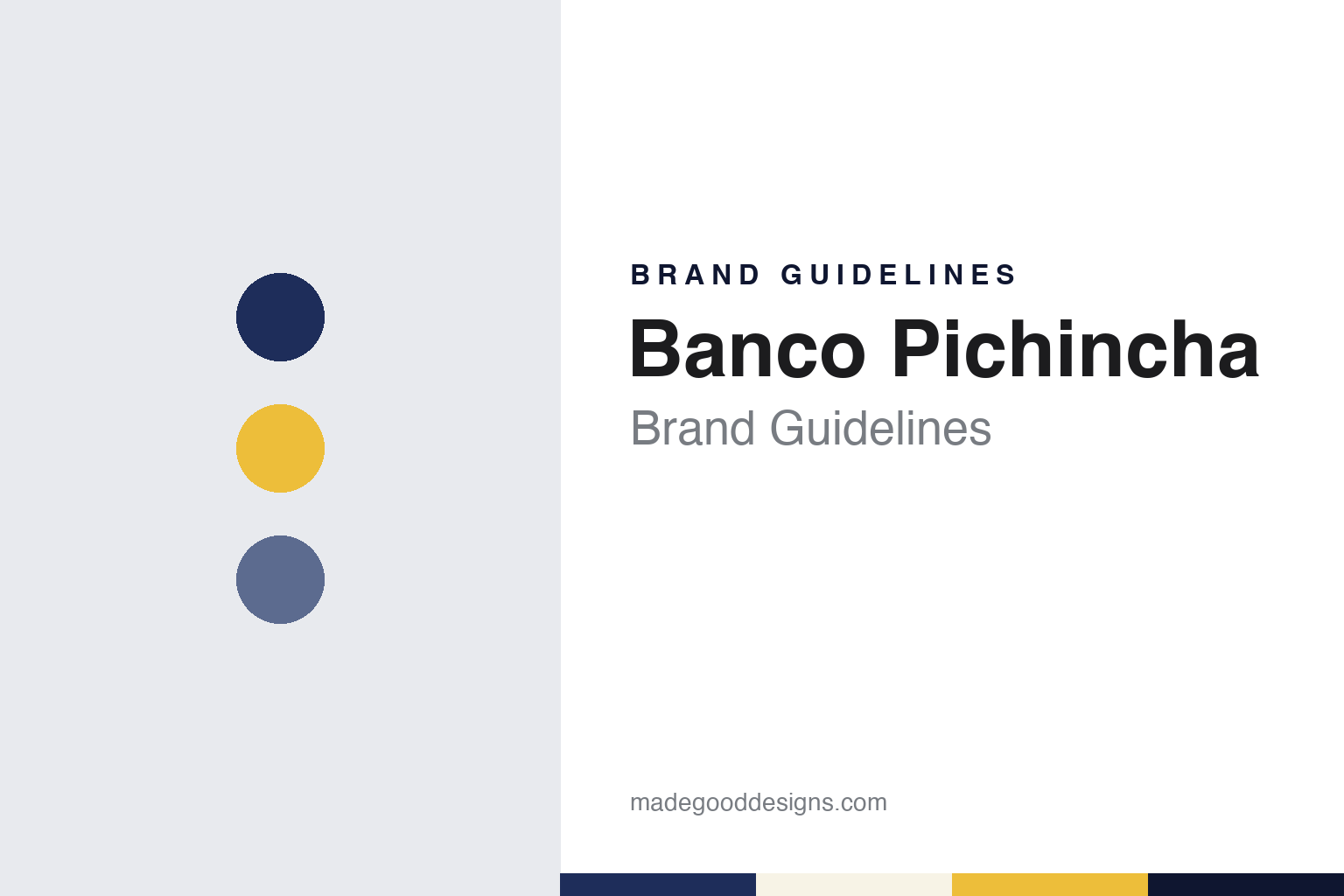
Two constants: a navy, gold and slate palette and a solid grotesque sans register. Abstract homage — not a Banco Pichincha asset; no logo, note or card is reproduced.
Banco del Pichincha
Fifty-two citizens, a municipal hall and a note issue.
Banco Pichincha was founded in Quito on 11 April 1906. Spanish Wikipedia, drawing on the historian Enrique Ayala Mora, says 52 citizens of Quito met in the city’s municipal hall and that, 24 days later, the deed for the Compañía Anónima Banco del Pichincha was signed there, setting up “a bank of issue, circulation and discount.” The chief promoter, Manuel Jijón Larrea, a landowner and textile producer, was named its first president; English Wikipedia lists Manuel Freile Donoso and Ignacio Fernández Salvador as founding managers. The bank takes its name from Pichincha, the Andean province around Quito, and today trades as Banco Pichincha.
It began as a bank that printed money. Ecuador’s central bank did not yet exist, and Banco del Pichincha was a bank of issue. Spanish Wikipedia says the board approved a first order of notes in June 1906, which arrived in February 1907 and went straight into circulation, together with share certificates, cheques, bills of exchange and account books. The first office stood at the corner of Venezuela and Sucre streets in Quito, and its seven staff were picked, a document quoted by the same article says, mainly for their handwriting. The bank worked closely with foreign trade and, Spanish Wikipedia adds, helped finance the paving of Quito and the last rails of the Guayaquil–Quito railway. In 1927 the new Banco Central del Ecuador took over the issue of the national currency.
Growth outside Ecuador came late in the century. English Wikipedia records an agency in Miami from 1986, an alliance with Banco de Loja in southern Ecuador from 1996, and the purchase in 1997 of Peru’s Banco Financiero, which operated under that name until August 2018 and then became Banco Pichincha. In 2001 it bought the Ecuadorian business of ABN AMRO; in 2004 it set up Banco Pichincha Panamá; in 2009 it bought AIG’s lending operation in Colombia, Inversora Pichincha, which began trading as a bank in Colombia on 7 June 2011. The bank sits at the centre of Grupo Pichincha, whose Ecuadorian businesses include Diners Club del Ecuador.
Colour
Branches, a stadium and a Messi joke.
Banco Pichincha presents itself as a full-service retail bank. Its website lists accounts, cards such as the Quantum credit card, PlazoDólar term investments, home loans, international transfers and remittance pages, plus a card for the Metrovía bus network in Guayaquil and mobile payments through Apple Pay and Google Pay. Its “Conoce tu Banco” pages describe a bank present on two continents and in six countries, and a programme that it says preserves the country’s historic heritage and promotes access to art and culture.
Its name is also a fixture of Ecuadorian football. The home ground of Barcelona Sporting Club in Guayaquil is the Estadio Monumental Banco Pichincha, and the bank has used that link in its marketing. Merca2.0 reported on 16 September 2026 that “En el nombre de Messi,” a campaign created by the agency Delta MullenLowe for Banco Pichincha, was a finalist at Effie Latam 2026 in two categories, seasonal marketing and financial products and services. When Lionel Messi visited Guayaquil with Inter Miami to play Barcelona SC at the stadium on 7 February 2026, the campaign featured Ecuadorians whose first name is Messi, with lines such as “Messi opened his first account at Banco Pichincha.” Tickets for the match were sold, among other channels, through Banco Pichincha and Diners Club cards, Merca2.0 noted.
The bank also runs a second brand with a different tone. Pibank, Banco Pichincha’s online bank, began in Spain in 2018, according to Infobae, moved into Colombia in 2022 and the United States in 2024, and launched in Peru in September 2026 with a fee-free savings account opened on the web. In Peru, branch service stays under the Banco Pichincha name, while Pibank handles the remote relationship. For a designer, the pairing is a useful study: a century-old name on branches, cards and a stadium, and a short, lower-key digital name for customers who never visit a branch.
Typography
How Latin American banks present themselves.
Latin American banks tend to present themselves through bold wordmarks and a small set of strong colours. Blues, reds, greens and yellows recur across the region’s banking brands, usually paired with a short name or acronym that has to work on a branch front, a debit card and an app icon alike. Many names are Spanish and carry a place, a nation or a founding purpose in them, and slogans are written for a home audience first.
Photography does much of the work. Bank websites and reports in the region often show branches, city streets and customers rather than abstract imagery, and some banks make a landmark headquarters building part of their public face. Financial-inclusion programmes — accounts for people new to banking, credit for small businesses, scholarships — are a recurring theme, presented alongside the core pages on accounts, cards, loans, remittances and mobile apps.
Sponsorship is another constant. Football leagues, stadiums and clubs carry bank names in several countries, and banks also run cultural foundations, art collections and exhibitions that put the brand in a setting far from the branch counter.
The paper trail matters too. Listed banks and the subsidiaries of international groups publish annual reports and sustainability reports, and these, together with dated press coverage and public histories, are what this guide draws on. Each entry sets out who founded the bank, who owns it now and how its name has changed, and marks what rests only on the bank’s own word. The colours and typefaces shown here are unofficial interpretations, not the banks’ own specifications.
Aa
A solid, legible grotesque — the register of branch signs and card faces. (Specimen set in Libre Franklin, a sans STAND-IN; NOT the Banco Pichincha logo or its lettering.)
Grupo Pichincha
Spain, Pibank and a pending card deal in Peru.
Spain became the bank’s European base. Banco Pichincha arrived there in 2007, opening a representative office in Madrid to serve Ecuadorians living in the country, and in 2010 received a licence from the Spanish authorities to act as a commercial bank, Spanish Wikipedia says. The Spanish bank later lent its licence to Pibank, which operates with its own name and products while keeping offices in several Spanish cities.
The group is still adding businesses. Infobae reported on 18 September 2026 that Peru’s banking regulator, the SBS, had authorised Banco Pichincha in Peru to acquire up to 100 per cent of the card company Diners Club Perú as a subsidiary, following board decisions in January and May 2026. In Ecuador, the bank is part of a group that also includes the local Diners Club.
Across all of this, the identity stays plain: a place name, a long history in Quito, and the same name on a city stadium and a payments card. For a design guide, Banco Pichincha shows how a bank can keep a historic, geographic name for its branches while giving a newer digital service a separate, shorter brand. Compare it with its Ecuadorian neighbour Banco Guayaquil and Colombia’s Davivienda. For this guide we use Andean navy, highland gold and slate with a solid grotesque sans, an unofficial interpretation; no product or logo is reproduced.
Explore & save
Keep Banco Pichincha’s identity on hand — save it to a board in the Made Good inspiration library.
Banco Pichincha identity set
Pin the Banco Pichincha navy, gold and slate palette and the solid grotesque sans register to your own board.