Daishin Securities Brand Guidelines
The Seoul brokerage that kept one name from 1975 and built its own trading software brands.
Aa
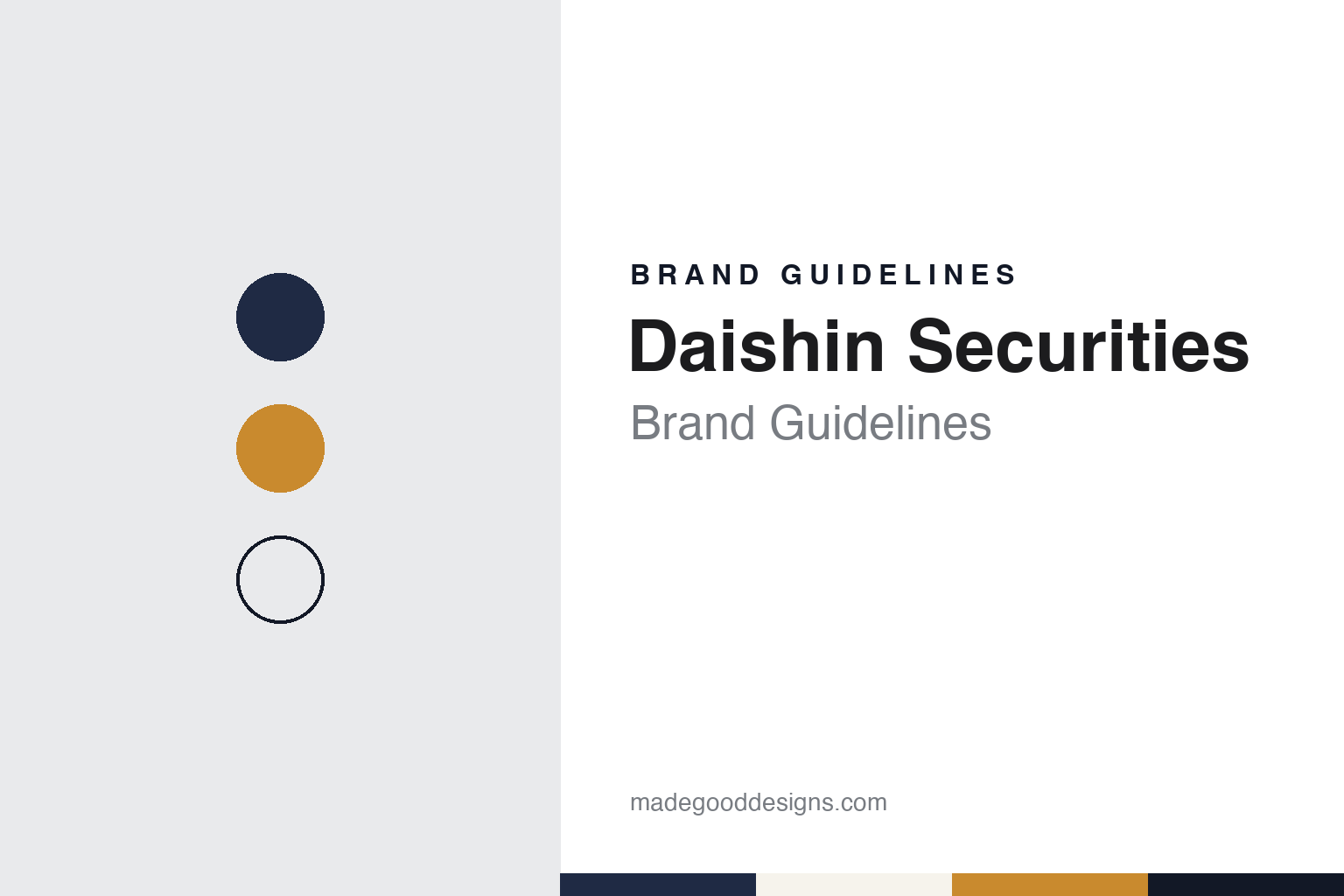
Two constants: a deep navy and warm amber palette and a clean sans register. Abstract homage — not a Daishin Securities product or mark; no logo, screen or document is reproduced.
Samrak Securities
A 1962 brokerage renamed in 1975.
Daishin Securities is one of the older names on the Seoul market, and its story begins under another name. The company started in 1962 as Samrak Securities, the business newspaper Herald Business wrote in June 2022, when the firm marked its 60th anniversary; Korean Wikipedia adds that it was renamed Jungbo Securities in 1968. In 1975 the founder, Yang Jae-bong, bought the company and renamed it Daishin Securities, and Korean Wikipedia records its listing on the Korea Stock Exchange in the same year. The company still counts its age from 1962: in June 2026 it held a ceremony for its 64th anniversary, The Asia Business Daily reported, with chairman Lee Eo-ryong speaking under the theme “Beyond Innovation, Toward Transformation.”
Its offices have moved with the market. Herald Business reported that Daishin first settled in 1976 in the building that is now the Myeongdong Arts Theatre, the former National Theatre; moved to Yeouido, Seoul’s finance district, in 1985, in line with a government policy to develop the capital market; and returned to Myeongdong at the end of 2016, after 32 years. On its 60th anniversary in June 2022 it renamed its head office from Daishin Finance Center to “Daishin 343,” a name taken from the building’s street number.
The group grew around the brokerage. Korean Wikipedia lists the Daishin Economic Research Institute, founded in 1984; an investment-advisory arm founded in 1988 that became Daishin Asset Management in 2010; a life insurer founded in 1989 and sold in 2003; and a cultural foundation set up in 1990. Herald Business described a later move into finance and real estate: a savings bank in 2011, Daishin F&I in 2014 and Daishin Asset Trust in 2019. Overseas, Korean Wikipedia records subsidiaries in Singapore in 2017 and New York in 2018.
Colour
Cybos and Creon.
Daishin’s reputation is closely tied to online trading. Herald Business wrote in 2022 that its Cybos series marked the start of home trading systems (HTS) in Korea and led the online brokerage market, though the paper added that the firm’s investment-banking and brokerage businesses lost ground in the 2000s. In 2007 Digital Times featured the U-Cybos Global HTS in its brand-power awards, describing tools for domestic and overseas economic indicators and an alert service for market news.
The second software brand is Creon. Digital Times reported in June 2011 that the name combines “Creative” and “Online,” and that the Creon trading system covered HTS, web trading (WTS) and mobile trading (MTS). It was built as a bank-linked service: customers opened a Daishin-linked account at a partner bank or a post office and traded online at low commission, according to the paper. Creon had its own website, creontrade.com, and its own unit inside Daishin. Fifteen years on, the name is still in use: in September 2026 Herald Business described Creon as Daishin’s online securities trading service and reported a campaign for customers opening their first non-face-to-face account.
The firm also points to a run of industry firsts. According to Herald Business, in 1991 Daishin became the first in the industry to win a licence to arrange mergers and acquisitions; and of the five large brokerages at the time of the 1997 Asian financial crisis — Daishin, Daewoo, Dongsuh, Ssangyong and LG — it is the only one that still exists under the same controlling owner. The Korea Economic Daily reported in October 2026 that Daishin introduced an employee share-ownership plan in 2003, the first in the securities industry, and has paid cash dividends for 28 consecutive years.
Typography
Design and documentation.
Korean securities firms present themselves in two languages at once. Their names usually appear in Hangul and in English side by side, on websites, in apps and on annual reports, and many of the larger houses carry the name of a wider financial group — Mirae Asset, Samsung, NH, KB or Hanwha — in front of the word for securities. Their wordmarks tend to rely on a single strong colour, and orange, blue, yellow and green all appear across the sector.
Most of a broker’s daily contact with customers now happens on screens. The industry has its own shorthand for them: an MTS, or mobile trading system, is the phone app, and an HTS, or home trading system, is the desktop program that came before it. The apps are named products in their own right. Samsung Securities calls its app mPOP, and Mirae Asset Securities renamed its M-STOCK app MAPS in 2026, describing the change as a shift from order-taking towards portfolio advice.
Beyond the trading screens, the websites follow a familiar pattern. Pages for overseas shares sit next to pages for retirement pensions; The Korea Herald noted in 2026 that Korean retail investors have expanded their investments in overseas markets. Each large house also runs a research centre whose analyst reports feed the apps, the websites and the firm’s institutional clients, and some now present that research with AI tools.
The formal record lives in reports. Listed brokers publish annual reports and, increasingly, sustainability or integrated reports in Korean and English, alongside disclosures to the Financial Supervisory Service. For a design reader these documents, more than any advertising, show how each firm sets its type, colour and tables when it speaks to shareholders and regulators.
Aa
A clean sans for a trading-software brand. (Specimen set in IBM Plex Sans KR, a sans STAND-IN; NOT the Daishin Securities logo.)
Daishin Securities
One name since 1975.
Its recent strategy is about scale. In December 2024 Daishin was designated Korea’s tenth comprehensive financial investment business operator, The Korea Financial Times reported in September 2026. The firm has set 2025 to 2028 as a “capital expansion period” aimed at qualifying as a mega investment bank, followed by a profit-growth phase to 2030, the paper said; its chief executive since 2026, Jin Seung-wook, joined Daishin in 1993. Its retail pitch leans on income products, with high-dividend and high-yield assets for long-term portfolios.
The company also carries the record of the Lime Asset Management fund failure of 2019, in which redemptions on many funds were halted. In July 2021 the dispute settlement committee of the Financial Supervisory Service (FSS) advised Daishin to compensate investors for 80 percent of their losses on Lime funds it had sold, the highest ratio it had recommended in the Lime case, The Korea Times reported; the FSS said breaches of the capital markets act at Daishin had been confirmed in court, where an employee was convicted. The recommendation was not binding. FSS data reported by Chosunbiz in October 2025 showed Daishin among three brokerages with three mis-selling sanctions each between 2020 and August 2025, including over Lime.
For a design guide, Daishin Securities shows how a brokerage can keep one corporate name for half a century while giving its trading software separate brands, Cybos and Creon. Compare Kiwoom Securities, another Seoul brokerage in this series, and Shinhan Securities, the brokerage of a banking group. For this guide we use a deep navy and a warm amber with a sans, an unofficial interpretation; no product or logo is reproduced.
Explore & save
Keep Daishin Securities’s identity on hand — save it to a board in the Made Good inspiration library.
Daishin Securities identity set
Pin the Daishin Securities deep navy and warm amber palette and the clean sans register to your own board.