Sucden Brand Guidelines
A Paris sugar trader with roots in post-war Morocco.
Aa
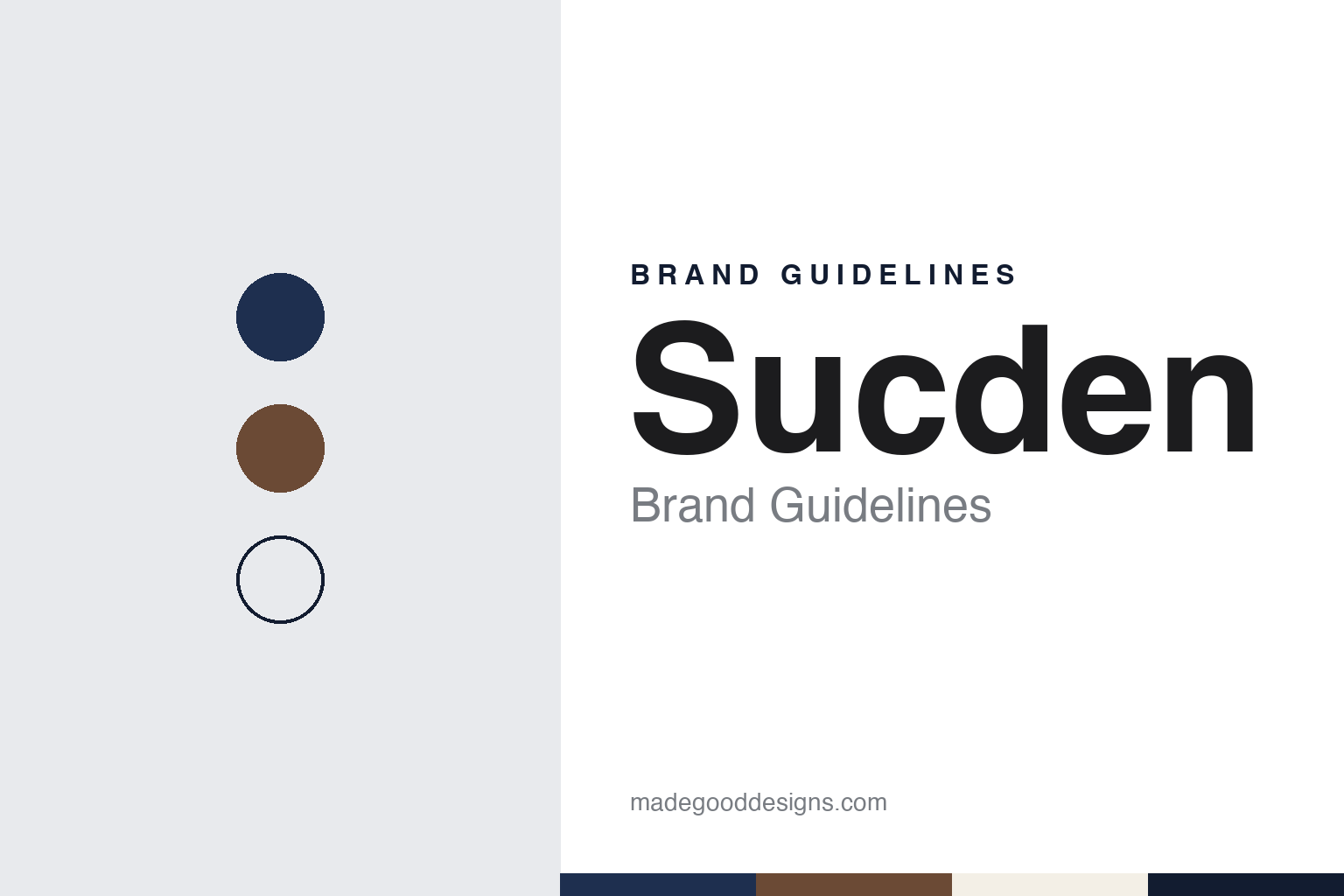
Two constants: a trading navy, cocoa brown and sugar white palette and a Merchant serif register. Abstract homage — not a Sucden product or mark; no logo or document is reproduced.
Sucres et Denrées
From Morocco to Paris.
Sucden is the short name of Sucres et Denrées — roughly “sugars and foodstuffs” in French — a commodity trading house based in Paris. Its story begins in Morocco. The company says that at the end of the Second World War Maurice Varsano and Jacques Roboh started a business there buying and selling sugar, tea and salt, and that its success paid for a move to Paris, where they launched Sucres et Denrées in 1952. English Wikipedia gives the same founders, city and year.
French Wikipedia tells the start differently. It says Sucres et Denrées was founded in Paris in 1952 by Marcel Dahan with two partners, and that Varsano and Roboh, who had been importing Cuban sugar into Morocco, joined the company in 1957; that passage carries a request for a citation. The company’s own wording is that its “founding partners sold their first bag of sugar” in 1952.
By 1955, the company says, it had gathered the team that would stay close to the Varsano family for the next 30 years, trading mainly sugar through a network that ran from Europe to Japan and the Americas. In the 1970s, by then known as Sucden, it moved into the Arabian Peninsula, North Africa and Latin America, and into molasses, coffee, cocoa and financial brokerage, the origin of Sucden Financial. It also went into food: the company lists meat and frozen-food businesses, Sogéviandes and Davigel, and milk trading through Sogélait. It names its values as ingenuity, audacity, integrity and sustainability.
Colour
Diversify, retreat, rebuild.
The 1980s were its widest period. From 1980, the company says, Max Benhamou, backed by Maurice Varsano’s son Serge Varsano, led it into diversification and industry, with investments in meat through Charal and in cocoa through Cacao Barry, the French chocolate and cocoa maker; French Wikipedia dates the Cacao Barry purchase to 1982. The 1990s reversed that course: Sucden says it went back to its core business of sugar trading and pulled out of peripheral activities, and French Wikipedia links that retreat to heavy losses on a cocoa trade at the end of the 1980s. Serge Varsano now chairs the management board, the company says.
Russia then became its industrial base. Sucden says it relaunched a sugar farming and processing initiative there in 1998, strengthened that agro-industrial business through the 2000s and bought the Elets sugar plant in 2019.
Trading widened again after 2000. The company lists cocoa, coffee and ethanol among its products, and added grains, oilseeds and rice in 2022. It bought the New York coffee trader Coffee Americas in 2014 and Amsterdam’s Nedcoffee in 2015, dates English Wikipedia also gives, and in 2016 four handymax bulk carriers, which French Wikipedia says are managed by the German company Hamburg Bulk Carriers. In 2019 it took over the Colombian coffee business of Engelhart Commodities Trading Partners, the company says. Its website groups its work into sugar, beet pulp and molasses, cocoa, coffee, ethanol, grains and oilseeds, finance and freight, with operations pages for Russia, the United States, Brazil and Ivory Coast.
Typography
Design and documentation.
Sugar and ethanol producers sit between the farm and the factory, and their identities usually show both sides. Many use green, blue or gold in their wordmarks and colour systems, and their websites and reports lean on photographs of the raw material: rows of cane in Brazil or India, beet harvests and clamps in northern Europe, and the mills, boilers and storage silos that turn a crop into sugar, alcohol and power.
Most of these companies sell more to industry than to shoppers, so the consumer face is often a separate brand. A packaged sugar name on a supermarket shelf can be older than the group that owns it, and the same group may also make bioethanol for fuel, alcohol for drinks and cosmetics, animal feed from beet pulp, and electricity from bagasse, the fibre left after cane is crushed. Tereos, for example, sells sugar in France under the Béghin Say name, while Raízen sells fuel in Brazil under a licensed Shell brand.
Ownership shapes the language. Cooperatives such as Tereos speak to and for their grower members, and talk about fields, harvests and the farmers who supply the mills; listed companies and family groups address investors, and joint ventures often carry the names of their parents. Their websites tend to follow a familiar pattern, with pages on products, sustainability and the communities around their mills.
Much of what can be checked about these companies sits in their annual and sustainability reports, stock-exchange filings and regional business press. This guide sets out who founded each producer, who owns it, where it operates and what it says about its brands, and marks clearly what rests on the company’s own word.
Aa
A merchant serif — a trading house that shortened its name to Sucden. (Specimen set in Libre Baskerville, a serif STAND-IN; NOT the Sucden logo.)
Sucden
Back to Morocco, out to London.
Its largest recent sugar move took it back to Morocco. Aujourd’hui le Maroc reported on 15 December 2023, citing the Moroccan capital-markets authority AMMC, that Wilmar Sugar Holdings had sold all its shares in Cosumar, the Moroccan sugar producer, on 30 November 2023 to several buyers including the Sucden group and Moroccan institutional investors, leaving Sucres et Denrées with a total direct and indirect stake of 10 per cent, partly held through its subsidiary Sucden Maroc. Sucden describes it as a minority stake.
Sucden Financial, the London subsidiary, is the group’s other public name. English Wikipedia describes it as a multi-asset execution, clearing and liquidity provider for foreign exchange, fixed income and commodities, and a ring-dealing member of the London Metal Exchange. In January 2025 it announced in a press release that it had opened a European office, Sucden Financial Hamburg GmbH, authorised by Germany’s financial regulator.
That gives a designer an unusual task. A trading house has few packs or shopfronts, so its identity lives in documents: contracts, market reports, ship names, office signs and a website that lists commodities like a table of contents. The name itself does much of the work. “Sucres et Denrées” describes what the firm first traded, while the contraction “Sucden”, in use by the 1970s according to the company, reads as a single word that works in French and English alike and sits comfortably beside the Sucden Financial name on a London trading screen.
For a design guide, Sucden shows how a trading house with almost no consumer products builds its identity from a shortened name, a family history and a list of commodities. Compare Wilmar, which sold its Cosumar shares in the 2023 deal, and Louis Dreyfus Company, another family-founded trading house. For this guide we use a trading navy, a cocoa brown and a sugar white with a serif, an unofficial interpretation; no product or logo is reproduced.
Explore & save
Keep Sucden’s identity on hand — save it to a board in the Made Good inspiration library.
Sucden identity set
Pin the Sucden trading navy, cocoa brown and sugar white palette and the Merchant serif register to your own board.