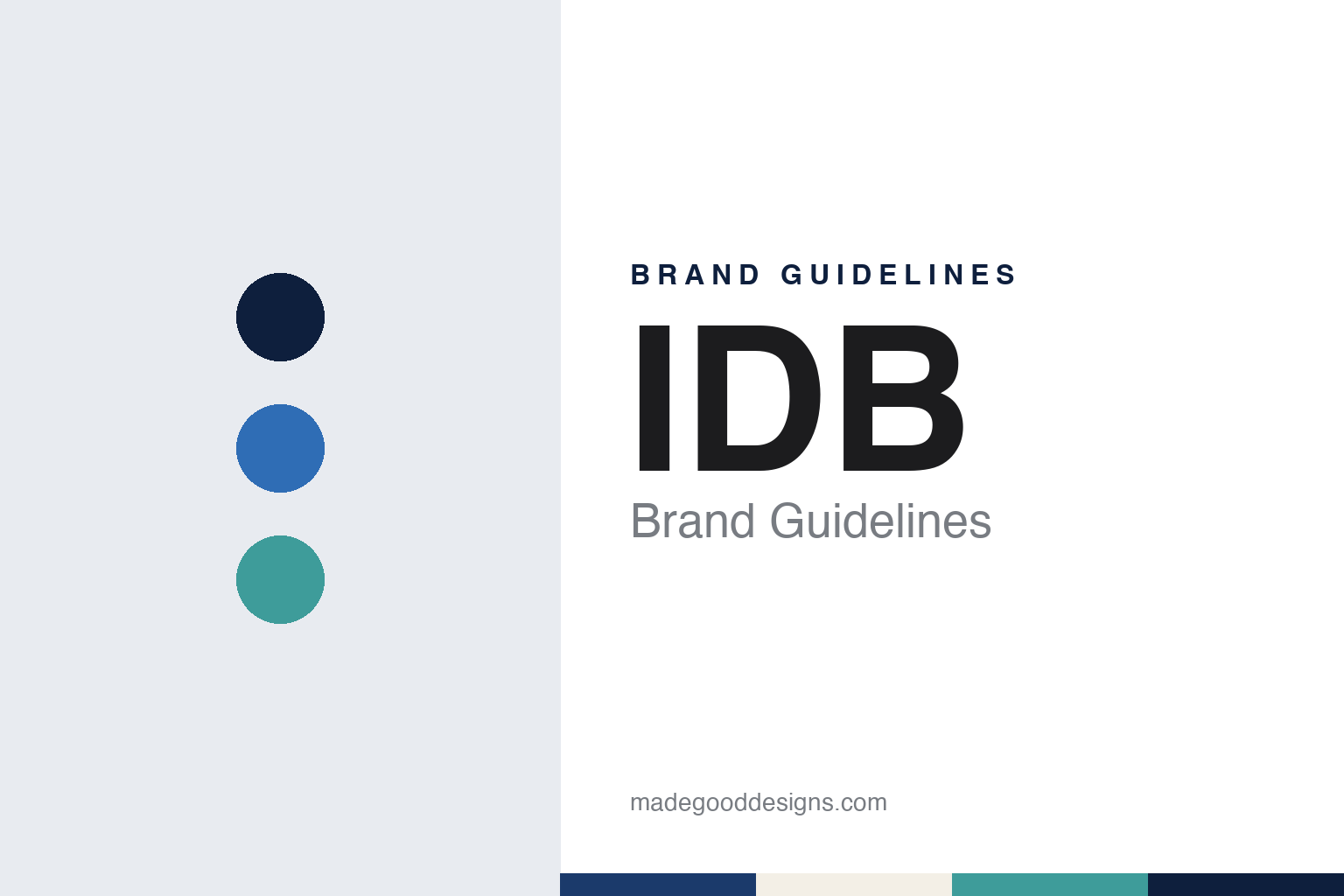
IDB Brand Guidelines
The 1959 Washington lender for Latin America and the Caribbean.
Aa
Two constants: an IDB navy, blue and teal palette and an institutional sans register. Abstract homage — not an IDB asset or mark; no logo, seal or publication is reproduced.
Washington, 1959
An idea from 1890 and an agreement signed in 1959.
The Inter-American Development Bank, the IDB, is a development lender for Latin America and the Caribbean with its headquarters in Washington, D.C. English Wikipedia traces the idea back to the First Pan-American Conference of 1890, when a development institution for the region was first suggested, and credits the initiative that finally made it real to Brazil’s President Juscelino Kubitschek. The Articles of Agreement were drafted within the Organization of American States and signed in Washington on 8 April 1959. Spanish Wikipedia adds that the agreement came into force on 30 December 1959, which is why some accounts give December 1959 as the founding date, and notes that the bank works independently of the Organization of American States.
The founding group was small. Spanish Wikipedia lists the United States and 19 Latin American and Caribbean countries as the original members, from Argentina, Bolivia and Brazil to Uruguay and Venezuela. Membership widened over the decades. Global Affairs Canada, on a page last updated in August 2026, says Canada has been an active member since 1972, and the bank now counts 48 member countries. Of these, 26 are borrowing members in Latin America and the Caribbean. The other 22, which include Canada, the United States, Japan, Korea, China, Israel and sixteen European states, do not borrow but subscribe capital and vote in proportion to it, Spanish Wikipedia explains.
That split shapes the institution. English Wikipedia notes that the borrowing countries of the region together hold just over half of the shares, while the United States holds 30 percent, and that each member’s voting power follows its subscription to the bank’s ordinary capital. The callable capital pledged by the non-borrowing members works as a guarantee for the bonds the IDB sells to institutional investors, the same article explains, and the bank lends on to its borrowing members from the money it raises in that way. Spanish Wikipedia adds that since the ninth general capital increase, approved in 2010, at least 35 percent of yearly lending has been set aside for borrowing countries the bank classes as small and vulnerable.
Colour
One bank, an investment arm and a lab.
Today the IDB sits at the centre of a three-part group. Global Affairs Canada describes the IDB Group as the IDB itself, which works with the public sector; IDB Invest, responsible for private-sector operations; and IDB Lab, a trust fund that serves as the group’s innovation laboratory. IDB Invest says on its own site that it is owned by 48 member countries, 26 of them in Latin America and the Caribbean, with each country’s voting power in line with the shares it holds, and that it finances projects in clean energy, agriculture, transport and access to finance. Spanish Wikipedia says IDB Invest is the renamed Inter-American Investment Corporation, which took its new name in 2017, while Global Affairs Canada says Canada joined IDB Invest in 2014, “when it was created,” so the two sources date the private-sector arm differently. IDB Lab, the Canadian page says, was created in 1993 and has 40 members.
The work itself is broad. English Wikipedia says the bank lends to governments and sub-national agencies, gives technical assistance to its borrowing members and works across infrastructure, education, energy, environmental sustainability, trade, transport, housing and small businesses. Global Affairs Canada calls it “the oldest regional development bank and the largest source of multilateral development financing for Latin America and the Caribbean.” English Wikipedia, more cautiously, calls it one of the largest multilateral sources of financing for the region.
Governance follows the shareholder model. The Board of Governors, usually finance ministers or senior economic officials, meets at an annual meeting in March or April, English Wikipedia says. Spanish Wikipedia describes a Board of Executive Directors of 14 directors who approve loans, guarantees, policies and country strategies, chaired by the president, who votes only to break a tie. Ilan Goldfajn of Brazil was elected president on 20 November 2022 and took office on 19 December 2022. At its 2024 annual meetings the board approved a new institutional strategy, a doubling of IDB Invest’s capital and an “originate to share” model for the investment arm; the bank groups those approvals under the name IDBImpact+, English Wikipedia says.
Typography
Design and documentation.
Development banks are owned by their member countries and economies rather than by private shareholders, and their websites put that ownership up front. The Asian Development Bank lists its 69 members with the year each one joined; the Asian Infrastructure Investment Bank publishes a register of regional, non-regional and prospective members with their subscriptions and voting power. For these institutions the shareholder list is part of the brand, set out as openly as a logo.
Names travel in several languages. ADB’s website runs in English, Japanese and Chinese, with some country pages in other languages, and most of these lenders are known by short sets of initials that have to read the same on a loan document in one country and a project sign in another. The palettes in this group of guides lean on deep blues, greens and teals, chosen here as our own unofficial interpretations rather than official colours.
Their websites are organised around what they finance and where. ADB’s menus divide its work by region and subregional programme and separate public- from private-sector financing, which can take the form of loans, guarantees or equity; the AIIB sorts its project list by status, from proposed to approved, on hold or cancelled, and by sovereign-backed and nonsovereign-backed financing. These project databases are where a reader can follow a single road, power line or water scheme from proposal onward.
Accountability is presented as part of the same identity. ADB lists an Accountability Mechanism and Independent Evaluation among its pages; the AIIB has its Project-affected People’s Mechanism, approved in 2018. Alongside annual reports and financial statements, these evaluation pages and complaint routes are where the banks set out, in their own words, how their projects are reviewed.
Aa
An institutional sans for a four-language lender. (Specimen set in Source Sans 3, a sans STAND-IN; NOT the IDB logo.)
IDB
Initials that change with the language.
The IDB works in four languages. English Wikipedia lists English, Spanish, Portuguese and French as its official languages, and Spanish Wikipedia says the founding agreement was drafted in all four, each text equally authentic, and that the four are used in the bank’s daily work. That gives the institution more than one set of initials: in Spanish it is the Banco Interamericano de Desarrollo, the BID, the abbreviation Spanish Wikipedia uses throughout, while English texts use IDB and sometimes IADB. English Wikipedia gives the bank’s mission and slogan as “improving lives.”
The group names follow one pattern. IDB Invest and IDB Lab both carry the parent’s initials in front of a single plain word, and Spanish Wikipedia uses the same shape in Spanish, BID Invest. The bank’s current strategy, as English Wikipedia summarises it, sets seven focus areas, among them biodiversity and climate action, gender equality and inclusion, sustainable infrastructure, private-sector development and regional integration. English Wikipedia also records criticism from the Bank Information Center, a civil-society group, which says groups have long raised concerns about the environmental and social effects of some IDB-funded operations on local communities and indigenous peoples.
For a design guide, the IDB shows how a lender owned by 48 countries and working in four languages can keep a short set of initials at the centre while its full name changes from one language to the next. Compare the World Bank, also based in Washington, and the AfDB, another regional development bank. For this guide we use a harbour navy, a clear blue, a sea teal and a warm sand with a sans, an unofficial interpretation; no product or logo is reproduced.
Explore & save
Keep IDB’s identity on hand — save it to a board in the Made Good inspiration library.
IDB identity set
Pin the IDB navy, blue and teal palette and the institutional sans register to your own board.