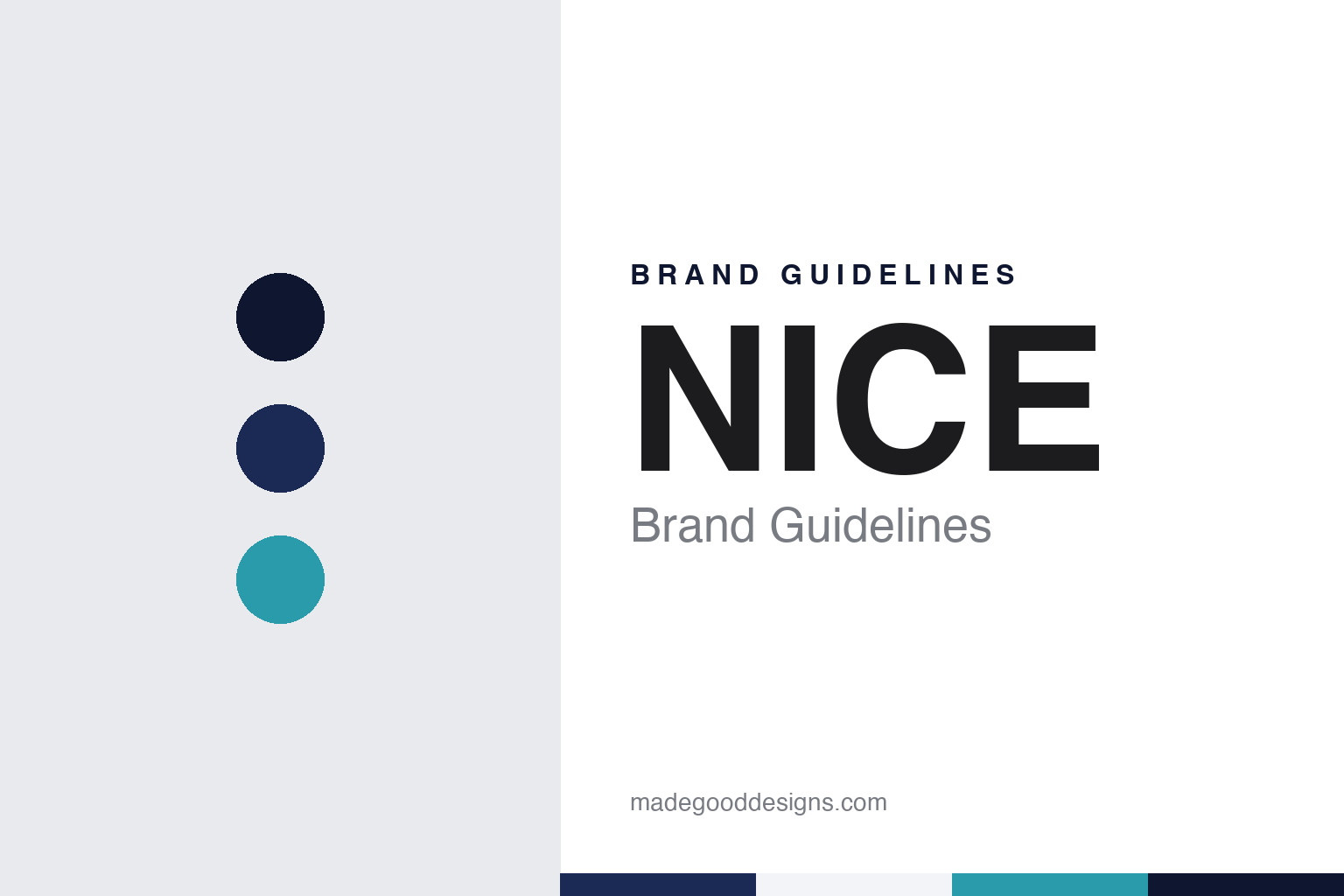
NICE Brand Guidelines
Seoul’s credit-information company, named for National Information & Credit Evaluation.
Aa
Two constants: a deep navy and lagoon palette and a Geometric sans register. Abstract homage — not a NICE product or mark; no symbol, logo or report is reproduced.
National Information & Credit Evaluation
Two founding dates and a merger.
NICE is the name shared by a South Korean group of credit-information, payments and technology companies, and by its listed credit-bureau company, NICE Information Service (in Korean, NICE평가정보). The name is an acronym. The company’s own identity page says NICE was taken from the English name of Korea Credit Information, National Information & Credit Evaluation, Inc., and was later widened from a product brand into the name of the whole group.
Two founding dates circulate, and both are correct for different companies. The group’s history, published by its holding company, NICE Holdings, dates the founding of Korea Credit Information, “the parent company,” to 1986. NICE Information Service, the listed credit bureau, dates its own company to February 1985, and Korean Wikipedia gives the same month. The present business took shape in November 2010, when, according to Korean Wikipedia and the company, it was launched as NICE Credit Information Service through a split and merger of Korea Credit Information and a second credit-rating information company; in August 2013 it changed its name to NICE Information Service.
The listing history follows the same path. The company says its shares were listed on KOSDAQ in 2000 and moved to the main KOSPI market in January 2023, and Korean Wikipedia lists it on the main board. The company says it moved into the group’s combined head-office building in May 2018; the group’s address is in Yeouido, Seoul’s financial district.
The group’s own timeline sketches the early credit business: designation as an authorised corporate-bond rating agency in 1987; an online service called NICE-TIPS in 1989, which the group describes as the first such online service in Korea; the NICE-CHECK card-authorisation service in 1990; and, in 1999, an agreement with Japan’s Tokyo Shoko Research to exchange and sell credit information. NICE Holdings itself was set up in 2010 and became the group’s holding company in 2012, the timeline says.
Colour
Credit reports, company data and identity checks.
Korean Wikipedia describes NICE Information Service as a credit-information company that uses databases on individuals and businesses to provide personal credit scoring, company information, company ratings, technology credit ratings, identity verification and credit-management services. The company says it holds the largest credit-information database in Korea, and divides its work into a personal credit-information business and a corporate credit-information business.
Its named services include NICE CB, its credit bureau; NICE Jikimi, which the company calls a platform for people to watch over their own credit, identity, family and asset information; NICE ID, for identity verification; and NICE BizLINE, for company information. It also runs a qualification for personal credit analysts. Recent press releases on its website, from autumn 2026, cover an AI-based service that recommends government support programmes and an API service for blocking malicious text messages.
The company works with other data firms. In August 2026, Chosunbiz reported that the data platform COOCON had signed a memorandum of understanding with NICE Information Service, at NICE’s headquarters, to distribute services such as its company information and identity verification through COOCON’s platform, to explore new data businesses built on NICE’s credit-evaluation models, and to support NICE’s overseas credit-bureau work.
Abroad, the company’s history points to Vietnam. It opened an office there in 2014 and launched a local subsidiary in 2017, and in 2023 set up NICE Credit Information Limited to run a credit-information business, according to Korean Wikipedia and the company. On 20 May 2026 the State Bank of Vietnam licensed that subsidiary to provide credit-information services, The Asia Business Daily reported, citing Korea’s Financial Services Commission; it became the fourth credit-information company in the Vietnamese market, about ten months after applying, with services planned from the first half of 2027, including early-warning and fraud-detection systems for lenders.
At home the company has also bought outside its core field, according to Korean Wikipedia and its own history: two advertising agencies and the bond-pricing firm NICE P&I in 2024, and another advertising agency in 2025.
Typography
Design and documentation.
Credit bureaus and business-information firms sell something nobody can see: records of who borrowed, who repaid and which companies are still trading. Their brands lean on a small set of visual signals to make that work visible. Look for wordmarks in blue, green or purple, and for data shown the way the companies publish it: dashboards, trend charts and the curved score gauge that places a number on a scale.
Most of these firms speak to two audiences at once. One set of pages is for consumers checking their own credit report or score, with sign-up steps and explanations of what moves a number up or down. Another is for lenders and businesses checking a customer or a supplier, with language about risk, onboarding and decisions. The same brand has to read as approachable to an individual and as technical to a bank.
Regulation shapes these identities as much as design does. Credit information companies work under central banks and data-privacy regulators, so their sites carry pages on how personal data is used, how to correct a record and how to raise a dispute. Their histories include licences, regulatory decisions and court rulings, and this guide states those events with their dates and outcomes, as the cited sources give them.
The firms also publish themselves through annual reports, research notes on lending trends and anniversary campaigns. For each company, this guide covers where it began, who owns it now and how it describes its own services, and marks the company’s own claims as such. No score, report or rating is described here as accurate or fair.
Aa
A geometric sans for a mark built on a grid. (Specimen set in Manrope, a sans STAND-IN; NOT the NICE logo.)
NICE
A grid for standards, a light for value.
NICE explains its identity in detail on its own websites. The older group identity, still explained on the company’s website, set the NICE name against a square shape that, the company says, stood for modern society as a place of credit and trust. A graphic at the centre meant the “light” of a credit society and a plus sign for adding value to customers. Its two colours carried stated meanings: NICE Blue for credit, trust, accuracy and expertise, and NICE Orange for a spirit of challenge and creativity.
On 1 July 2024 the group began changing its corporate identity, a notice on the NICE Holdings website says, keeping its existing brand assets while updating colour and form for a digital setting; affiliates would switch over one after another, using the old and new marks side by side in the meantime. The new symbol uses a grid and a light as its motifs. The vertical lines, the group says, stand for the right standards for a client’s business and the horizontal lines for a reliable foundation, while the light at the centre shows the better value built on them; it sums up the idea as “Standards and Foundation Provided by NICE,” and names clarity, transparency, stability, balance and scalability as the qualities it wants the grid to suggest.
The new palette is set out in the same place. NICE Navy and NICE White are the primary brand colours, with navy said to stand for trust, clarity and agility; a lighter navy, a turquoise the company calls Tiffany and a purple form a secondary set, which it recommends as accents covering about a tenth of a layout. The symbol, the guidance says, must be used as it is, without changing its shape, colour or style, combining it with other graphics or adding a frame.
For a design guide, NICE shows how a credit-information group can turn a functional acronym into a symbol with a written rationale, and document it openly. Compare CIBIL, another Asian credit bureau, and Experian. For this guide we use a deep navy and a lagoon turquoise on a cool white with a sans, an unofficial interpretation; no product or logo is reproduced.
Explore & save
Keep NICE’s identity on hand — save it to a board in the Made Good inspiration library.
NICE identity set
Pin the NICE deep navy and lagoon palette and the Geometric sans register to your own board.