Knutsen Brand Guidelines
The Haugesund shipowner whose family name runs through its fleet.
Aa
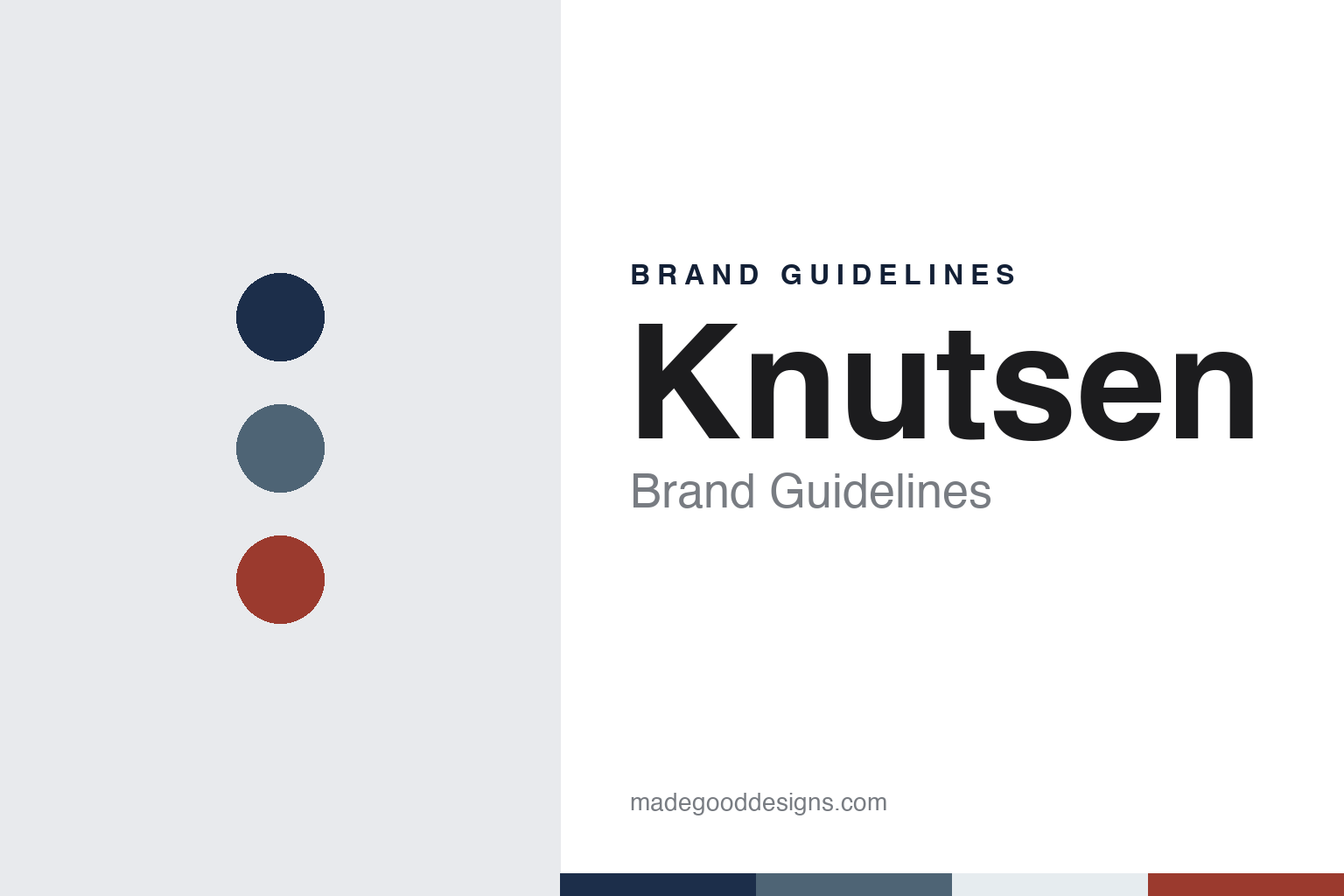
Two constants: a Knutsen navy, slate and hull red palette and a Maritime sans register. Abstract homage — not a Knutsen vessel or mark; no ship, logo or funnel marking is reproduced.
Haugesund, 1896
A herring merchant becomes a shipowner.
Knutsen’s story begins in Haugesund, on Norway’s west coast, in 1896. Store norske leksikon, the Norwegian encyclopedia, dates the group’s roots to that year, when Knut Knutsen O.A.S. invested in his first steamship to carry herring; the company’s own history says he set up his shipping company in Haugesund that year. The letters O.A.S. stand for “Ole Andreas’ son,” after his father, Ole Andreas Knudsen, according to Norsk biografisk leksikon.
Knutsen began as a herring merchant, exporting fresh herring to Britain, and became a shipowner from about 1900, the biographical dictionary says. The large growth came between the wars. In 1927 he set up his first liner service, Den Skandinaviske Syd-Pacific Linje, with the Oslo firm Winge & Co. as general agents, and in 1929 his first two liners, John Bakke and Samuel Bakke, were delivered from the Götaverken yard in Sweden. His first oil tankers, Ida Knudsen and O. A. Knudsen, had arrived in 1925.
By 1939, Norsk biografisk leksikon says, his fleet was the third largest in Norway, with most of its growth in liner shipping and tankers: twelve liners with three more on order, and seven tankers, all carrying “Knudsen” in their names. The liners were named Bakke, after his wife’s family. The habit of family names on the hull has lasted: the current fleet list pairs “Knutsen” with a place, as in Bilbao Knutsen, Haugesund Knutsen and Paris Knutsen.
The sources used for this guide do not say how the company operated during the occupation of 1940–1945.
The company says it kept a strong position as a tanker owner into the 1970s. Then the international shipping crisis of the mid-1970s led to a wide restructuring in 1984, Store norske leksikon says, in which the Knutsen family lost control of the business.
Colour
Shuttle tankers, then gas.
The two main accounts of 1984 differ in emphasis. Store norske leksikon says the company’s director, Jens Ulltveit-Moe, took over ownership and set up Knutsen OAS Shipping AS inside his Umoe group, and that the new company won a long-term contract from Statoil, now Equinor, for two shuttle tankers in the North Sea that same year. The company’s history says Knutsen OAS Shipping AS was established in 1984 by Bergen Bank, the Knutsen family and Ulltveit-Moe; that Trygve Seglem joined as technical director and part owner; and that the family and the bank later sold their shares. Its first two Suezmax shuttle tankers with dynamic positioning were delivered in 1987, it says.
Shuttle tankers, which load crude oil at offshore fields, became the core of the business. The group was organised as Knutsen Group in the early 1990s, according to Store norske leksikon; Seglem became majority shareholder in 2008 and sole owner of the shuttle tanker fleet in 2010. That year an agreement with the Japanese shipowner NYK (Nippon Yusen Kaisha) created Knutsen NYK Offshore Tankers (KNOT), owned 50/50, and in 2013 the partners set up KNOT Offshore Partners, which is listed in New York. The encyclopedia says Seglem and his family control the group through TS Shipping Invest AS.
Gas came next. The company says it won its first two LNG contracts in 2001 and took delivery of its first LNG carrier in 2004: a 138,400-cubic-metre ship built in Spain with steam-turbine propulsion. In 2010 it received four 173,400-cubic-metre carriers from DSME in South Korea, with tri-fuel diesel-electric engines; two 176,300-cubic-metre ships followed in 2016, three 180,000-cubic-metre ships in 2019 and 2020 with ME-GI engines, and a 30,000-cubic-metre carrier in early 2021. All its large LNG carriers use membrane cargo tanks, it says. At the other end of the scale is Pioneer Knutsen, a 1,100-cubic-metre coastal carrier with two pressure tanks, which the company calls one of the smallest LNG carriers in the world and which delivers LNG along the Norwegian coast.
Knutsen OAS Shipping, the group’s management arm, runs the LNG carriers and the product and chemical tankers from Haugesund and from a branch office in Madrid, Knutsen OAS España; most of the LNG ships fly the Spanish flag or the Norwegian International Ship Register flag, the company says. The Spanish link shows in names such as Cadiz Knutsen, Sevilla Knutsen and Rioja Knutsen. Store norske leksikon put the whole group’s fleet at 59 ships in 2025, with 20 LNG carriers and shuttle tankers under construction.
Typography
Design and documentation.
LNG and gas-carrier owners sell a service rather than a product, and their websites tend to show the ships themselves. Corporate pages lean on deep blues, teals and white, with photographs of carriers at sea, at terminals and in shipyards. The hull type in those pictures — a membrane carrier with its long flat deck, or a Moss-type carrier with its row of spherical tanks — is often the most distinctive image a company has.
The fleet list is the core document. Owners such as GasLog publish each vessel by name, cargo capacity in cubic metres, year built, propulsion and ownership share, and use engine shorthand such as TFDE, X-DF and ME-GI that their customers read at a glance. Floating storage and regasification units, or FSRUs, get their own project pages, usually set out by country and terminal, as BW LNG does for its units in Brazil, Pakistan, El Salvador and the Philippines.
Charter and terminal pages sit alongside investor sections. Listed owners carry results, filings, presentations and governance documents; owners that have gone private often keep the investor pages they built while listed. Sustainability pages report fuel-efficiency targets and new engine types in the companies’ own terms, and are read here as company statements rather than independent findings.
This guide sets out what can be checked about each owner — who founded it, who owns it today, which deals have closed and which are only announced — and marks clearly what rests on the company’s own word. Vessel names, capacities and dates come from dated company pages and trade press; the colours and typefaces shown are an unofficial interpretation, not a brand standard.
Aa
A maritime sans — a family name on every hull. (Specimen set in Archivo, a sans STAND-IN; NOT the Knutsen logo.)
Knutsen
Charters, technology and names.
Recent charters show how the LNG business works: ships are ordered against long contracts with energy companies. In December 2025 Offshore Energy reported that the Italian energy company Edison had signed a long-term charter with Knutsen OAS Shipping for a new 174,000-cubic-metre LNG carrier, to be built by Hanwha Ocean at Geoje in South Korea, with four membrane tanks and dual-fuel engines, for service from 2028. The partnership began in 2018, the report said, with the 30,000-cubic-metre Ravenna Knutsen, which supplies a small-scale LNG depot at the port of Ravenna and refuels other ships.
The group also develops its own technology and gives it registered names: KVOC for recovering vapour during tanker loading, KBAL for ballast water treatment and PNG for carrying compressed natural gas, according to its website. A newer venture, Knutsen NYK Carbon Carriers (KNCC), works on ships for liquefied carbon dioxide; in April 2022 the company announced that the classification society DNV had granted an approval in principle for its PCO2 tank system. The company lists its core values as credibility, innovation and care.
Its website presents the group as a set of businesses — shuttle tankers, LNG, ship management, technology and investor pages — with fleet lists sorted by ship type, from LNG carriers to the floating storage units Hanne Knutsen and Jorunn Knutsen.
For a design guide, Knutsen shows how a family name can run through a fleet for more than a century, from Bakke liners and Knudsen tankers to Knutsen LNG carriers. Compare Höegh LNG, another Norwegian owner of gas ships, and Equinor, the former Statoil, which chartered two Knutsen shuttle tankers in 1984. For this guide we use a navy, a slate and a hull red with a sans, an unofficial interpretation; no product or logo is reproduced.
Explore & save
Keep Knutsen’s identity on hand — save it to a board in the Made Good inspiration library.
Knutsen identity set
Pin the Knutsen navy, slate and hull red palette and the Maritime sans register to your own board.