Maran Gas Brand Guidelines
The Angelicoussis Group’s LNG arm, founded in Athens in 2003.
Aa
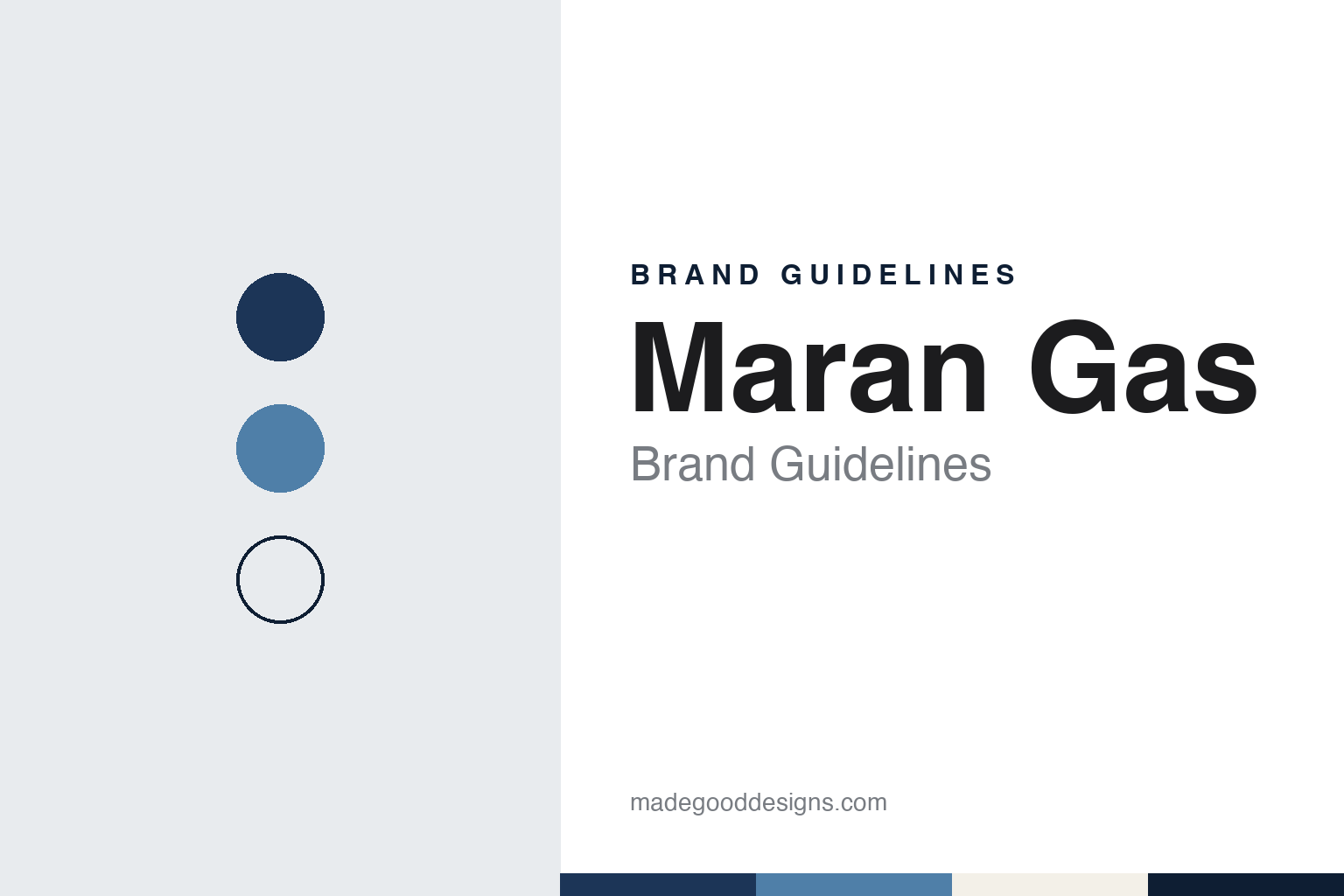
Two constants: an Aegean navy, sea blue and chalk white palette and a condensed sans register. Abstract homage — not a Maran Gas mark; no vessel, logo or funnel marking is reproduced.
A 1947 shipping house
A dry-cargo family business that moved into gas.
Maran Gas Maritime is the liquefied natural gas arm of the Angelicoussis Group, a Greek shipping business. The group’s own history page dates its track record to 1947, when Antonis I. Angelicoussis founded the business, and says its first cargo vessel, the 500-deadweight-ton Astypalea, was bought in 1950. English Wikipedia, in its article on his son, gives the founder’s name as Anthony Angelicoussis and also places the first ship purchase in 1950.
For its first decades the group was a dry-cargo company. It ordered its first newbuilding, a bulk carrier, from Ishikawajima-Harima Heavy Industries in Japan in 1965; the ship was delivered in May 1968 as the Afovos and placed under the Greek flag. Between 1965 and 1985, the group says, it ordered 42 newbuildings at the same Japanese builder. English Wikipedia, citing the Greek Shipping Hall of Fame, adds that a listed arm, Anangel-American Shipholdings, was floated on the Luxembourg stock market in 1987 and on Nasdaq two years later.
The move into oil and gas came in the 1990s and 2000s. In 1991 the group ordered four capesize bulk carriers at Hyundai Heavy Industries, which it describes as the largest bulk carriers a Greek shipowner had ordered at the time. Tankers followed between 1992 and 2000, and the Daewoo-built Maria A. Angelicoussis became the group’s first newbuilding VLCC in 2000.
Then, in 2003, the group says, John A. Angelicoussis ordered its first LNG carrier, the Maran Gas Asclepius, and founded Maran Gas Maritime as the LNG ship-management arm of the group. The group’s company pages say Maran Gas Maritime was set up that year to handle the commercial, technical and operational management of LNG carriers.
Colour
More than 50 LNG carriers, most under the Greek flag.
Maran Gas presents itself as a pioneer at home: its services page says that in 2003 it became the first Greek company to order LNG ships and operate them under the Hellenic flag, and that it has since worked with more than 35 charterers. Its fleet page lists the Maran Gas Asclepius with a 2005 build date, and its home page counts 52 ships under management and seven on order, with figures covering the fleet up to the third quarter of 2025.
The fleet list draws heavily on Greek names. Most ships carry the Maran Gas prefix followed by a place or a name from Greek history and myth — Maran Gas Delphi, Maran Gas Sparta, Maran Gas Troy and Maran Gas Achilles among them. Others take their charterers’ names, such as Woodside Rogers and Woodside Goode, and four ships marked “Global” are listed as managed for third parties. Most are flagged in Greece; the yards named include Hanwha, HSHI and SHI, with a trio from SHI — Maran Gas Marseille, Maran Gas Nice and Maran Gas Antibes — dated 2023 and 2024.
The newest ships show the fleet’s reach beyond Greece. Two 2026 deliveries carry Polish names, Rotmistrz Witold Pilecki and Danuta Siedzikówna – Inka; the Warsaw Business Journal reported in September 2026 that the Danuta Siedzikówna-Inka had made its first call at Poland’s Świnoujście terminal as the sixth vessel of Orlen’s contracted LNG fleet to visit it, and that the ship was built in South Korea in 2026.
On chartering, the company names Shell, QatarGas, Woodside and JERA among its customers and says most of its charters run for five to 20 years, alongside spot and short-term business handled from its Athens offices. It also says its crews have carried out more than 3,000 cargo operations at over 140 terminals. In November 2026 the newspaper eMakedonia, citing the trade site metaforespress.gr, reported that Skaramangas Shipyards had completed the drydocking, repairs and special survey of the Maran Gas Amphipolis, owned by Maran Gas Maritime, and described it as the first LNG carrier repaired at a Greek shipyard.
Typography
How gas-carrier owners present themselves.
LNG and gas-carrier owners sell a service rather than a product, and their websites tend to show the ships themselves. Corporate pages lean on deep blues, teals and white, with photographs of carriers at sea, at terminals and in shipyards. The hull type in those pictures — a membrane carrier with its long flat deck, or a Moss-type carrier with its row of spherical tanks — is often the most distinctive image a company has.
The fleet list is the core document. Owners such as GasLog publish each vessel by name, cargo capacity in cubic metres, year built, propulsion and ownership share, and use engine shorthand such as TFDE, X-DF and ME-GI that their customers read at a glance. Floating storage and regasification units, or FSRUs, get their own project pages, usually set out by country and terminal, as BW LNG does for its units in Brazil, Pakistan, El Salvador and the Philippines.
Charter and terminal pages sit alongside investor sections. Listed owners carry results, filings, presentations and governance documents; owners that have gone private often keep the investor pages they built while listed. Sustainability pages report fuel-efficiency targets and new engine types in the companies’ own terms, and are read here as company statements rather than independent findings.
This guide sets out what can be checked about each owner — who founded it, who owns it today, which deals have closed and which are only announced — and marks clearly what rests on the company’s own word. Vessel names, capacities and dates come from dated company pages and trade press; the colours and typefaces shown are an unofficial interpretation, not a brand standard.
Aa
A condensed display sans, close in spirit to the Bebas Neue Pro face the Maran Gas website loads. (Specimen set in Bebas Neue, a sans STAND-IN; NOT the Maran Gas logo.)
Maran Gas
One group voice, many Maran companies.
Maran Gas is one of several companies that share the Maran name inside the Angelicoussis Group. The group lists Maran Tankers Management, set up in 1992 for oil tankers; Maran Dry Management, set up in 2001 as Anangel Maritime Services for bulk carriers; Maran (UK), a London agent from 2013; and Maran Asia, a Singapore agent from 2011. Entering 2025, the group says, it acquired Altera Shuttle Tankers, now Maran Shuttle Tankers, and integrated its 18 shuttle tankers into the group fleet.
The identity follows the group closely. The Maran Gas website opens with the same vision line as the group site, “Leader in Seaborne Solutions,” and lists five values — integrity, reliability, innovation, care and endurance. Both sites’ theme files load Bebas Neue Pro, a condensed display face, along with Roboto, and both present the fleet through large counters of ships, cubic metres and nautical miles. The ship names do much of the brand work, tying a modern LNG fleet to Greek places and stories.
One domain trap: angelicoussis.com is a parked page with no link to the shipping group, whose own site is angelicoussisgroup.com; Maran Gas Maritime uses marangas.com.
For a design guide, Maran Gas shows how a shipping arm can borrow a family group’s voice and let a naming system carry its national story. Compare GasLog, another LNG owner with Greek roots, and Dynagas, an Athens-based owner of ice-class carriers. For this guide we use an Aegean navy, a sea blue and a chalk white with a condensed sans, an unofficial interpretation; no product or logo is reproduced.
Explore & save
Keep Maran Gas’s identity on hand — save it to a board in the Made Good inspiration library.
Maran Gas identity set
Save the Maran Gas navy, sea blue and chalk white palette and the condensed sans register to your own board.