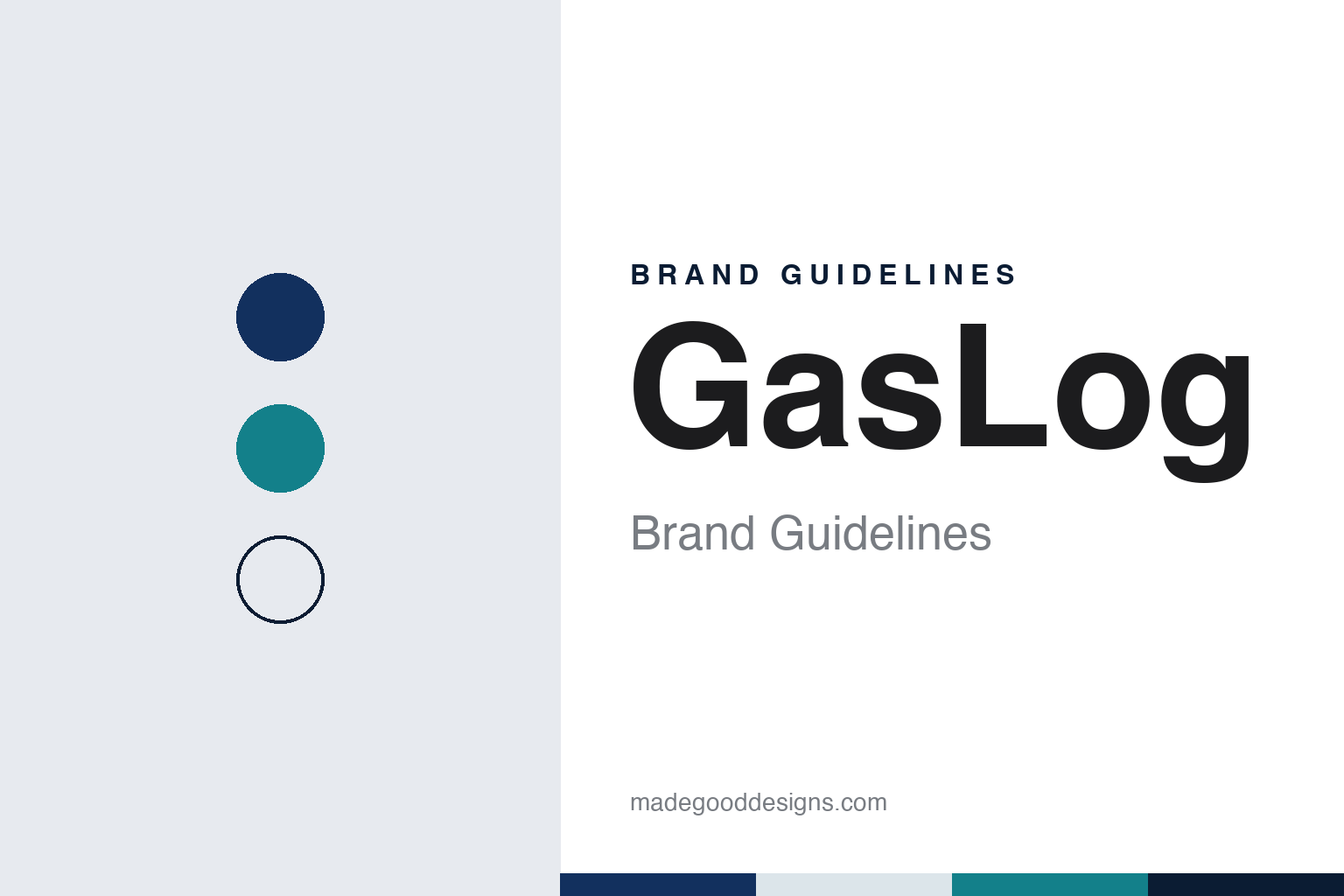
GasLog Brand Guidelines
A Livanos family LNG shipowner that makes its fleet table the centre of its brand.
Aa
Two constants: a GasLog deep blue and Aegean teal palette and a Geometric sans register. Abstract homage — not a GasLog asset or mark; no vessel, logo or livery is reproduced.
Ceres Hellenic’s LNG arm
A Livanos family company, formed in 2001.
GasLog is an owner, operator and manager of LNG carriers. The company says it was formed in 2001 by Ceres Hellenic, which it calls the long-established shipping arm of the Livanos family. English Wikipedia’s article on Ceres Hellenic Enterprises says that group was founded by George Livanos in 1949, that the family’s shipping interests date back to 1824, and that it remains family-controlled, with three main divisions: DryLog for dry bulk, TankLog, and GasLog for LNG carriers.
Ceres narrowed its focus in the 2000s. Wikipedia says it sold its tanker fleet to Euronav in spring 2005 and then concentrated on bulk cargo and LNG carriers; in 2022, the article adds, Ceres launched ECOLOG, a venture for shipping carbon dioxide as part of carbon-capture schemes. GasLog went public in March 2012, when a minority of its shares was sold in an initial public offering, according to the same article, and its common shares traded on the New York Stock Exchange under the ticker GLOG, as its press releases show.
The company is registered in Bermuda, with its registered office in Hamilton, and run from Piraeus, where its website places its principal executive office and its technical manager, GasLog LNG Services. It says its 160 onshore staff work across offices in Piraeus, London and Singapore, with more than 1,600 seafarers aboard its ships.
Colour
Steam, TFDE, X-DF, ME-GI.
GasLog’s most detailed public document is its fleet list, headed “Creating the LNG fleet of tomorrow,” where the company says it works closely with shipyards and suppliers on the efficiency of its ships. The fleet page sets out each carrier by name, three-letter code, propulsion, cargo capacity in cubic metres, year built and ownership, and explains the engine shorthand: TFDE for tri-fuel diesel-electric, X-DF for low-pressure two-stroke engines made by WinGD, and ME-GI for dual-fuel two-stroke engines developed by MAN B&W. The oldest ships on it are steam carriers such as Methane Nile Eagle, built in 2007 and 25% owned by GasLog.
The list reads as a timeline of LNG engines. The 155,000-cubic-metre GasLog Savannah and GasLog Singapore of 2010 are TFDE ships; GasLog Genoa, GasLog Houston and GasLog Hong Kong of 2018 are 174,000-cubic-metre X-DF ships; GasLog Warsaw, GasLog Wales and GasLog Westminster carry 180,000 cubic metres; and the ME-GI ships GasLog Italy and Marvel Phoenix date from 2024, followed in 2025 by Woodside Barrumbara and Woodside Jirrubakura. Many carry the GasLog name followed by a place, from GasLog Savannah to GasLog Wales; a separate table lists the ships of GasLog Partners.
GasLog also has an FSRU interest. Its “What we do” page says it invested in Gastrade in 2016 to develop an independent natural gas system offshore at Alexandroupolis in northern Greece, built around an FSRU, and its October 2024 announcement described a 20% interest in a floating storage and regasification terminal. Its fleet page also lists a vessel named Alexandroupolis, built in 2010, in which GasLog holds 20%. The same page describes FSRUs as purpose-built or converted LNG carriers, permanently moored offshore, that receive LNG, turn it back into gas and feed it into a distribution system.
Typography
Ships, terminals and fleet lists.
LNG and gas-carrier owners sell a service rather than a product, and their websites tend to show the ships themselves. Corporate pages lean on deep blues, teals and white, with photographs of carriers at sea, at terminals and in shipyards. The hull type in those pictures — a membrane carrier with its long flat deck, or a Moss-type carrier with its row of spherical tanks — is often the most distinctive image a company has.
The fleet list is the core document. Owners such as GasLog publish each vessel by name, cargo capacity in cubic metres, year built, propulsion and ownership share, and use engine shorthand such as TFDE, X-DF and ME-GI that their customers read at a glance. Floating storage and regasification units, or FSRUs, get their own project pages, usually set out by country and terminal, as BW LNG does for its units in Brazil, Pakistan, El Salvador and the Philippines.
Charter and terminal pages sit alongside investor sections. Listed owners carry results, filings, presentations and governance documents; owners that have gone private often keep the investor pages they built while listed. Sustainability pages report fuel-efficiency targets and new engine types in the companies’ own terms, and are read here as company statements rather than independent findings.
This guide sets out what can be checked about each owner — who founded it, who owns it today, which deals have closed and which are only announced — and marks clearly what rests on the company’s own word. Vessel names, capacities and dates come from dated company pages and trade press; the colours and typefaces shown are an unofficial interpretation, not a brand standard.
Aa
A geometric sans — a fleet table set as an identity. (Specimen set in Manrope, a sans STAND-IN; NOT the GasLog logo.)
GasLog
Private since 2021.
GasLog has been private since 2021. On 22 February 2021 it announced a merger agreement with BlackRock’s Global Energy & Power Infrastructure team, under which that fund would buy the shares not held by a group of existing shareholders: Blenheim Holdings, wholly owned by the Livanos family, and an affiliate of the Onassis Foundation. The deal closed on 9 June 2021, the company said, after a shareholder meeting on 4 June; trading in the common shares on the NYSE was suspended, and the Livanos and Onassis holders were left with about 55% and the fund with about 45%.
Further changes followed. In April 2023 GasLog agreed to acquire the publicly held units of its listed subsidiary, GasLog Partners, and LNG Prime reported in November 2023 that the merger had been completed earlier that year. On 21 October 2024 GasLog announced that GIC, the Singapore investment firm, had agreed to buy the roughly 45% stake held by a fund managed by Global Infrastructure Partners, part of BlackRock, with the Livanos family company and the Onassis Foundation keeping about 55%.
GasLog calls itself “a leading global provider of LNG shipping services” and, on its investor page, one of the largest independent owners of LNG carriers, with 34 vessels; those are its own descriptions. Its website, designed by the agency FB&A and built by 22 Group according to its footer, leads with the line “Partners for performance.” One domain trap: in November 2026 gaslog.com was a parked address forwarding to a domain-sales page, while the company uses gaslogltd.com.
For a design guide, GasLog shows how a shipowner can make a fleet table the centre of its brand. Compare Maran Gas, another LNG carrier owner in this series, and Flex LNG. For this guide we use a deep blue, an Aegean teal and white with a sans, an unofficial interpretation; no product or logo is reproduced.
Explore & save
Keep GasLog’s identity on hand — save it to a board in the Made Good inspiration library.
GasLog identity set
Pin the GasLog deep blue and Aegean teal palette and the Geometric sans register to your own board.