Ardmore Shipping Brand Guidelines
A 2010 Irish start, a 2013 NYSE listing and a fleet that carries the company name.
Aa
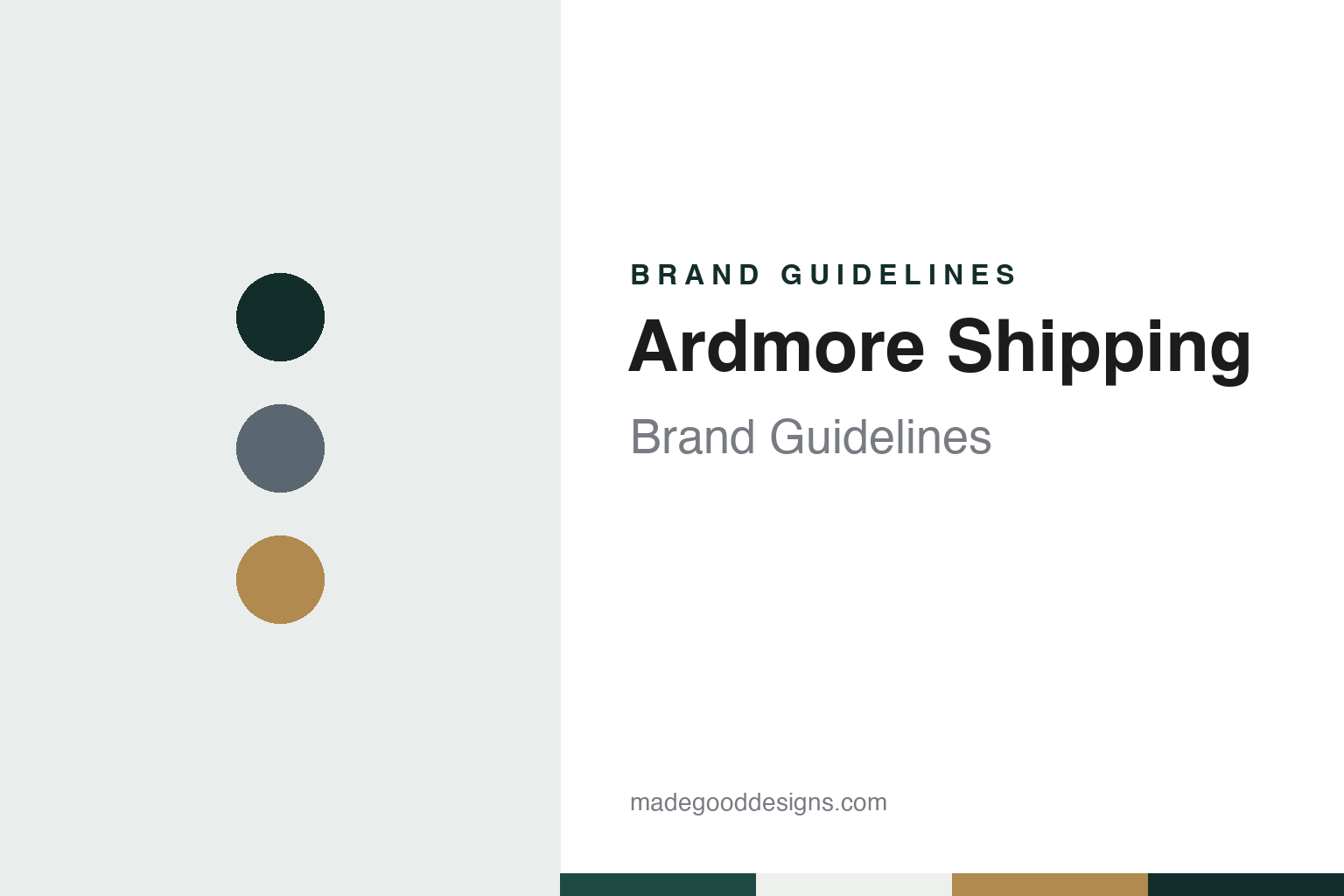
Two constants: an Atlantic green, slate and brass palette and a plain corporate sans register. Abstract homage — not an Ardmore Shipping asset; no ship, logo or mark is reproduced.
From Cork to New York
A 2010 start and a 2013 listing.
Ardmore Shipping was founded in 2010. The Maritime Executive, introducing a February 2025 interview with its chief executive, described it as an NYSE-listed product tanker specialist that had “carved out a place for itself” since that founding as an owner and operator willing to try out new technology. The company’s own account names Anthony Gurnee as its founder and first chief executive, and says the business grew from its inception “in a humble Irish farmhouse.”
The company is spread across several places. Its website gives its headquarters as Hamilton, Bermuda, and its principal operating office as Cork, Ireland, with further offices in Singapore and Houston. A ship-management joint venture with Anglo Eastern, Anglo Ardmore Ship Management, has its own office in Singapore; the chief executive named it in the 2025 interview as one example of how the company keeps changing the way it works.
Ardmore’s shares were listed on the New York Stock Exchange in 2013, under the ticker ASC. In the same interview the chief executive counted the public listing among the ways the company had evolved over 15 years, alongside expanding the fleet and moving “from a simple, high-quality time charter portfolio to a fully-fledged global trading platform,” with commercial teams in Europe, Singapore and Houston.
Leadership changed in 2024. Gurnee retired on 16 September 2024 after 14 years in charge, the company says, and Gernot Ruppelt, who joined in 2013 and had led chartering and commercial operations, became chief executive, while Bart Kelleher became president and chief financial officer. Ruppelt told The Maritime Executive that the board had started the succession process in 2020, and that before Ardmore he had worked as a tanker broker with Poten & Partners in New York and, earlier, for Maersk in Germany, Singapore, Denmark and the United States.
Colour
Medium Range tankers with Ardmore names.
Ardmore describes itself as an owner and operator of product and chemical tankers, carrying refined petroleum products, chemicals and other liquid goods, and as a “fully integrated” company that keeps its commercial, technical, operational and corporate functions inside its own structure, according to its third-quarter 2026 results release of 3 November 2026.
The fleet page lists 23 ships in November 2026, every one named with the Ardmore prefix. Most are Medium Range (MR) tankers of roughly 49,000 to 50,000 deadweight tonnes, built in South Korea between 2013 and 2020, among them the Ardmore Purpose of 2020, the Ardmore Gibraltar of 2017 and the Ardmore Seafox of 2015. Four smaller product and chemical tankers of about 25,000 tonnes, the Ardmore Chippewa, Chinook, Cheyenne and Cherokee, were built in Japan in 2015, and two of about 37,800 tonnes, the Ardmore Defender and Ardmore Dauntless, in South Korea the same year. Most fly the Marshall Islands flag, the page shows. The company says its MR tankers can carry a wide range of refined products, chemicals and edible oils.
The fleet is changing. In the third-quarter release the company said it had sold the 2013-built Ardmore Endeavour, which was delivered to its buyer in October 2026, and had taken up its last options for 40,500-deadweight Handysize product and chemical tankers at Wuhu Shipyard in China, bringing that order to six ships. Baird Maritime reported the order on 4 November 2026, noting that it had grown to four ships in June and that deliveries are due to begin in late 2028. The fleet page lists the six newbuildings as “to be named,” with delivery between 2028 and 2030.
Technology is part of how the company talks about its ships. In the 2025 interview Ruppelt described an AI-supported voyage optimisation system, DeepSea AI, whose rollout the company had completed the year before, and the company’s news page reported in November 2025 that it had deployed SteelCorr, an AI tool for monitoring corrosion and paint maintenance on its vessels.
Typography
How tanker owners present themselves.
Tanker owners rarely sell to the public, so their brands live mostly on corporate websites, in investor material and on the ships themselves. The pattern is consistent across the companies in this series: a short purpose line, a fleet page, an investor section and a sustainability page, set in restrained corporate type and colour. The palettes in these guides, from navy and steel to deep sea greens, are tones of our own choosing rather than any company’s colours.
Photographs do much of the work. Owners publish photographs of their own crude and product tankers, and Ardmore Shipping’s homepage, for example, pairs its values with pictures of named ships from its fleet. The ship names themselves often carry the identity: Ardmore puts its own name on every hull, while Okeanis names its tankers after Greek islands.
The fleet list is the core document. Companies set out their ships by size class, from Medium Range (MR) and Handysize product tankers to Suezmax and VLCC crude carriers, usually with the year built, the shipyard, the deadweight and the flag, and they list newbuildings on order with expected delivery dates. Pages on pools, chartering arms and ship-management partners explain who markets and runs the ships commercially and technically.
Many of these companies are listed, so investor pages sit close to the top of the menu: press releases, quarterly results, presentations, filings with regulators and share data, sometimes for two stock exchanges at once. ESG and sustainability reports, often published once a year and prepared with reference to named reporting frameworks, complete the picture. This guide sets out what each company’s own pages and dated independent sources show about its history, ownership and fleet, and keeps the company’s own claims marked as its own.
Aa
A plain corporate sans for a company that names every ship after itself. (Specimen set in Archivo, a sans STAND-IN; NOT the Ardmore Shipping logo.)
Ardmore Shipping
Values on the page, ships in the photographs.
Ardmore’s public identity is plain and corporate. Its website states a purpose of “connecting the world through global trade across cultural boundaries” and three core values, professionalism, integrity and respect, and is organised around a fleet page, an investor hub, a governance section, annual sustainability reports and a news page. The homepage pairs that copy with photographs of the company’s own ships, including the Ardmore Seahawk and the Ardmore Dauntless.
One phrase recurs. The company published its 2025 sustainability report in July 2026 under the heading “performance through sustainability,” its about page says its culture “connects performance and progress,” and Ruppelt told The Maritime Executive in 2025 that the company’s approach was to “integrate performance with progress.” The news page also carries a run of features about people: interviews with seafarers and managers, a story about colleagues supporting local communities, and an April 2026 report on staff taking part in the Maritime Mountain Race in support of seafarers. Its investor hub, signed by Bart Kelleher as president, speaks of transparency and long-term value for shareholders.
For a design guide, Ardmore Shipping shows how a mid-sized tanker owner builds a brand from one repeated prefix: every ship carries the company name, so the fleet list doubles as part of the identity. Compare Scorpio Tankers, another product tanker owner, and TORM, a product tanker company with Danish roots. For this guide we use a deep Atlantic green, a slate grey and a warm brass with a sans, an unofficial interpretation; no product or logo is reproduced.
Explore & save
Keep Ardmore Shipping’s identity on hand — save it to a board in the Made Good inspiration library.
Ardmore Shipping identity set
Keep the Ardmore Shipping Atlantic green, slate and brass palette and the plain corporate sans register for your own board.