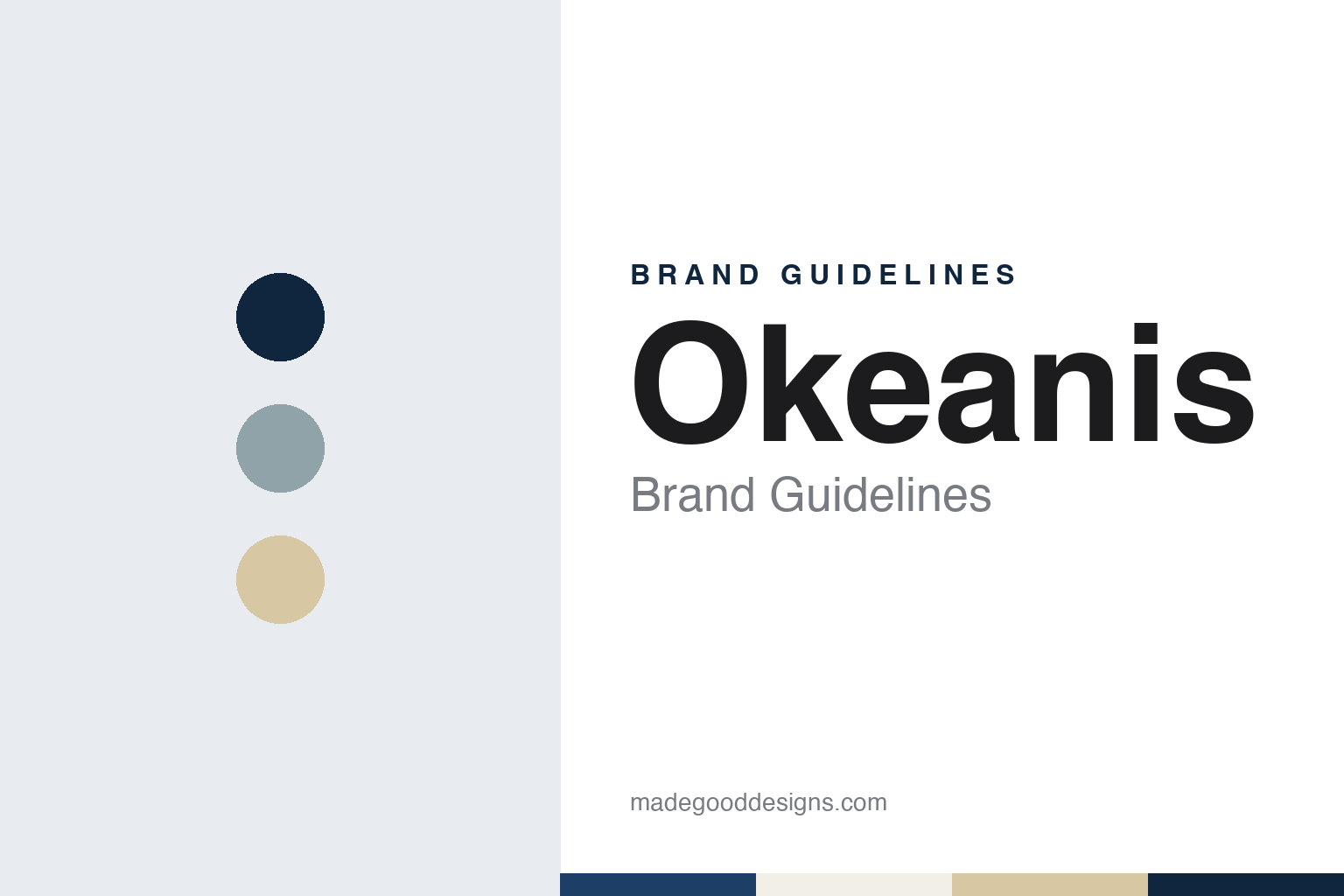
Okeanis Brand Guidelines
A 2018 tanker owner with VLCCs, Suezmaxes and Greek island names.
Aa
Two constants: an Aegean blue, sea-foam and sand palette and a classical serif register. Abstract homage — not an Okeanis asset; no ship, logo or mark is reproduced.
Okeanis Eco Tankers
A 2018 company with a shipping family behind it.
Okeanis Eco Tankers Corp., which shortens its name to Okeanis and OET, was incorporated in 2018 under the laws of the Marshall Islands, according to its website. Its contact address is in Neo Faliro, in the Athens area, care of its chartering subsidiary, OET Chartering Inc. The company names its sponsor as the Alafouzos family, which it says has more than fifty years of experience in international shipping and holds about 46 per cent of the shares.
The people page names Ioannis Alafouzos as chairman since the company’s inception; he was also chief executive from the start until December 2022, and the page says he began his shipping career in 1981 and founded the tanker arm of Kyklades Maritime Corporation. Aristidis Alafouzos, chief operating officer from 2018, has been chief executive since December 2022. Iraklis Sbarounis became chief financial officer in January 2023, and Christopher Papaioannou, head of chartering at OET Chartering Inc. from June 2018, became chief commercial officer in May 2023. Several members of the management team list earlier roles at Kyklades Maritime. The board has eight members, six of them independent under New York Stock Exchange and Oslo Stock Exchange rules, the company says.
Okeanis is listed in two places. Its shares were first listed in Oslo, under the ticker OET. In December 2023 the company added a listing on the New York Stock Exchange under the ticker ECO, keeping Oslo as a secondary listing; its investor FAQ, dated 5 December 2023, set 11 December 2023 as the expected first day of trading in New York. The FAQ said the aim was to give American and other international investors access to the company and to improve trading liquidity. Hellenic Shipping News described the company in January 2026 as listed on both the Oslo Stock Exchange and the New York Stock Exchange.
Colour
Eight VLCCs and ten Suezmaxes.
Okeanis carries crude oil and refined products. Its website lists 18 ships in November 2026: eight VLCCs (Very Large Crude Carriers) and ten Suezmax tankers, with a combined capacity the company gives as about four million deadweight tonnes and an average age of 5.4 years. It describes every ship as eco-design and scrubber-fitted, and its fleet list marks each one as fitted with a ballast water treatment system.
All eight VLCCs were built by Hyundai Heavy Industries in South Korea: six of about 319,000 tonnes delivered between May 2019 and January 2020, including the Nissos Rhenia and the Nissos Anafi, and two of about 300,000 tonnes, the Nissos Kea and the Nissos Nikouria, in 2022. The Suezmaxes come from several yards: the Milos and the Poliegos from Sungdong in 2016 and 2017, the Kimolos and the Folegandros from Japan Marine United in 2018, the Nissos Sikinos and the Nissos Sifnos from Hyundai Samho in 2020, and four ships from Daehan Shipbuilding in South Korea delivered in 2026.
That last group is the company’s newest growth. In January 2026 Hellenic Shipping News reported that Okeanis had raised new equity partly to fund two newbuilding Suezmaxes under construction at Daehan, due in the second quarter of 2026 and sister ships to two delivered earlier that month; at that point, the paper said, the fleet stood at eight Suezmaxes and eight VLCCs, and the purchases were still subject to debt financing. The company’s fleet list now shows the Nissos Piperi and the Nissos Serifopoula delivered in January 2026, the Nissos Tigani in May and the Nissos Vous in July.
The company’s business page describes its chartering as “spot-oriented,” and lists disciplined capital allocation and active fleet management among its aims.
Typography
How tanker owners present themselves.
Tanker owners rarely sell to the public, so their brands live mostly on corporate websites, in investor material and on the ships themselves. The pattern is consistent across the companies in this series: a short purpose line, a fleet page, an investor section and a sustainability page, set in restrained corporate type and colour. The palettes in these guides, from navy and steel to deep sea greens, are tones of our own choosing rather than any company’s colours.
Photographs do much of the work. Owners publish photographs of their own crude and product tankers, and Ardmore Shipping’s homepage, for example, pairs its values with pictures of named ships from its fleet. The ship names themselves often carry the identity: Ardmore puts its own name on every hull, while Okeanis names its tankers after Greek islands.
The fleet list is the core document. Companies set out their ships by size class, from Medium Range (MR) and Handysize product tankers to Suezmax and VLCC crude carriers, usually with the year built, the shipyard, the deadweight and the flag, and they list newbuildings on order with expected delivery dates. Pages on pools, chartering arms and ship-management partners explain who markets and runs the ships commercially and technically.
Many of these companies are listed, so investor pages sit close to the top of the menu: press releases, quarterly results, presentations, filings with regulators and share data, sometimes for two stock exchanges at once. ESG and sustainability reports, often published once a year and prepared with reference to named reporting frameworks, complete the picture. This guide sets out what each company’s own pages and dated independent sources show about its history, ownership and fleet, and keeps the company’s own claims marked as its own.
Aa
A classical serif for a fleet named after Greek islands. (Specimen set in Noto Serif, a serif STAND-IN; NOT the Okeanis logo.)
Okeanis
Island names and a two-exchange investor site.
The ship names are the most visible part of the Okeanis identity. They are Greek place names, many with the prefix “Nissos,” the Greek word for island, such as the Nissos Rhenia, the Nissos Despotiko and the Nissos Kythnos, alongside older ships named simply Milos, Kimolos and Folegandros. The homepage line is “Driving value at sea.”
The website, which credits the design studio Freshdesign, puts the share prices from New York and Oslo near the top of its homepage, followed by headline fleet figures: deadweight tonnes, average age and the number of ships. Its menu gives as much room to investors as to the business, with press releases, financial reports and webcasts, presentations, SEC filings, a financial calendar, a page on dividends and share buybacks, and analyst coverage. The sustainability section links annual ESG reports from 2021 to 2025, which the company says are prepared with reference to the Global Reporting Initiative and the Sustainability Accounting Standards Board standards for marine transportation, and the footer shows memberships including INTERTANKO and HELMEPA.
For a design guide, Okeanis shows how a young, family-sponsored tanker company can build a recognisable fleet from names alone, and present itself to two stock markets at once. Compare Frontline, another crude tanker owner, and DHT, an all-VLCC owner. For this guide we use a deep Aegean blue, a sea-foam grey and a warm sand with a serif, an unofficial interpretation; no product or logo is reproduced.
Explore & save
Keep Okeanis’s identity on hand — save it to a board in the Made Good inspiration library.
Okeanis identity set
Keep the Okeanis Aegean blue, sea-foam and sand palette and the classical serif register for your own board.