Dynagas Brand Guidelines
Ice-class LNG carriers from Athens, listed in New York since 2013.
Aa
Two constants: a polar navy, ice blue and frost white palette and a technical sans register. Abstract homage — not a Dynagas mark; no vessel, logo or funnel marking is reproduced.
A manager and a partnership
Two companies under one name.
The Dynagas name covers two linked companies. Dynagas Ltd, the ship manager, describes itself as an LNG maritime transportation company established in 2004 that runs its ships with in-house management. Dynagas LNG Partners LP is the listed owner of the vessels: a master limited partnership whose press releases carry an Athens dateline. In 2013 the maritime news site gCaptain described Dynagas as the liquefied natural gas shipping arm of the shipping enterprises of George Prokopiou.
The partnership explains the structure on its corporate pages. Its sponsor, Dynagas Holding Ltd, holds a significant ownership interest and controls the general partner, Dynagas GP LLC, which manages the partnership’s affairs. Day-to-day commercial and technical operation of the ships is carried out by the manager, Dynagas Ltd, under management agreements.
The listing came in late 2013. According to the partnership’s press archive, it announced an initial public offering of 12,500,000 common units on 5 November 2013, priced the offering on 12 November and, two days later, announced that it would ring the Nasdaq closing bell to celebrate the offering. Today its common units trade on the New York Stock Exchange under the symbol DLNG, with preferred units under DLNG PR A, and the partnership files an annual report on Form 20-F with the US Securities and Exchange Commission; it announced its latest filing in April 2026.
The partnership’s copyright line runs from 2013 and the manager’s from 2004, matching the two founding stories. The pages also show what the partnership talks about most: charters, fleet and distributions to unitholders.
Colour
Six Hyundai-built carriers, five of them ice-class.
Dynagas LNG Partners says its fleet consists of six LNG carriers with a combined capacity of about 914,000 cubic metres, all built at Hyundai Heavy Industries in South Korea, and that five of the six carry the Ice Class 1A FS notation and are fully winterised. Its fleet table lists three ships of about 150,000 cubic metres with steam propulsion — the Clean Energy and the Ob River of 2007, and the Amur River of 2008 — and three of 155,000 cubic metres from 2013, the Arctic Aurora, the Yenisei River and the Lena River, with engines the table lists as TFDE. Only the Clean Energy is listed without ice class, and the table gives charter redelivery dates between 2028 and 2034.
gCaptain reported the arrival of the 2013 pair in July of that year. The Yenisei River was delivered at Hyundai’s Ulsan yard one day before the Arctic Aurora; both were classed by Lloyd’s Register under its ice-class and winterisation rules, fitted with GTT Mark III membrane cargo tanks and powered by four Wärtsilä-Hyundai engines able to burn gas or fuel oil, which drove two propulsion motors and a single fixed-pitch propeller. They were registered in the Marshall Islands and, the site said, would work on charter to Gazprom and Statoil.
The Ob River has its own place in that ice-class story. In October 2013 gCaptain, republishing a Bloomberg report, said the Ob River had been the first LNG vessel to sail the northern passage, in October 2012, carrying a cargo loaded at Hammerfest in Norway that was delivered on 5 December to the Kita-Kyushu LNG terminal at Tobata in southern Japan. The same report followed the new Arctic Aurora, which had loaded at Statoil’s Hammerfest terminal and left on 19 September 2013 for Tokyo Electric Power’s Futtsu terminal. The partnership’s own pages tell the Ob River story too and say the manager has carried out Northern Sea Route voyages since.
Typography
How gas-carrier owners present themselves.
LNG and gas-carrier owners sell a service rather than a product, and their websites tend to show the ships themselves. Corporate pages lean on deep blues, teals and white, with photographs of carriers at sea, at terminals and in shipyards. The hull type in those pictures — a membrane carrier with its long flat deck, or a Moss-type carrier with its row of spherical tanks — is often the most distinctive image a company has.
The fleet list is the core document. Owners such as GasLog publish each vessel by name, cargo capacity in cubic metres, year built, propulsion and ownership share, and use engine shorthand such as TFDE, X-DF and ME-GI that their customers read at a glance. Floating storage and regasification units, or FSRUs, get their own project pages, usually set out by country and terminal, as BW LNG does for its units in Brazil, Pakistan, El Salvador and the Philippines.
Charter and terminal pages sit alongside investor sections. Listed owners carry results, filings, presentations and governance documents; owners that have gone private often keep the investor pages they built while listed. Sustainability pages report fuel-efficiency targets and new engine types in the companies’ own terms, and are read here as company statements rather than independent findings.
This guide sets out what can be checked about each owner — who founded it, who owns it today, which deals have closed and which are only announced — and marks clearly what rests on the company’s own word. Vessel names, capacities and dates come from dated company pages and trade press; the colours and typefaces shown are an unofficial interpretation, not a brand standard.
Aa
A plain technical sans for fleet tables and notations. (Specimen set in IBM Plex Sans, a sans STAND-IN; NOT the Dynagas logo.)
Dynagas
Rivers, ice and investor pages.
The Dynagas identity is mostly carried by its ships and its two websites. Four of the six carriers are named after rivers — the Ob, the Amur, the Yenisei and the Lena — and the other two are the Clean Energy and the Arctic Aurora. The partnership’s site describes the fleet as built for “trading flexibility” and gives sub-zero and ice-bound trade its own section of the menu.
The two sites, dynagas.com for the manager and dynagaspartners.com for the listed partnership, share the same layout and much of the same menu, which makes them easy to confuse. The partnership’s pages lean towards investors, with share prices, unit distributions, presentations, annual reports and filings with the Securities and Exchange Commission; the manager’s pages cover technical management, crewing, newbuildings and vessel construction. The manager says it holds ISO 9001, ISO 14001 and ISO 50001 certification as well as OHSAS 18001, and that it is a member of SIGTTO.
The partnership also states its priorities plainly: employing its ships on multi-year time charters with international energy companies, reducing debt and returning capital to unitholders. Those words, with the fleet tables beside them, are the core of how it presents itself.
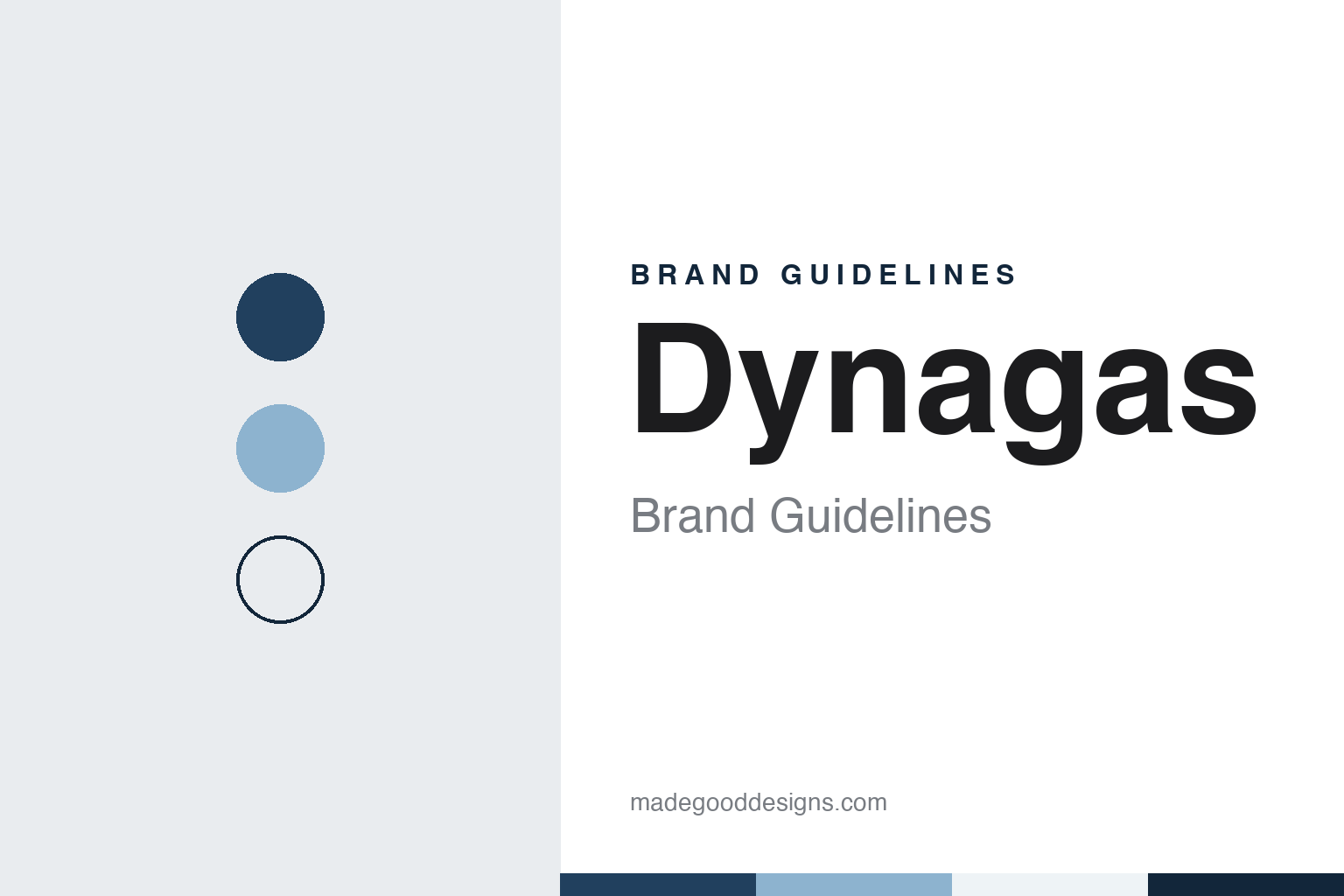
For a design guide, Dynagas shows how a small fleet can build a clear identity from one technical capability and a consistent naming system. Compare Maran Gas, another Athens-based LNG shipowner, and Flex LNG, an LNG carrier owner listed in New York. For this guide we use a polar navy, an ice blue and a frost white with a sans, an unofficial interpretation; no product or logo is reproduced.
Explore & save
Keep Dynagas’s identity on hand — save it to a board in the Made Good inspiration library.
Dynagas identity set
Save the Dynagas polar navy, ice blue and frost white palette and the technical sans register to your own board.