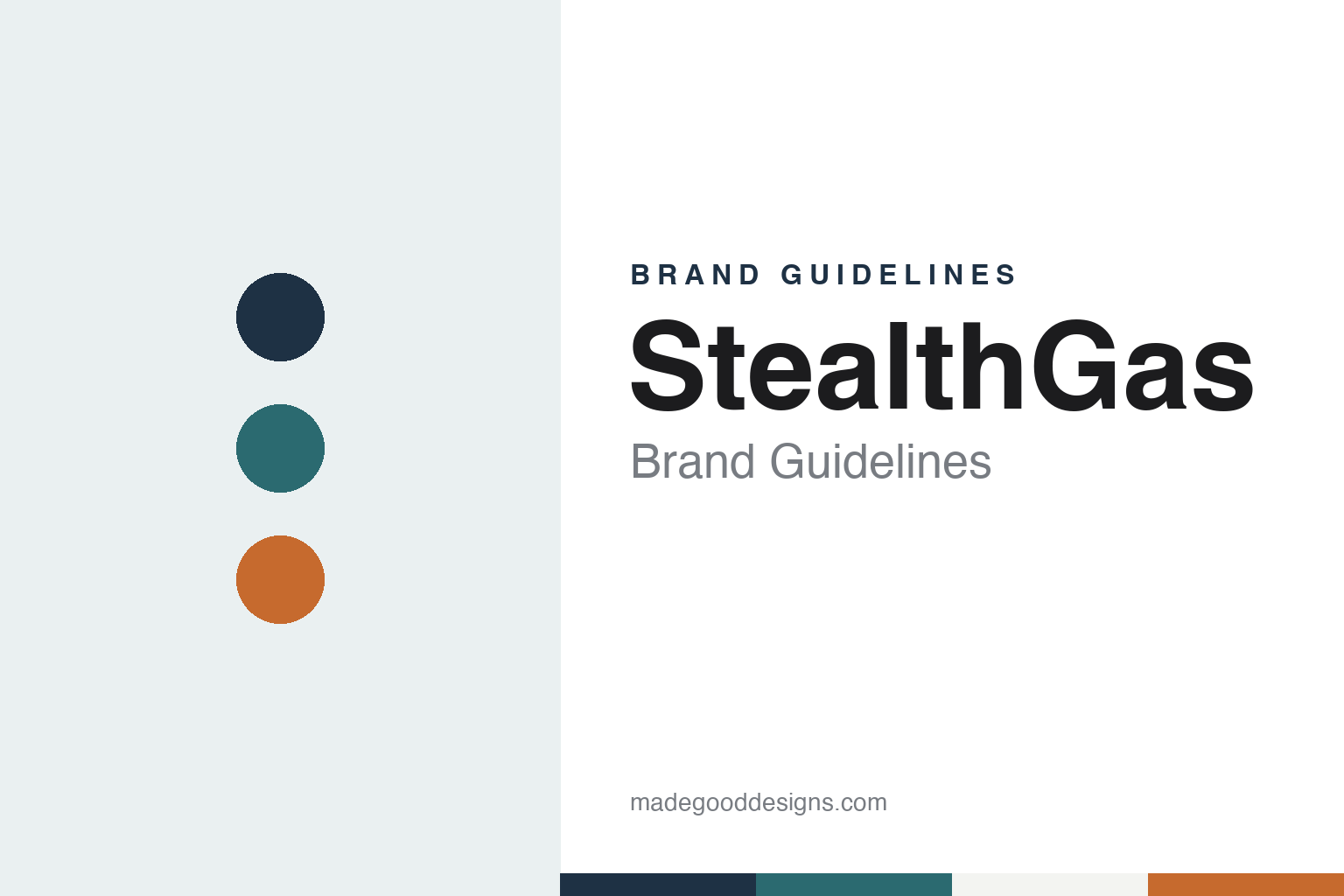
StealthGas Brand Guidelines
The Athens owner of small pressurised LPG carriers.
Aa
Two constants: a StealthGas navy, teal and orange palette and an industrial sans register. Abstract homage — not a StealthGas asset or mark; no vessel, logo or livery is reproduced.
Nine small gas carriers
A 2004 start and a Nasdaq listing a year later.
StealthGas is a ship-owning company that carries liquefied gas by sea. Its own milestones page says it was founded in 2004 with an initial fleet of nine LPG carriers of between 3,000 and 8,000 cubic metres, and its management page dates the company’s inception to December 2004. Trade press places it in Athens: gCaptain described it in February 2014 as an “Athens-based LPG shipper.” Hellenic Shipping News, in a December 2021 analysis of shipping companies on Wall Street, said StealthGas was founded by Harry Vafias, who the company says has been its president and chief executive since that inception.
The company moved quickly to the public market. Its milestones page records a Nasdaq initial public offering in October 2005, and the shares trade under the symbol GASS. Michael G. Jolliffe, a co-founder and vice chairman of Tsakos Energy Navigation, has chaired the board since 2004, according to the company. Day-to-day ship management sits with a separate firm: the company’s management page describes Stealth Maritime S.A. as a shipping company managing a fleet of more than 70 vessels, including the StealthGas fleet.
The early growth is set out year by year on the company’s own site. The fleet reached 28 LPG carriers in 2006 and 38 in 2007. In 2009 the company placed its first newbuilding orders, for five LPG carriers, and added three medium-range product tankers; an Aframax crude tanker followed in 2010. The cargoes it lists are the by-products of natural gas and crude oil: propane, butane, butadiene, isoprene, propylene and vinyl chloride monomer, among other liquefied gases.
Colour
Pressurised ships, then bigger refrigerated ones.
The core of StealthGas has always been the small pressurised gas carrier, a ship that keeps its cargo liquid under pressure. In April 2013 gCaptain, carrying a Bloomberg report, said the company had a fleet of 37 carriers, 33 of them fully pressurised ships of 3,200 to 7,500 cubic metres, which company data put at a 14 percent share of that market. The same report described StealthGas as “the owner with the most LPG carriers” and said it was moving ships from the Persian Gulf–Asia trade towards the Americas as United States exports of LPG grew. Today the company describes its fleet as one of the largest independently owned LPG carrier fleets in the 3,000 to 8,000 cubic metre range.
The 2010s brought a large building programme and a step up in size. gCaptain reported in February 2014 that two more ships had been ordered from Japanese yards, bringing to 17 the new vessels due between March 2014 and August 2015. In September 2014 it reported that StealthGas had exercised options for two 22,000 cubic metre semi-refrigerated carriers from a South Korean yard for delivery in 2017, after a similar order that July. The company’s milestones list 47 vessels in the water in 2014 and 56 in 2016, and in 2019 its first joint venture and a move into medium gas carriers of 38,000 to 45,000 cubic metres.
One of the larger ships drew an industry award. SAFETY4SEA reported on 30 January 2019 that StealthGas had received the 2019 SMART4SEA Technology Award in Athens for Eco Freeze, a 22,000 cubic metre semi-refrigerated carrier for LPG, ammonia and vinyl chloride monomer, built by Hyundai Mipo in Korea in 2018 and holding an Ice Class 1B notation. Presenting the award, the head of the sponsor, Propulsion Analytics, called StealthGas the largest owner in the 3,000 to 8,000 cubic metre segment and noted twenty-six newbuildings in less than a decade from Japanese and Korean yards.
Typography
How gas-carrier owners present themselves.
LNG and gas-carrier owners sell a service rather than a product, and their websites tend to show the ships themselves. Corporate pages lean on deep blues, teals and white, with photographs of carriers at sea, at terminals and in shipyards. The hull type in those pictures — a membrane carrier with its long flat deck, or a Moss-type carrier with its row of spherical tanks — is often the most distinctive image a company has.
The fleet list is the core document. Owners such as GasLog publish each vessel by name, cargo capacity in cubic metres, year built, propulsion and ownership share, and use engine shorthand such as TFDE, X-DF and ME-GI that their customers read at a glance. Floating storage and regasification units, or FSRUs, get their own project pages, usually set out by country and terminal, as BW LNG does for its units in Brazil, Pakistan, El Salvador and the Philippines.
Charter and terminal pages sit alongside investor sections. Listed owners carry results, filings, presentations and governance documents; owners that have gone private often keep the investor pages they built while listed. Sustainability pages report fuel-efficiency targets and new engine types in the companies’ own terms, and are read here as company statements rather than independent findings.
This guide sets out what can be checked about each owner — who founded it, who owns it today, which deals have closed and which are only announced — and marks clearly what rests on the company’s own word. Vessel names, capacities and dates come from dated company pages and trade press; the colours and typefaces shown are an unofficial interpretation, not a brand standard.
Aa
An industrial sans for a fleet register. (Specimen set in Archivo, a sans STAND-IN; NOT the StealthGas logo.)
StealthGas
A pure LPG owner after the 2021 spin-off.
The mixed fleet did not last. In December 2021 StealthGas completed the spin-off of Imperial Petroleum Inc., the holding company for four tanker vessels, effective 3 December, the company announced in a release carried by Hellenic Shipping News. That paper’s analysis later that month said StealthGas had owned 45 LPG carriers, three product tankers and one crude tanker, and that the split created two pure plays: StealthGas kept the gas carriers and Imperial Petroleum, listed on Nasdaq as IMPP, took the tankers. The company’s management page adds that Imperial Petroleum in turn spun off C3is Inc., listed on Nasdaq in June 2023.
Since then the fleet has become smaller in number, with larger ships added at the top end. Two newbuilding medium gas carriers joined the fully owned fleet in 2024, the company’s milestones say, and in 2025 it reports that it repaid the remaining debt on its fully owned fleet. As of March 2026, the company says, it had 28 LPG carriers, including one joint-venture vessel, with a total capacity of 334,118 cubic metres. Its published fleet list runs from Gas Alice, a 3,500 cubic metre pressurised ship built in 2006, through the 11,000 cubic metre Eco Blizzard of 2021, to the 40,000 cubic metre fully refrigerated Eco Oracle of 2024 and the joint-venture ship Eco Sorcerer of 2023.
The naming is the most consistent piece of the identity. Every ship on the current list carries one of two prefixes, Gas or Eco, followed by a single word: Gas Haralambos, Gas Husky, Eco Frost, Eco Arctic. The website itself is plain, a short profile, a milestones timeline, a fleet list and investor pages with press releases and filings. The company describes itself as an international shipping company specialised in carrying petroleum and petrochemical gases in liquefied form, with a presence in LPG seaborne transport of more than two decades.
For a design guide, StealthGas shows how a listed shipowner can build recognition through a fleet register and a disciplined naming system rather than a heavy visual campaign. Compare Dynagas and Maran Gas, two other gas-carrier owners run from Greece. For this guide we use a harbour navy, a deck teal and a cargo orange with a sans, an unofficial interpretation; no product or logo is reproduced.
Explore & save
Keep StealthGas’s identity on hand — save it to a board in the Made Good inspiration library.
StealthGas identity set
Pin the StealthGas navy, teal and orange palette and the industrial sans register to your own board.