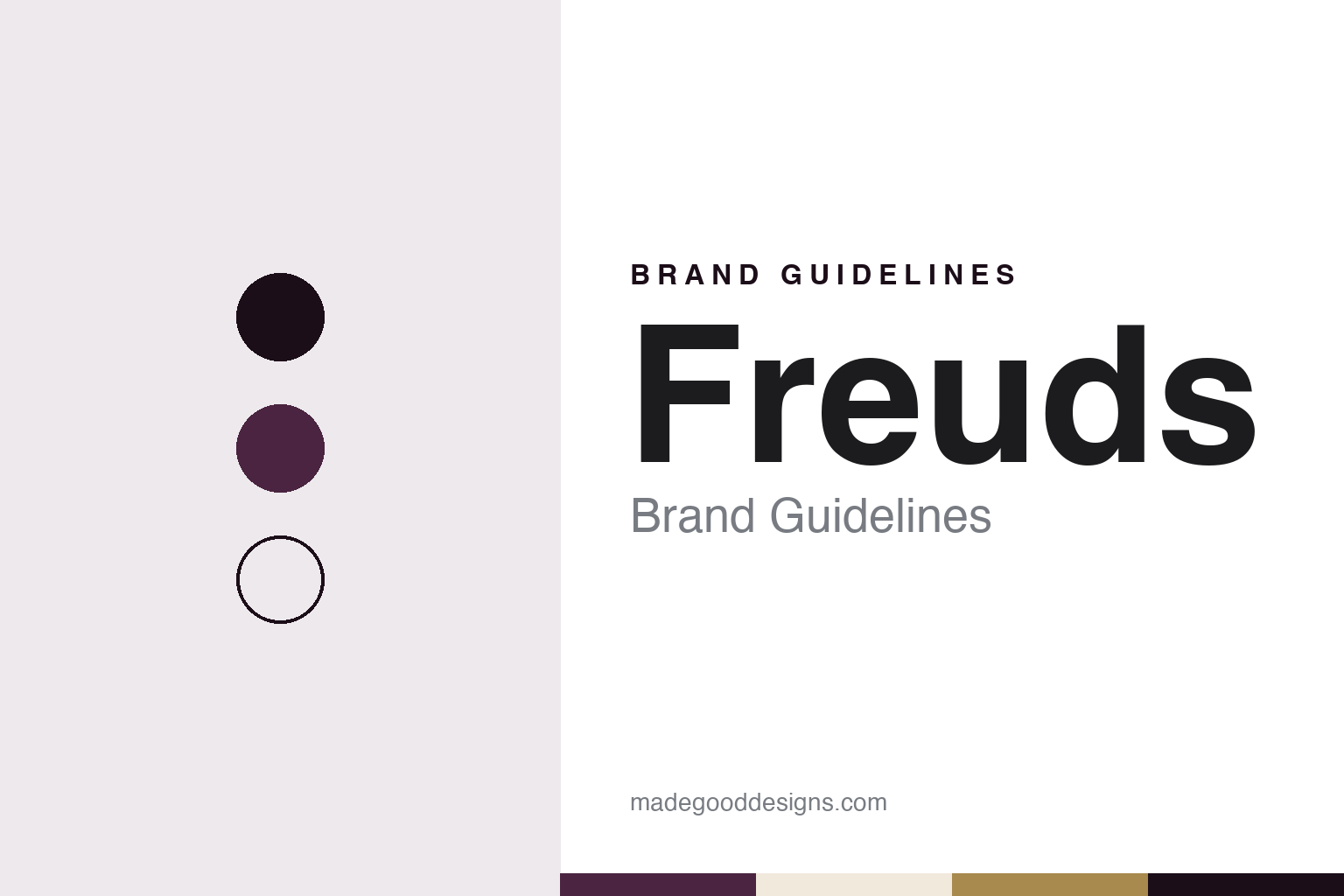
Freuds Brand Guidelines
Matthew Freud’s 1985 London agency and its two buybacks.
Aa
Two constants: a deep plum, cream and gold palette and a Theatrical serif register. Abstract homage — not a Freuds asset or mark; no logo or wordmark is reproduced.
Freud Communications
A London agency started in 1985.
Freuds is a London communications agency founded in 1985 by Matthew Freud, according to English Wikipedia, which records it under its formal name, Freud Communications. The agency marked forty years in 2025 with an anniversary feature, “40 Years of Love and Work,” in which it says it was started with a fax machine and a cat, and that its very early client was the Irish band Clannad. The company’s website still carries the Freud Communications name in its copyright line, while the trading name on its pages, offices and reports is simply Freuds.
Its ownership has twice passed to larger groups and twice returned to its founder. In 1994 the agency was acquired by the London advertising agency Abbott Mead Vickers BBDO, The Guardian reported in April 2011. After AMV was itself acquired by the American group Omnicom, Freud and his partners bought the agency out in 2001. In 2005 the French group Publicis Groupe took a 50.1% stake, and in April 2011 Freud bought back that majority holding, the newspaper reported, quoting the agency’s then chief executive as saying it looked forward to “our future as an independently owned company.” Publicis said at the time that it would keep serving its clients’ public relations needs through its own network, MSLGroup.
English Wikipedia gives June 2005 as the date of the Publicis purchase and adds that Freud Communications ran an office in New York until February 2009. The agency’s contact page now lists offices in London and in New York again, and names both as addresses of the wider Freuds Group. English Wikipedia adds that the agency bought the advertising agency DFGW in 2006, and that in 2011 it had a staff of more than two hundred and was ranked sixth in the UK by PR Week.
Colour
Entertainment, brands and campaigns.
For much of its history Freuds was associated with entertainment. Its anniversary feature says that in the 1980s, 1990s and early 2000s it was “predominantly known as an entertainment-led agency,” working on British television and film releases and premieres, and that it worked with BAFTA on its film, television and games awards for more than 20 years. The same feature lists hotel and restaurant openings it promoted, from Planet Hollywood in London in 1991 to the Rosewood London in 2013, and says the agency has also created venues of its own, the Bull and the Highway in Burford. Freuds says it has worked on television shows including Top Gear, The Grand Tour, Clarkson’s Farm and Welcome to Wrexham, and with arts institutions such as the National Portrait Gallery and The Old Vic.
Brand campaigns sit alongside that work. The Guardian listed Nike, Pepsi and Sony among the agency’s clients in 2011. Freuds itself says its relationship with Pepsi began in 1995 and ran for 15 years across PepsiCo brands, and it recalls a Concorde painted blue for Pepsi among its remembered stunts. Its current home page features work for Nike welcoming the England women’s football team home after a second consecutive European Championship win, and says Freuds played a key role in delivering the inaugural SXSW London.
The agency now presents itself under the line “The Art of Influence.” Its website lists services that run from corporate reputation and crisis management to brand communications, arts and culture, film and entertainment, sport, design and identity, and behaviour change. It publishes an annual B Corp report; the 2025 edition, presented as a scrolling microsite, sets out campaigns on sustainability, culture and charity, and names Matthew Freud as the agency’s chairman.
Typography
How communications agencies present themselves.
Public relations and communications agencies sell advice, so their visual identity is mostly carried by what they publish about themselves. Case-study pages, award announcements and research reports do much of the work that a product range does for a manufacturer. FleishmanHillard, for example, announced in October 2026 that a campaign it made with Icelandair had been named the top entry in PRovoke Media’s Global SABRE Awards, and the guides in this set treat such pages as the agency’s own dated claims.
Names change more often than logos in this field, usually after a merger. Founders’ surnames are joined, shortened or dropped, and a hyphen can disappear: FleishmanHillard closed up its two founders’ names in 2013, English Wikipedia says. When holding groups rearrange their agencies, one firm may also keep another as a dedicated brand inside it, as FleishmanHillard did with Porter Novelli in February 2026.
Many firms present their offices and their people rather than objects. Partner profiles, office lists and pages on how the firm is owned and run take the place of a catalogue; Brunswick’s site, for instance, gives a page to each of its offices and describes the firm as a partnership. Some firms also publish magazines or research series under their own names, which become a second visible identity beside the logo.
Ownership and leadership are recorded on corporate pages, in company registers and in trade and business press, and they change with each acquisition, investment or appointment. The guides in this set give office, staff and partner counts only as a dated source states them, name the owner as of that source, and treat colours and typefaces as an unofficial interpretation unless the agency has published its own.
Aa
A theatrical serif for a founder’s name. (Specimen set in Fraunces, a serif STAND-IN; NOT the Freuds logo or wordmark.)
Freuds Group
An agency with a family of companies.
Freuds sits at the centre of a small group. Its home page presents companion businesses under the Freuds name, among them Republic, an insight and research consultancy; Goals House, a programme of gatherings that Freuds says it builds, produces and runs up to ten times a year; and Atomized Studios, a content studio that makes documentaries, podcasts and digital content. The same page lists The One Nine Three Group, which works on corporate affairs, financial communications and investor relations, and Proud Robinson + Partners, a creative agency. Republic, the home page says, uses a multilingual team and both qualitative and quantitative research to show clients where their reputations stand; Goals House is described as a community of business leaders, activists, NGOs and entrepreneurs; and Proud Robinson + Partners describes a network of partners stretching, in its words, from Shanghai to San Francisco and from Mumbai to Miami.
Visually, the agency’s presence is built around its campaigns rather than a corporate system. The anniversary feature is organised in four chapters, celebration, change, connection and courage, and is illustrated with photographs of openings, premieres and events. The trading name is the founder’s surname in the plural, set beside the line “The Art of Influence,” and the agency describes its approach as turning insight into stories, stories into meaning and meaning into action.
For a design guide, Freuds shows how an agency can carry its founder’s name through changes of ownership and back to independence. Compare Publicis, which held a majority stake from 2005 to 2011, and Finsbury, another London communications firm. For this guide we use a deep plum, a warm cream and a muted gold with a serif, an unofficial interpretation; no product or logo is reproduced.
Explore & save
Keep Freuds’s identity on hand — save it to a board in the Made Good inspiration library.
Freuds identity set
Pin the Freuds deep plum, cream and gold palette and the Theatrical serif register to your own board.