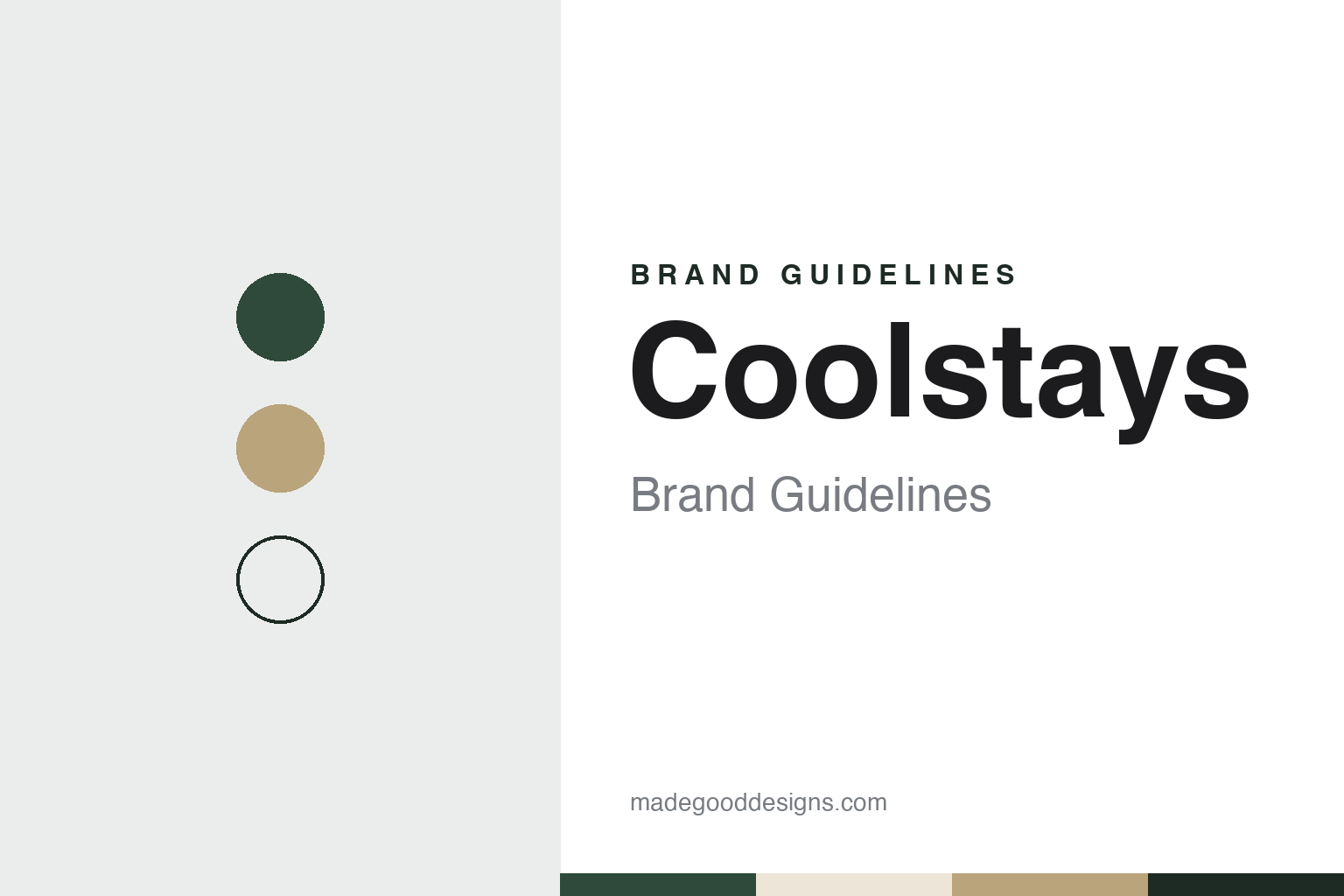
Coolstays Brand Guidelines
The Brighton site that hand-picks unusual places to stay.
Aa
Two constants: a woodland green, oak and lime-plaster palette and a characterful serif register. Abstract homage — not a Coolstays asset; no logo, photograph or property is reproduced.
Out of the ordinary
A small Brighton company built around one idea.
Coolstays is a British website for unusual places to stay: treehouses, shepherd’s huts, castles, converted churches, lighthouses and boutique hotels, chosen by hand rather than gathered in bulk. Its operating company, Coolstays Ltd, was incorporated on 10 October 2011 with a registered office in Brighton, according to the public register at Companies House. The site itself dates its launch to 2013: its page for property owners says that “since 2013” it has championed self-catering holiday lets that stand out, and the American travel site Islands reported in September 2025 that Coolstays was launched in the UK in 2013.
The founding story is a simple one. Islands, in an article by Carrie Back published on 4 September 2025, wrote that the founders built the site after growing frustrated with the run-of-the-mill properties they kept finding on mainstream rental platforms. The company tells the same story in its own words, saying it started Coolstays to make it effortless to uncover out-of-the-ordinary places to stay, with a curated collection in place of endless generic listings.
The company’s team page names four co-founders: Tim Wills, a director who looks after finance and marketing; Claire Wills, a director who handles communications with owners and journalists; John Stables, the sales director; and Nick Wills, the technical director, who is responsible for planning and building the platform. The directors are based in Brighton, while the wider team works from Manchester, Reading, Winchester, Newcastle and the Lake District, the same page says. Coolstays describes itself as a small, friendly crew, and its sales team spends its time finding new properties and helping owners make the most of the site.
Coolstays is UK-based, but its collection is not limited to Britain. The company says it lists over 3,000 unique places to stay across the UK, Europe and beyond, a figure Islands also gave in 2025, with sections for villas in Spain, boutique breaks in France and what it calls extraordinary escapes worldwide.
Colour
Hand-picked, and rated for green credentials.
What sets the brand apart is selection. The company says every listing is hand-picked for style, character or “a little quirk,” and it writes about supporting independent hosts and small businesses: from a couple running a barn conversion in Devon to a family looking after a villa in Tuscany, in its own examples. Islands listed the kind of places the site carries: restored vintage trains, a working windmill, a sixteenth-century fort overlooking the sea and an eighteenth-century jail turned into a hotel.
The same article picked out individual stays. It described Middleton Castle in the east of England, built in the fifteenth century, surrounded by a moat and sleeping up to 30 guests; a restored Gothic church in Somerset with stained glass and a cinema room; hotel suites carved into caves overlooking Murgia National Park in southern Italy; and the Peace and Quiet Hotel in Swedish Lapland, reached by dogsled, snowmobile or boat. English Wikipedia says that St John’s Church at East Horrington, in Somerset, a former church restored by owners who bought it in 2021, has been let as “the Gothic Church” through Coolstays since 2023.
Sustainability is the second strand of the identity. Coolstays rates properties for their eco-friendliness, and Islands reported that a five-leaf rating is the highest a property can receive on the site; its examples included the Treshnish Shepherd’s Hut on the Isle of Mull, the Wolf Wood Spa Treehouse in Devon and PYTCHAir, a converted Boeing 727 near Bristol run on solar power. The same article said the company is certified as carbon neutral and has partnerships with wildlife organisations.
Those partnerships run through GreenTheUK, which distributes funds from Coolstays to UK wildlife and woodland projects. For 2025 and 2026 the company says it chose four partnerships, including Plantlife’s work on temperate rainforest sites in the South West and the planting of 800 trees in Devon and North Yorkshire with the Royal Forestry Society.
Typography
How the category presents itself.
Holiday cottage agencies sell places rather than products, and their pages are built around the property photograph. A typical listing opens on an exterior shot of a cottage, a cabin or a tent in its landscape, followed by interiors, the view from the door and, increasingly, the hot tub or the log burner. The companies publish these images themselves, usually taken for the agency or supplied by the owner, and the look of a brand is set as much by that photography as by any logo.
Naming follows the way people plan a break. Agency menus are organised by region (the Lake District, Cornwall, the Scottish Highlands, North Wales) and by collection: dog-friendly cottages, cottages with a hot tub, coastal cottages, large houses for groups, last-minute breaks. Sykes Holiday Cottages, for example, lists collections of this kind alongside its region pages, and glamping and campsite platforms apply the same logic to shepherd’s huts, yurts, treehouses and pitches.
Search is the core interface. Guests enter a place, dates and party size, then filter by features and browse results as a list or on a map. Some groups now add conversational search: in February 2026 Awaze said it had launched an app within ChatGPT that starts with Cottages.com and returns live availability from a plain-language request.
Behind the consumer brands sits a second audience: property owners. Most agencies run separate pages that invite owners to let their home through them, and corporate sites describe group structures. Several of the names in this guide belong to larger groups: Cottages.com to Awaze, and Sykes Holiday Cottages to Forge Holiday Group, the parent brand Sykes launched in 2023. This guide sets out who founded each brand, who owns it, and what it publishes, and marks what rests only on the company’s own word.
Aa
A characterful serif for a collection of characterful places. (Specimen set in DM Serif Display, a serif STAND-IN; NOT the Coolstays logo.)
Coolstays
A marketing platform, not a booking agent.
Coolstays works differently from a classic letting agency. On its page for property owners it describes itself as “a marketing platform, not a booking agent”: owners pay a subscription, which can be annual, quarterly or monthly, and keep control of their own pricing, availability and guest communication. Guests contact owners through the site’s messaging system and then book directly with them, so owners always know who is coming to stay, the company says. It also says it never asks owners for exclusivity, leaving them free to advertise their property wherever they choose.
The brand leans on editorial coverage as much as on advertising. Its press page lists features in which national newspapers and magazines have picked out properties from the collection, among them The Times, The Guardian, The Independent and The i Paper, with recent subjects ranging from Scottish castles to remote cabins and lighthouse cottages. The company says its team knows every property in the collection and invites travel writers to ask for suggestions, while its website mixes search by location and collection with blog round-ups and a last-minute deals page.
The site’s structure follows the same idea. Visitors can search by place and dates, or browse collections built around a type of stay, such as treehouses, castles or quirky buildings. Each listing leads with photography of the property itself, from cabins in woodland to converted railway carriages, and the eco rating sits alongside the description. Owners, in turn, are offered a dedicated area of the site and an account manager who approves new properties and suggests improvements, according to the team page.
For a design guide, Coolstays shows how a small company can build a brand from curation: the promise is not size but character, and the voice is informal and personal. Compare Canopy & Stars, another British collection of hand-picked unusual stays, and Unique Cottages. For this guide we use a woodland green, a weathered oak and a lime-plaster cream with a serif, an unofficial interpretation; no product or logo is reproduced.
Explore & save
Keep Coolstays’s identity on hand — save it to a board in the Made Good inspiration library.
Coolstays identity set
Pin the Coolstays woodland green, oak and lime-plaster palette and the characterful serif register to your own board.