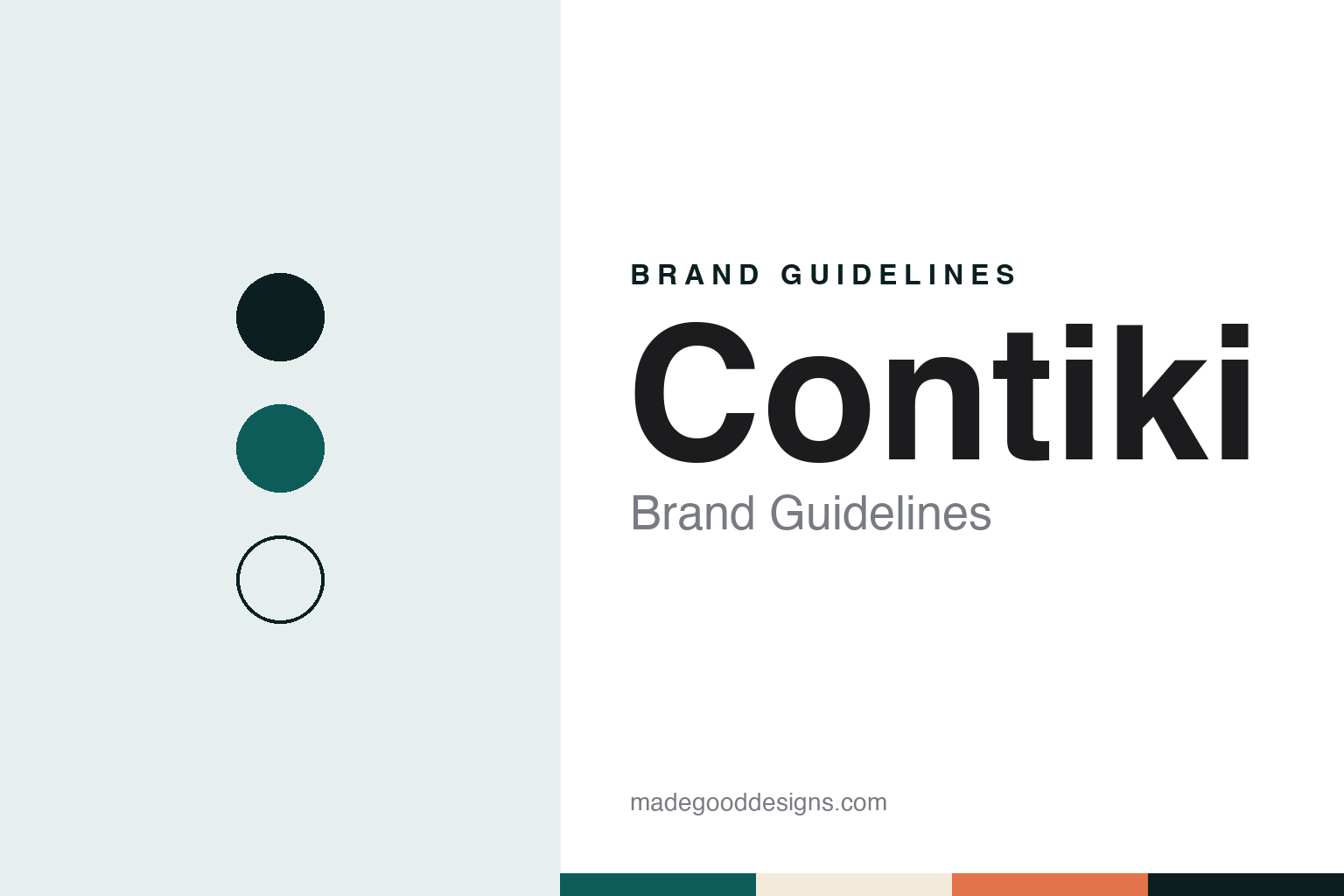
Contiki Brand Guidelines
A New Zealander’s 1962 minibus tour that became a youth travel brand.
Aa
Two constants: a lagoon teal and sunset coral palette and a bold road sans register. Abstract homage — not a Contiki product or mark; no logo, coach livery or brochure is reproduced.
Tiki Tours
A minibus, a dozen travellers and a borrowed charm.
Contiki began with one trip. English Wikipedia says that in 1962 the New Zealander John Anderson, newly arrived in England and short of funds, put a deposit on a minibus, gathered a group of fellow travellers and spent 12 weeks touring Europe with them. Its article on Anderson adds that he advertised for 11 other young Australasians to share the costs, and that the group travelled in a 12-seater Commer van they christened Tiki, after the Māori good-luck charm.
The first trip led to a second. When Anderson failed to sell the minibus at the end of the season, English Wikipedia says, he promoted the Europe trip again and this time fitted two trips into the summer season. Those early tours were booked by travellers aged 19 to 29, the same source says, which set the pattern of a company built around young people; the band later widened to the 18–35 range the brand still uses.
The name came out of a dispute. The tours first ran as Tiki Tours, in honour of the van, but English Wikipedia says the New Zealand Tourist Board challenged Anderson over that name, and he changed it to Contiki, with the “con” taken from the Continent. The Contiki Tours article describes the word as a blend of “Continent” and “Tiki”, and notes that “tiki tour” is also New Zealand slang for taking the long way round to a destination.
The business soon became a company. Contiki Travel Ltd was established in the UK in 1966, English Wikipedia says, and by the end of the 1960s it had moved beyond its European coach tours to run ski programmes and trips in India and the Middle East. In the 1980s, according to the article on Anderson, the company diversified away from touring, building hotel resorts in Queenstown and on the Great Barrier Reef and buying Fullers Ferries, and by the middle of the decade it was run from a headquarters in Hong Kong.
Colour
From a founder’s company to The Travel Corporation.
Contiki’s ownership changed through the 1980s. English Wikipedia’s article on Anderson says he sold down his holding early in the decade so that fellow directors could invest, that Omnicorp, a company controlled by Lloyd Morrison, bought a 50 per cent stake in 1985, and that Anderson sold his remaining shares in 1989. The Contiki Tours article says the company was acquired by The Travel Corporation in the mid-1980s.
The Travel Corporation, known as TTC, was a family-owned group. Travel Weekly reported in February 2019 that TTC traced its foundation to the fishing village of Paternoster in South Africa’s Western Cape in 1920, and that its youth brands then included Contiki and Busabout, alongside escorted-touring names such as Trafalgar, AAT Kings and Insight Vacations. TTC’s own site still describes the group as “driven by service since 1920”.
That family ownership ended in 2024. Travelnews in South Africa reported on 17 July 2024 that TTC had agreed to sell 18 of its brands, among them Trafalgar, Uniworld, Contiki and Insight Vacations, to funds managed by Apollo, after 104 years of Tollman family ownership, while the Red Carnation Hotel Collection stayed with the family. Canadian Lawyer’s deals listing records the transaction as closed on 31 October 2024, and English Wikipedia now describes Contiki as a subsidiary of TTC owned by funds managed by Apollo Global Management.
The trips themselves kept spreading. English Wikipedia says Contiki offers more than 350 tours in more than 75 countries, that it launched safari trips in sub-Saharan Africa in 2018, added South Korea in 2023 and the Philippines in 2024. The same source says the company owns lodgings in Europe, including the Château de Cruix, a 16th-century castle in the Beaujolais wine region, and the Gasthof Schoneck in the Austrian Tyrol.
Typography
How tour operators present themselves.
Escorted and adventure tour operators sell a trip rather than a single product: a fixed route, a group of strangers travelling together and a guide who stays with them. Some build that around coaches and hotels on long touring circuits; others around small groups on trails, local buses and homestays. The operators in this guide sit at different points along that range, and their brands are built to signal which kind of trip a traveller is booking.
Group size and the guide are central to how these companies describe themselves. Intrepid Travel says its groups are usually 12 to 14 people with a local leader, while G Adventures sorts its departures into named travel styles, from Classic to Local Living and trips for travellers aged 18 to 39. These style names do the work that a range name does for a manufacturer: they let a catalogue of hundreds of itineraries be read at a glance.
Brochure and website naming in this sector tends to be plain and descriptive. Trips are usually titled by region, route or length, and the brand voice lives in the surrounding copy and in the names of collections, partnerships and community programmes. Some operators also run foundations or work with non-profit partners whose names appear beside the trips; Intrepid has The Intrepid Foundation, and G Adventures works with the Planeterra Foundation.
The corporate pages tell a second story, about founders and owners. Intrepid Travel began in Melbourne in 1989 and G Adventures in Toronto in 1990; both have since passed through outside investors, and Intrepid through a joint venture and a series of acquisitions. This guide sets out who founded each brand, who owns it now and when that changed, as dated sources report it, and keeps each company’s own claims clearly marked as its own.
Aa
A bold, rounded sans in the spirit of a coach-window sticker. (Specimen set in Archivo, a sans STAND-IN; NOT the Contiki logo.)
GO WANDER
A brand rebuilt around travel styles.
Contiki’s reputation has shifted with its travellers. English Wikipedia says its tours historically had a reputation for partying, and that it also runs cultural trips with less focus on alcohol that are more popular with Generation Z. The company’s own pages now sort trips into named Travel Styles, among them Contiki Originals, Contiki Lite, Contiki Highlights and Contiki Outdoors, and describe a team of Trip Leaders, road crew, sailing crew, safari guides and local guides.
In October 2026 B&T reported that Contiki had launched a new brand platform, GO WANDER, developed with Publicis Australia and Havas Media.
The company’s own about page presents Contiki as a brand for 18–35s and points to the year 1962 as its starting point. The same page lists the TTC-wide MAKE TRAVEL MATTER experiences on its trips, and the company says it worked with World Animal Protection on its animal welfare policy.
For a design guide, Contiki shows how a founder’s story, a name built from a place and a charm, and a recent repositioning can sit in one identity aimed at a fixed age band. Compare its sister brand Trafalgar, also part of TTC, and another youth touring name, Topdeck. For this guide we use lagoon teal, night-bus ink and sunset coral with a bold sans, an unofficial interpretation; no product or logo is reproduced.
Explore & save
Keep Contiki’s identity on hand — save it to a board in the Made Good inspiration library.
Contiki identity set
Pin the Contiki lagoon teal and sunset coral palette and the bold road sans register to your own board.