More Brand Guidelines
Trinethra’s 1986 roots, Aditya Birla’s 2007 rebrand, Samara and Amazon.
Aa
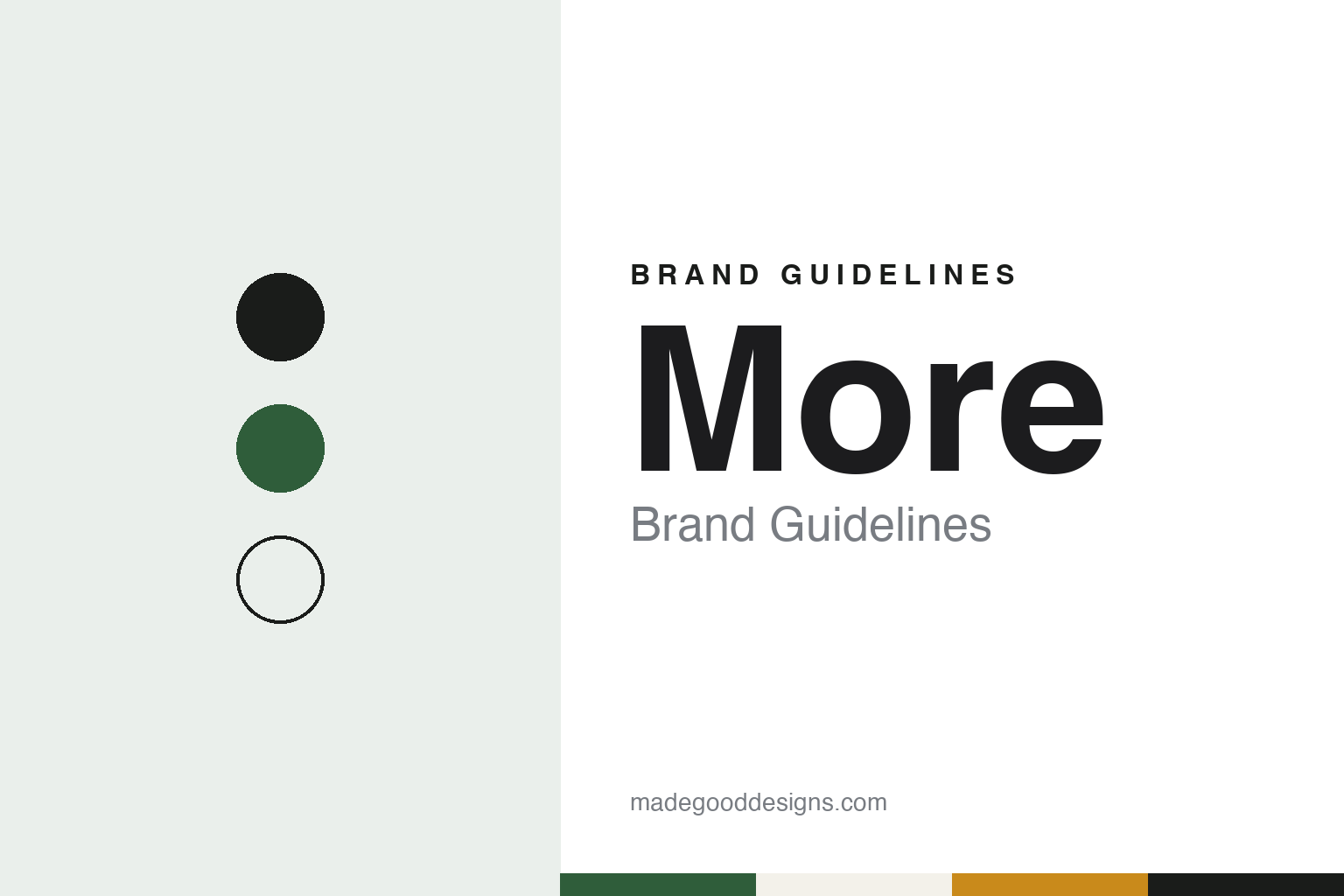
Two constants: a leaf green, rice white and turmeric palette and a lower-case sans register. Abstract homage — not a More product or mark; no logo, store front or pack is reproduced.
Trinethra
A Hyderabad grocer bought by a conglomerate.
The chain now called More began in Hyderabad in 1986 as Trinethra. English Wikipedia names its founder as K Anjaneyulu, who set up Trinethra Super Retail, and the company’s own history page opens with the same year and calls it “our roots.” Trinethra grew into a regional supermarket business in the south of India.
In 2007 the Aditya Birla Group bought it. English Wikipedia says Trinethra was the group’s first retail acquisition and that it then had more than 172 stores across four states: Andhra Pradesh, Karnataka, Tamil Nadu and Kerala. Two names were in use at the time, it adds: Trinethra in Tamil Nadu and Andhra Pradesh, and Fabmall in Karnataka and Kerala. The new owner, Aditya Birla Retail Limited, replaced both with a single brand. The company’s history page dates that change to 2007, calls it the start of “the ‘more’ era” and gives the store count as 172.
The name is short and deliberately plain. The company writes it in lower case, as “more,” on its website and app, and pairs it with the line “your supermarket.” This guide uses the capitalised form, More, for readability, and keeps the full company name, More Retail Private Limited, where the legal entity is meant.
Growth under the Birla group came through new formats and one more purchase. English Wikipedia says More Hypermarket opened in Baroda and Mysore in 2008, and that by 2012 the chain had grown to 635 stores. In 2015, it adds, Aditya Birla Retail acquired Total Super Stores from Jubilant Agri and Consumer Products.
Colour
Samara Capital, Amazon and a regulator’s approval.
In September 2018 the Aditya Birla Group agreed to sell the chain. Business Today reported on 19 September 2018 that the private-equity firm Samara Capital and Amazon had signed a deal to acquire Aditya Birla Retail, which then owned and ran 575 More stores. Samara would hold 51 per cent through its alternative investment fund, the magazine said, and Amazon’s investment arm, Amazon.com NV Investment Holdings, the other 49 per cent, subject to clearance from the Competition Commission of India. Until August 2018, Business Today added, Samara had been in talks with Amazon and Goldman Sachs about a three-way consortium, but Goldman Sachs left the group. Citing The Economic Times, it said the purchase would run through an existing facility-management back-end company, so that Aditya Birla Retail would not need separate state approvals to operate More stores under India’s rules on foreign investment in multi-brand retail. The magazine noted that the deal was Amazon’s second direct investment in Indian store retail, after it took a 5 per cent stake in the department-store chain Shoppers Stop in September 2017.
That clearance came in January 2019. The News Minute reported on 19 January 2019 that the Competition Commission of India had approved, the previous day, the acquisition of 99.99 per cent of Aditya Birla Retail by Witzig Advisory Services, a company controlled by Samara Capital, and, separately, the acquisition of 49 per cent of Witzig by the Amazon subsidiary. At that point, the report said, the business ran 532 supermarkets and 20 hypermarkets. English Wikipedia says the company was then renamed More Retail Private Limited and is no longer part of the Aditya Birla Group; the company’s own history says that in 2019 More Retail “came under the leadership of More Consumer Brands Private Limited.”
The structure matters for the brand. Amazon holds its stake through Witzig rather than owning More stores directly, and the stores continue to trade under the More name. English Wikipedia describes the chain as a food and grocery retailer with two formats, More Supermarket and More Hypermarket, plus an online grocery service through its app, and places its headquarters in Mumbai, with offices in Kolkata and Bengaluru.
Typography
How Indian chains present themselves.
India’s large store chains present themselves in quite different ways, and the differences start with where the stores stand. Department-store groups have long followed the shopping mall: afaqs! reported in 2019 that Shoppers Stop had opened a 50,000-square-foot store in Gurugram stocked with premium labels. DMart took the opposite route, Outlook Business reported in 2022, owning the land under its standalone supermarkets rather than leasing space in malls.
The festival calendar shapes the year for these retailers. Shoppers Stop’s first general manager writes in his memoir that the team hurried to name and open the original Andheri store in 1991 so that it could trade before Diwali. Advertising matters as much as the calendar: when Shoppers Stop changed its logo in 2008, afaqs! reported, the new identity arrived with seven commercials, a press campaign and outdoor posters, with creative work by Contract Advertising.
Own labels are a second thread. In August 2025 Indian Retailer reported that Shoppers Stop’s private brands and its value-fashion format, Intune, were growing alongside the third-party brands in its department stores; Forbes India wrote in 2017 that DMart meant to work harder on private labels of its own. Names are often simple phrases: Shoppers Stop’s, the same memoir says, was suggested by a supermarket name seen in Boston.
Most of the larger chains also keep corporate pages that set out their founders, parent groups and stock-exchange listings, since several trade on the BSE and NSE in Mumbai. This guide uses those pages alongside dated press, and marks clearly where a fact rests on the company’s own word.
Aa
A rounded lower-case sans for a name the company writes as “more.” (Specimen set in DM Sans, a sans STAND-IN; NOT the More logo.)
More
An app, a membership and own labels.
Under its new owners the chain has grown its store count and moved more of its business onto phones. The company’s history page says More reached 500 stores in 2020 and passed 800 in 2021; English Wikipedia gives a figure of more than 900 stores for 2022.
The company says it launched its own grocery delivery app in 2022, moved its store and billing systems onto a cloud platform it built in-house in 2023. As of November 2026, its website describes cashback in more+ points on every order and a store finder covering neighbourhoods such as Salt Lake and Rajarhat in Kolkata and Sholinganallur in Chennai.
Own labels are a visible part of the offer. The website groups its in-house collections under names such as Premium Staples, Value Staples, Cleaning Essentials and Ready To Eat, alongside fresh produce.
The brand’s history is mostly a history of owners: a Hyderabad founder, an industrial conglomerate that renamed the business, and a private-equity and e-commerce partnership that has run it since 2019. Through each change, the shop sign has stayed the same short word.
For a design guide, More shows how a one-word, lower-case name can survive two changes of ownership and replace two older regional banners. Compare Spencer’s, another grocer that rebuilt itself around a single name, and DMart. For this guide we use a leaf green, rice white and a turmeric yellow with a sans, an unofficial interpretation; no product or logo is reproduced.
Explore & save
Keep More’s identity on hand — save it to a board in the Made Good inspiration library.
More identity set
Save the More leaf green, rice white and turmeric palette and the lower-case sans register to your own board.