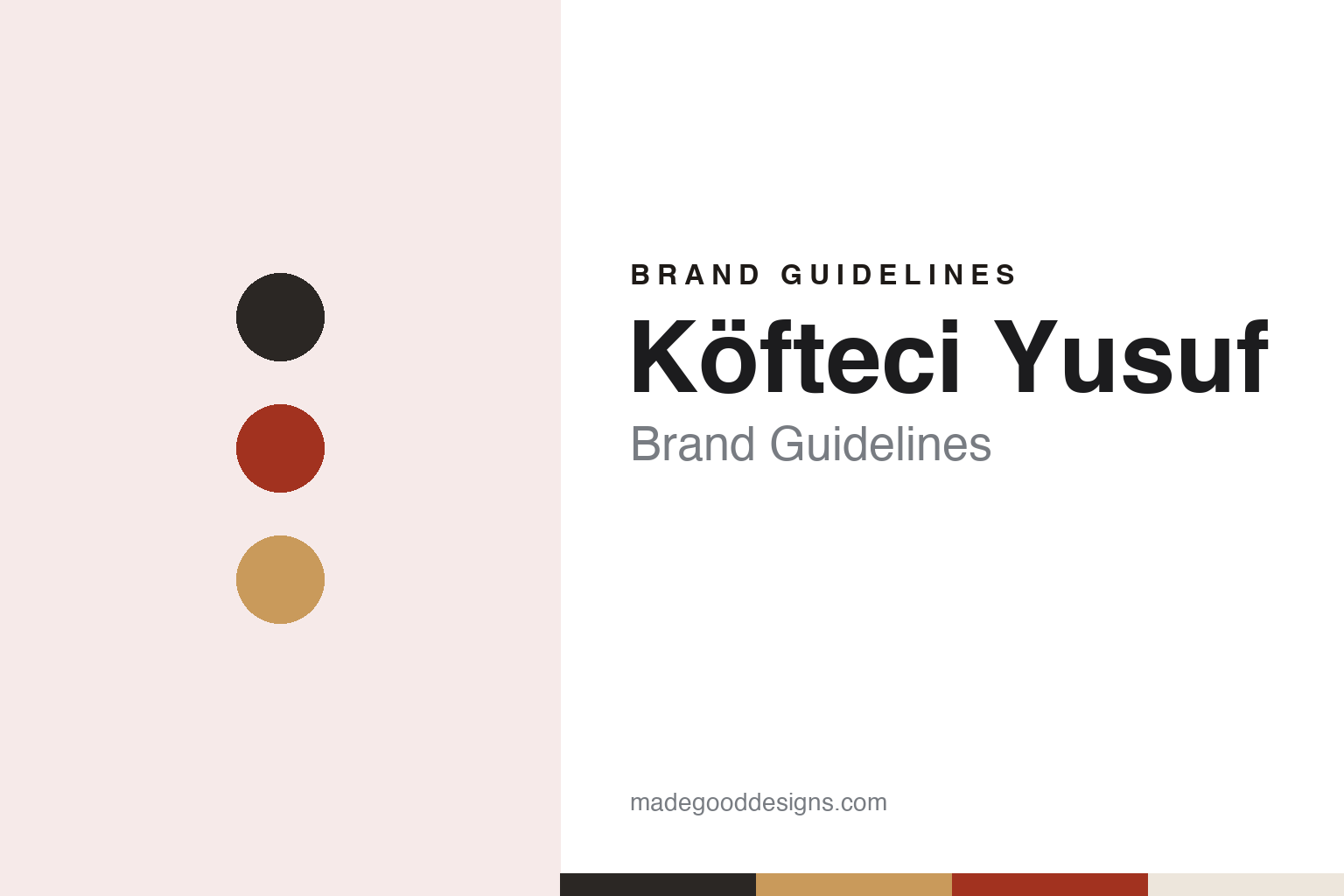
Köfteci Yusuf Brand Guidelines
The İznik köfte shop of 1996 that owns every branch.
Aa
Two constants: a charcoal, ember and crust palette and a sturdy grotesque register. Abstract homage — not a Köfteci Yusuf product or mark; no logo, sign or packaging is reproduced.
İznik, 1996
A four-table shop on a road used by lorries.
Köfteci Yusuf began in İznik, a lakeside town in Bursa province in north-western Turkey, in 1996. Turkish Wikipedia names the founder as Yusuf Akkaş and describes the first premises as a lokanta, a simple Turkish eatery, serving traditional grilled köfte. A column in the İzmir daily Yeni Asır in March 2017 described the start as a small shop with four tables that Akkaş opened with his family, and Ekonomist reported in October 2017 that the business had been set up in İznik as a butcher’s before it grew into a restaurant chain.
The name is plain Turkish: “Köfteci” means a köfte maker or köfte shop, and “Yusuf” is the founder’s first name. In an interview reported by the news site Herbiremlak in November 2026, Akkaş said his first shop stood on a route heavily used by lorries and found customers quickly. A second branch followed at the Orhangazi–Yeniköy junction on the road to Istanbul, which he said helped travellers from Istanbul get to know the name, and then a branch in the centre of Bursa reached a wider public.
Turkish Wikipedia dates that move out of İznik to 2003 and says the restaurants switched to a self-service format at the same time. By 2006, it says, the number of branches in Bursa had grown and the company had begun to formalise its structure.
The founder’s background is part of how the press tells the story. Yeni Asır wrote that Akkaş was a graduate of a tourism and hotel vocational school in Bursa who had worked in farming, as a café waiter and in cheese-making before turning to köfte. He is described in 2026 coverage as the company’s founder and owner, and a 2021 report named him as chairman of its board. The Yeni Asır column was written after Akkaş spoke at a weekly Wednesday meeting of the İzmir industrialists’ and businesspeople’s association, where he told his own story of the company.
Colour
Charcoal-grilled köfte, a meat plant and butcher’s counters.
The menu is built around one dish: grilled köfte, small hand-shaped meatballs. Ekonomist reported in 2017 that the chain’s köfte were made from a medium-fat mix of beef and lamb with only bread, chilli flakes, white onion and salt added, and that they were pressed by hand and turned often over a charcoal grill. In the 2026 interview Akkaş listed the core ingredients as beef, onion, bread, salt and chilli flakes, and said nothing beyond what is printed on the label could be used.
Production sits inside the company. Turkish Wikipedia says Köfteci Yusuf registered its logo in 2006, set up its own meat processing and packing facilities in 2013 to centralise production, and in the same year added butcher’s counters to its restaurants and began selling packaged meat. Ekonomist described a factory where about 250 women shaped köfte by hand in the evening for sale in the restaurants the next day. It said roughly half of the meat came from farms within the business and the rest from livestock farmers and other producers across a region stretching from İznik to Balıkesir, Eskişehir and Çanakkale.
The company has also tried other names under the same roof. Yeni Asır listed DönerY, Burgerage, Ciğerce and Kamenta among its own brands in 2017, and Ekonomist counted three döner branches that year, in Bursa, Kocaeli and İzmir, alongside 32 Köfteci Yusuf restaurants. Turkish Wikipedia adds YusuFırın, a bakery line, and Yusuf Burger, both introduced at some branches in 2018, and says the company began selling packaged meat and charcuterie online in 2020.
Typography
How Turkish chains present themselves.
Turkish café, bakery, kebab and casual-dining chains tend to build their names around a single dish or a single place. Some carry a city in the name, as Mado does with Maraş, the older name of Kahramanmaraş; others carry the food itself, as Simit Sarayı does with the sesame-covered simit. On their own websites the companies present the dish first and the shop second, with menus organised by named dishes such as künefe, baklava, simit or döner rather than by abstract product lines.
Many of these chains grew by moving street food indoors. Hürriyet Daily News wrote in 2013 that simit, once sold from carts, had become a large business run by chain restaurants, and the companies themselves describe their shopfronts as cafés, bakeries or restaurants with seating, counters and displays that make the food the main sight.
Franchising carries the brands abroad. Turkish chains publish franchise pages and lists of foreign branches, and some work through master franchisees that run a whole region; Daily Sabah reported in 2017 that a Saudi retail group had held such a franchise for Simit Sarayı across the Middle East and North Africa since 2014. Shops abroad often sit in malls and on main shopping streets, according to the companies’ own branch lists.
Ownership is usually described plainly on corporate pages: a family company, a holding company behind several brands, or a founding partnership that later sold a minority stake. This guide sets out who founded each brand, who owns it now and where its food is made, using dated press reports where they exist and marking what rests only on the company’s own word.
Aa
A sturdy grotesque for a roadside grill name. (Specimen set in Archivo, a sans STAND-IN; NOT the Köfteci Yusuf logo.)
Köfteci Yusuf
A Bursa chain that runs its own branches.
Growth came in steps. Turkish Wikipedia says the chain moved beyond the Marmara region from 2015, opening in Eskişehir and Afyonkarahisar, and opened its first Istanbul branch, in Pendik, in 2016, when its staff passed 1,000. Yeni Asır counted 30 restaurants in 10 provinces in March 2017, and Ekonomist counted 35 restaurants and about 7,000 staff in October 2017. Mynet Finans reported in July 2021 that the 200th branch had opened on Girne Boulevard in Karşıyaka, İzmir, giving 200 locations in 35 provinces and more than 10,000 staff. As of November 2026, Turkish Wikipedia gives 303 branches in 43 provinces.
The way the chain grows is part of its identity. Turkish Wikipedia says the company has expanded without a franchising model, on its own investment. In the 2026 interview Akkaş described a business that produces its own meat in volume and sells it in its own shops, with no intermediary in between, and said the company keeps its operation simple. He added that it is open to offers to open branches in shopping centres, but weighs each one on a feasibility study rather than accepting every proposal.
The name itself does much of the brand work: a trade word and a first name, carried unchanged from a four-table shop in İznik to a national chain. The logo that carries it has been registered since 2006, Turkish Wikipedia says, and since 2013 the restaurants have also housed butcher’s counters selling packaged meat.
For a design guide, Köfteci Yusuf shows how a single dish and a founder’s first name can carry a chain from one small town to hundreds of company-run branches. Compare it with Tavuk Dünyası, a franchised chicken chain from Istanbul, and HD İskender, another Turkish grill chain. For this guide we use charcoal grey, ember red and bread-crust tan with a sturdy sans, an unofficial interpretation; no product or logo is reproduced.
Explore & save
Keep Köfteci Yusuf’s identity on hand — save it to a board in the Made Good inspiration library.
Köfteci Yusuf identity set
Pin the Köfteci Yusuf charcoal, ember and crust palette and the sturdy grotesque register to your own board.
Source & notes
Frequently Asked Questions
What font can I use to match the Köfteci Yusuf look?
This guide describes Köfteci Yusuf’s type as “A sturdy grotesque for a roadside grill name”. Its type specimen is set in Archivo from Google Fonts as a stand-in; Archivo is not Köfteci Yusuf’s own lettering.
What colours are in the Köfteci Yusuf palette?
This guide’s Köfteci Yusuf palette is Charcoal grill #2B2724, Ember red #A2321F, Bread crust #C99A5B, Wood smoke #5A514A and Ash white #EDE6DC. The tones are the guide’s own unofficial interpretation, not official Köfteci Yusuf hex codes.
When was Köfteci Yusuf founded?
Köfteci Yusuf was founded in 1996, in İznik, Bursa province, Turkey.
Who founded Köfteci Yusuf?
Köfteci Yusuf was founded by Yusuf Akkaş in 1996. Köfteci Yusuf is known for Charcoal-grilled köfte, own meat plant.


