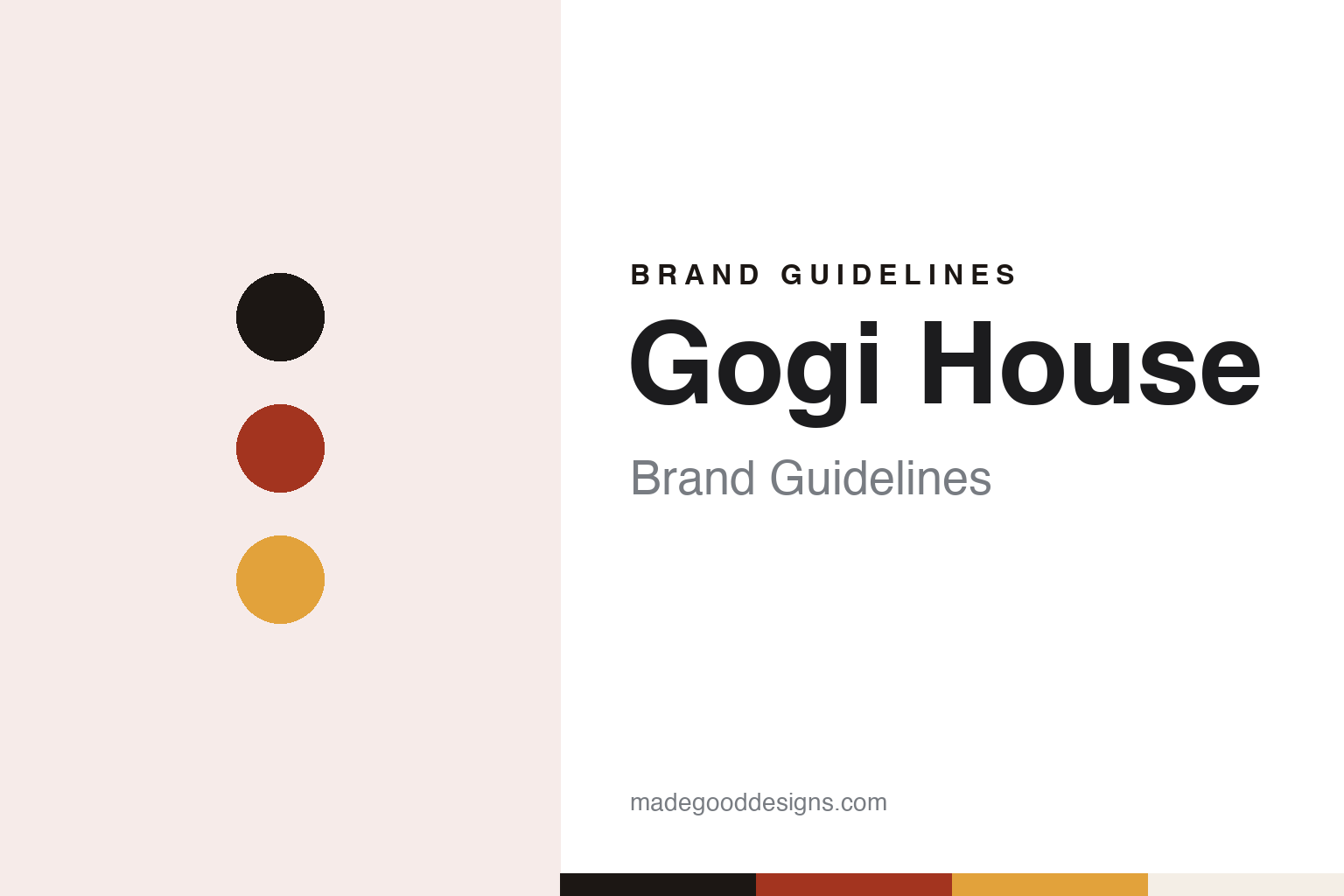
Gogi House Brand Guidelines
Golden Gate’s Korean barbecue chain, from a Hanoi hotpot start.
Aa
Two constants: a charcoal, ember red and amber palette and a bold grotesque sans register. Abstract homage — not a Gogi House product or mark; no sign, logo or menu is reproduced.
From Ashima to Gogi
A Hanoi hotpot restaurant, then a family of chains.
Gogi House is a Korean barbecue chain, and it is one of the restaurant brands of Golden Gate, the Hanoi company whose full name is Golden Gate Group Joint Stock Company. To understand the brand, it helps to start with the group, because Gogi House did not begin as a stand-alone business. It was created inside a company that already ran several restaurant concepts, and it has always been presented as one of a set.
Golden Gate began in 2005. In that year, VnExpress International reported in July 2018, the entrepreneur Đào Thế Vinh, then in his early thirties, opened an Ashima mushroom hotpot restaurant on Phan Đình Phùng Street in Hanoi with the help of two friends, after coming across a mushroom hotpot dish on a trip to Yunnan in China. The same report says Ashima grew to six restaurants within two years, three of them in Ho Chi Minh City. The company’s own website still tells the story the same way: it says Golden Gate was founded in 2005 with that Ashima restaurant on Phan Đình Phùng. A September 2024 report in the Vietnam Investment Review names Đào Thế Vinh as Golden Gate’s chief executive.
Outside money shaped what came next. According to VnExpress International, the Vietnamese private equity firm Mekong Capital invested in the operating company, then known as Hoàng Thành Joint Stock Company, and helped turn it into an operator of several restaurant concepts; Mekong Capital sold its holding to Standard Chartered Private Equity in 2014. In 2010 the group added the conveyor-belt hotpot chain Kichi-Kichi and the Sumo BBQ grill-and-hotpot chain.
Gogi House arrived in the next wave. VnExpress International describes 2013 as the start of the group’s strongest period: that year Golden Gate set up a food distribution and processing centre in Hanoi and introduced several new restaurant brands, “notably Gogi House,” together with the Vietnamese street-food concept 37th Street and the lamb restaurant Ba Con Cừu. That places the Korean barbecue chain in Golden Gate’s 2013 expansion.
Colour
Seoul-style barbecue, as the company describes it.
On its website the brand describes itself as a Korean barbecue restaurant, and the company says a visit is meant to feel like a trip to the barbecue restaurants of Seoul. It says the menu offers more than 20 kinds of marinated meat, alongside dishes it singles out such as bibimbap, kimchi soup and a range of Korean-style hotpots. These are the company’s own descriptions of its menu, and the brand’s website writes the name with a capital second G, as GoGi House, a styling the Vietnamese press often follows.
Gogi House also fits a pattern that the press has noted in Golden Gate as a whole. In a January 2017 article on the group’s own website, Golden Gate’s strategy was described as building restaurant concepts of its own, modelled on dining styles from abroad and then adjusted for urban Vietnamese diners. That article lists the group’s Japanese-style concepts, its American-style Cowboy Jack’s and its Vietnamese-style 37th Street next to Gogi House, which it groups with the Korean-style restaurants. It also notes that a small number of the group’s brands, such as Crystal Jade from Singapore and Osaka Osho from Japan, were taken on as franchises rather than created in-house. Gogi House sits on the home-grown side of that line.
The 2018 VnExpress International report made the same point from the outside. It said many diners did not realise that grill and hotpot names such as Kichi-Kichi, Gogi House and Sumo BBQ were Vietnamese-founded and Vietnamese-run, and it contrasted Golden Gate’s approach of creating “made-in-Vietnam” brands with rivals that relied more on buying franchises.
Typography
Design and documentation.
Vietnam’s café and restaurant chains grew up in a country with a deep street culture of coffee, tea and noodle soup, and most of them present themselves through the shop itself. A chain’s identity is carried by its shopfronts and seating, by the cup a drink is handed over in, and by the bags of ground coffee and boxes of tea sold at the counter or in supermarkets.
Menus are built around named drinks and dishes rather than abstract promises. Coffee chains list house blends, iced coffee with condensed milk and ice-blended drinks; tea chains list fruit teas, milk teas and loose-leaf varieties from Vietnam’s highland growing areas; phở, pizza and hot-pot chains name their broths, toppings and set menus. Store formats vary too, from large flagship cafés to kiosks placed inside supermarkets, and the press has followed which formats the chains keep and which they close.
Ownership is often part of the story. Several of the chains in this set belong to wider groups: Highlands Coffee sits under SuperFoods, in which the Philippine group Jollibee Foods holds a stake, alongside Phở 24; Phúc Long is a subsidiary of the Vietnamese consumer group Masan; others covered here belong to the restaurant group Golden Gate or the retail group Seedcom, as their own guides set out. Store counts change quickly, so each guide gives its figures with the date and the publication that reported them.
Each guide sets out what can be checked about a brand from independent, dated reporting by publications such as VnExpress International, Tuoi Tre News, Viet Nam News and Vietnam Investment Review: who founded it, who owns it, how it trades and what its stores and products look like, with company statements marked as the company’s own word.
Aa
A bold grotesque sans for a grill-house register. (Specimen set in Archivo, a sans STAND-IN; NOT the Gogi House logo.)
Gogi House
One brand in a group of more than 40.
Ownership of the parent company has changed over the years. In March 2022, The Investor reported that a 35.95% stake in Golden Gate had passed to three Singapore-based investors, Temasek, Seatown Private Capital Master Fund and Periwinkle Pte Ltd. According to the report, the stake was made up of a 32.92% holding sold by Prosperity Food Concepts Pte Ltd and a 3.03% stake from two of Golden Gate’s co-founders, and the transaction was reported to Vietnam’s State Securities Commission. The same article illustrated its story with a photograph of Korean barbecue at a Gogi House restaurant.
The group has kept adding brands. In April 2024, VnExpress International described Golden Gate as running over 20 food and drink brands with about 400 outlets. By April 2025 the same publication put the figure at over 40 brands and nearly 500 restaurants. Part of that growth came from outside the restaurant trade: Tuoi Tre News reported in April 2025 that Golden Gate had completed the purchase of a 99.98% stake in the operator of the coffee chain The Coffee House on 8 January 2025, according to the group’s audited 2024 financial report. That report named GoGi House, Manwah and Kichi-Kichi among the group’s chains. In June 2026, The Investor reported that the company’s website listed 40 food and drink brands across more than 500 outlets.
For the brand itself, that means Gogi House is easier to read as part of a portfolio than in isolation. The group’s website sorts its brands into hotpot, barbecue, Japanese, Western and drinks concepts, and promotes a single Golden Gate app with offers that it says apply at more than 450 of its restaurants.
For a design guide, Gogi House shows how a restaurant group can give each cuisine its own name and look while running the chains as one system. Compare Kichi-Kichi, the group’s conveyor-belt hotpot chain, and Manwah, its Taiwanese hotpot chain. For this guide we use charcoal, an ember red and a warm amber with a sans, an unofficial interpretation; no product or logo is reproduced.
Explore & save
Keep Gogi House’s identity on hand — save it to a board in the Made Good inspiration library.
Gogi House identity set
Pin the Gogi House charcoal, ember red and amber palette and the bold grotesque sans register to your own board.
Source & notes
Frequently Asked Questions
What font can I use to match the Gogi House look?
This guide describes Gogi House’s type as “A bold grotesque sans for a grill-house register”. Its type specimen is set in Archivo from Google Fonts as a stand-in; Archivo is not Gogi House’s own lettering.
What colours are in the Gogi House palette?
This guide’s Gogi House palette is Charcoal #1C1714, Ember red #A3341F, Grill amber #E2A23B, Rice paper #F4EEE6 and Smoke grey #6E6560. The tones are the guide’s own unofficial interpretation, not official Gogi House hex codes.
Who owns Gogi House?
Gogi House is owned by Golden Gate Group, Hanoi (founded 2005).


