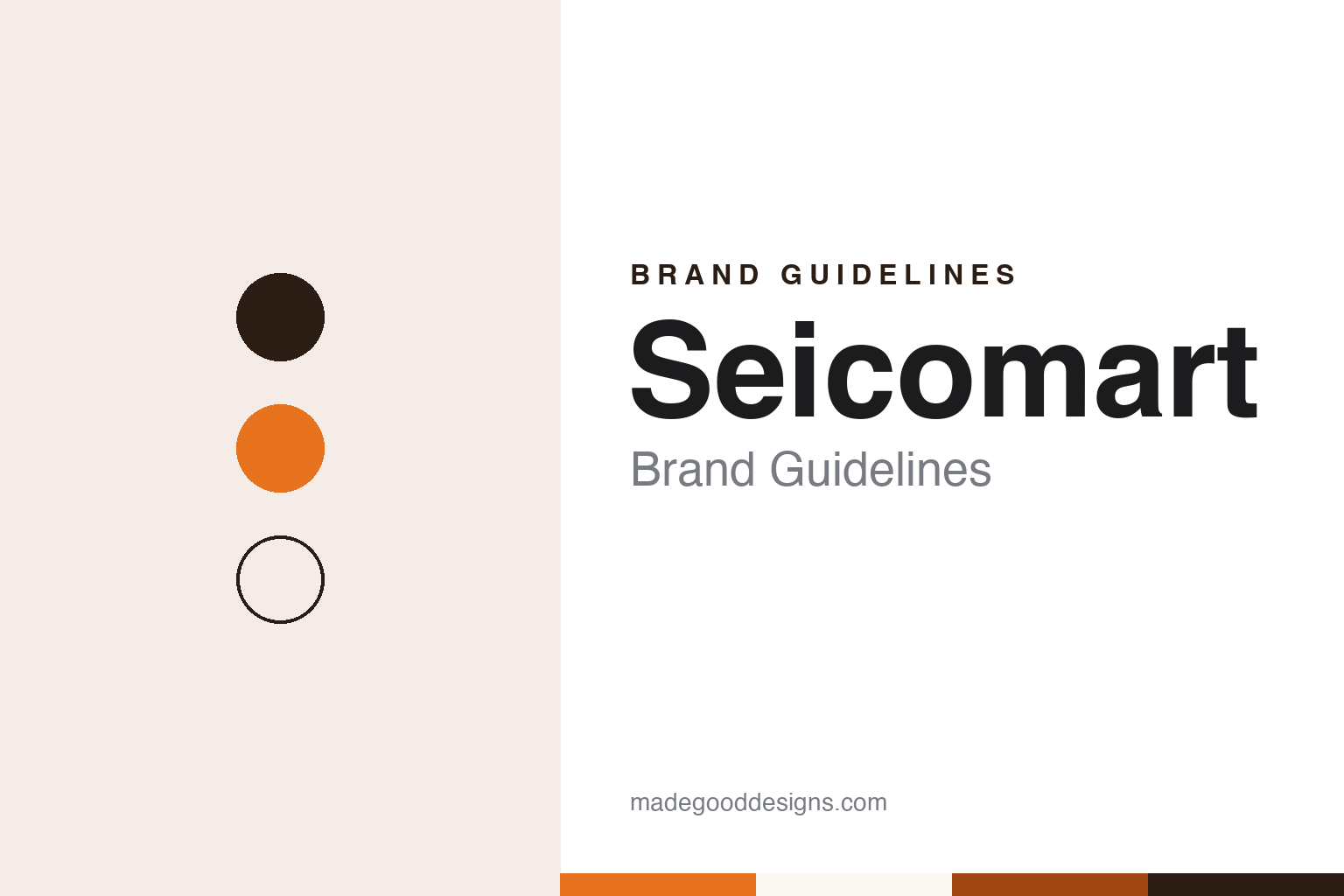
Seicomart Brand Guidelines
Sapporo’s 1971 convenience chain, under an orange sign.
Aa
Two constants: an orange, white and deep brown palette and a gothic sans register. Abstract homage — not a Seicomart product or mark; no sign, logo or phoenix is reproduced.
Haginaka
A liquor salesman’s idea in Sapporo.
Seicomart began in Sapporo in 1971. According to Japanese Wikipedia, Akihiko Akao, then a salesman at the Sapporo liquor wholesaler Maruyo Nishio, expected the growth of supermarket chains to squeeze the small shops he sold to. Around 1970 he read about American convenience stores in Snow, a magazine published by Snow Brand Milk Products, and began to study the format as a way to modernise liquor shops and supply them together.
In August 1971 he opened the first store, Convenience Store Haginaka, in Kita-ku, Sapporo; it still trades as Seicomart Haginaka, Japanese Wikipedia says. Secoma, the company behind the chain today, gives the same month and city for its founding and says the company itself was established in June 1974. The Seicomart name was adopted in 1972. Japanese Wikipedia explains it as a contraction of “success marketplace,” with a nod to the name of the first president, Nagamitsu Nishio, and describes Akao, the first head of the chain’s headquarters, as its founder in practice.
Because it grew out of the liquor trade, the chain converted many independent liquor shops into Seicomart stores, Japanese Wikipedia says, so that nearly every store could sell alcohol. In the 1980s it absorbed Weme, a convenience chain in the Kushiro area, and spread into Ibaraki, Saitama, the Kinki region and Tottori. It later left western Japan: 28 stores in Kyoto and Shiga passed to FamilyMart in January 2003, and 11 in Hyogo followed in May 2004.
In April 2016 the company renamed itself Secoma, the chain’s everyday nickname, while keeping Seicomart on the store signs. In November 2017 store operations moved to a new subsidiary named Seicomart, leaving Secoma as the group’s holding company, Japanese Wikipedia says. Hiroaki Akao became president in April 2020, and the company profile names him as president.
Colour
Hokkaido stores, in-store kitchens.
The network is concentrated in Hokkaido. Secoma’s company profile listed 1,192 stores at the end of October 2026: 1,090 in Hokkaido and 102 in the Kanto region, 92 of them in Ibaraki and 10 in Saitama. Japanese Wikipedia says the chain has stores in 175 of Hokkaido’s 179 municipalities, opens in thinly populated areas and supplies island stores by boat; its first island stores opened on Rishiri in 2000. The Seoul business paper The Asia Business Daily, in a March 2024 column, pointed to stores on Rebun Island and Okushiri Island as examples of that reach.
Many stores cook on site. The Hot Chef counters, which began at the Ashoro store in 1994 under the name Hot Food, prepare bento, side dishes, rice balls and hot snacks in an in-store kitchen. Japanese Wikipedia says they were developed so that stores on islands and in remote areas could keep selling food when deliveries were interrupted, using rice and frozen ingredients, and that by August 2019 more than half of all stores had one. SoraNews24, visiting a branch in Kazo, Saitama, in September 2023, contrasted the in-store kitchen with the central factories that make rice balls and bento for most chains. The Hot Chef sign carries a character called Sei-chan, now in its second version.
The group also makes and moves much of what it sells. Japanese Wikipedia says it has its own farms and processing plants, and that the group wholesaler Seico Fresh Foods, descended from Maruyo Nishio, handles purchasing and delivery to the stores. The own-label range began in 1995 with ice cream sold as Seico Fresh; in April 2016 the range was renamed Secoma, and Japanese Wikipedia puts it at about 1,000 items, from bento and milk to rice, wine and household goods. Because the chain grew out of liquor shops, wine has a large place on its shelves, with bottles bought directly in France and Italy since the early 1990s, Japanese Wikipedia says.
Seicomart has also lent its stores to research. On 24 July 2018 Hokkaido University opened a campus Seicomart built with Secoma, the university reported, as part of an agreement covering food and product development. The two-storey building, designed by Tsuchiya, has floor-to-ceiling glass on the ground floor and a terrace above, and was used to test energy and road-heating systems developed with university researchers.
Typography
Asian supermarket and convenience chains.
Supermarket and convenience chains across East and South-East Asia present themselves through a few fixed things: the name on the sign, the colours of the fascia and the carrier bag, the layout of the shop floor and the names of their own-label ranges. In Japan, Kobe Bussan’s Gyomu Super has built a recognisable store out of logistics, stacking fast-selling goods in the cardboard boxes they arrive in, a practice Japanese Wikipedia calls “hakochin”.
Names and signs do not always travel unchanged. FRIDAY DIGITAL reported in December 2024 that Gyomu Super stores are called “Gyomu Super” in Hong Kong but “GYOMU Japan” in Vietnam and Malaysia, where Japanese text cannot be shown on the sign. Chains in Korea, Indonesia, Thailand, Hong Kong, Malaysia and Singapore make similar choices about script, language and lettering, and this guide describes them as each company or a dated source shows them.
Ownership is often layered. Some chains are run directly by a listed retail group; others are franchised, licensed to local partners or held inside a larger conglomerate with interests far beyond food. Gyomu Super, for example, is almost entirely a franchise network: Japanese Wikipedia says that only three of its 1,007 stores were company-run at the end of October 2022. Where a chain has changed hands, this guide gives the buyer and the date from a dated source, and describes any deal not completed as pending.
Store counts, formats and own-label ranges are given in the companies’ own terms and with their dates, because networks change quickly. Founders, owners and retail groups are named as the companies’ corporate pages and the press record them. Colours and typefaces are treated as an unofficial interpretation unless a source documents them, and no sign, logo or package is reproduced.
Aa
A clean gothic sans — the register of a store sign seen from the road. (Specimen set in Zen Kaku Gothic New, a sans STAND-IN; NOT the Seicomart logo.)
Seicomart
One warm colour and one bird.
Seicomart’s look rests on one colour and one bird. Japanese Wikipedia says the corporate colour is orange, chosen to give a warm impression in a cold region, and that the logo has carried a phoenix since 1981, a symbol the company links to staying in business and renewing itself as times change. From 1972 until about 1981 the store logo was blue, with a different phoenix. SoraNews24 described the sign in 2023 as an orange-and-white colour scheme with a bird-in-flight logo, sometimes shown with no text at all.
Store design has moved through named generations. Japanese Wikipedia lists a “neon type” from 1977, an “orange type” developed with the American firm CDI from 1981, and later types dated 1988, 1991, 1996, 2003 and 2011, with the newest introduced in 2021. Between about 1981 and 1996 stores used a large projecting fascia sign, it adds. The campus store at Hokkaido University went further: its logo, hung in the centre of the shop, was carved from elm wood from the university grounds, the university reported in July 2018.
The names work on two levels. Seicomart is the store; Secoma is the company, the own-label range and the nickname, and both SoraNews24 and The Asia Business Daily use the short form. Japanese Wikipedia also records sponsorships that put the logo on sportswear: from February 2023 it appeared on the helmets of the Hokkaido Nippon-Ham Fighters baseball team and on the training wear of the football club Consadole Sapporo.
For a design guide, Seicomart shows how a regional chain can hold a clear identity with a single warm colour, a bird symbol and its own product names. Compare Lawson and FamilyMart, which took over Seicomart’s stores in Kyoto, Shiga and Hyogo in 2003 and 2004. For this guide we use a warm orange, white and a deep brown with a sans, an unofficial interpretation; no product or logo is reproduced.
Explore & save
Keep Seicomart’s identity on hand — save it to a board in the Made Good inspiration library.
Seicomart identity set
Pin the Seicomart orange, white and deep brown palette and the gothic sans register to your own board.
Source & notes
Frequently Asked Questions
What font can I use to match the Seicomart look?
This guide describes Seicomart’s type as “A clean gothic sans — the register of a store sign seen from the road”. Its type specimen is set in Zen Kaku Gothic New from Google Fonts as a stand-in; Zen Kaku Gothic New is not Seicomart’s own lettering.
What colours are in the Seicomart palette?
This guide’s Seicomart palette is Hearth orange #E8731F, Burnt orange #9E4512, Snow white #FBF8F3, Deep brown #2B1D14 and Paper #F6F1EA. The tones are the guide’s own unofficial interpretation, not official Seicomart hex codes.
When was Seicomart founded?
Seicomart was founded in August 1971 (first store), in Sapporo, Hokkaido.
Who founded Seicomart?
Seicomart was founded by Akihiko Akao in August 1971 (first store).