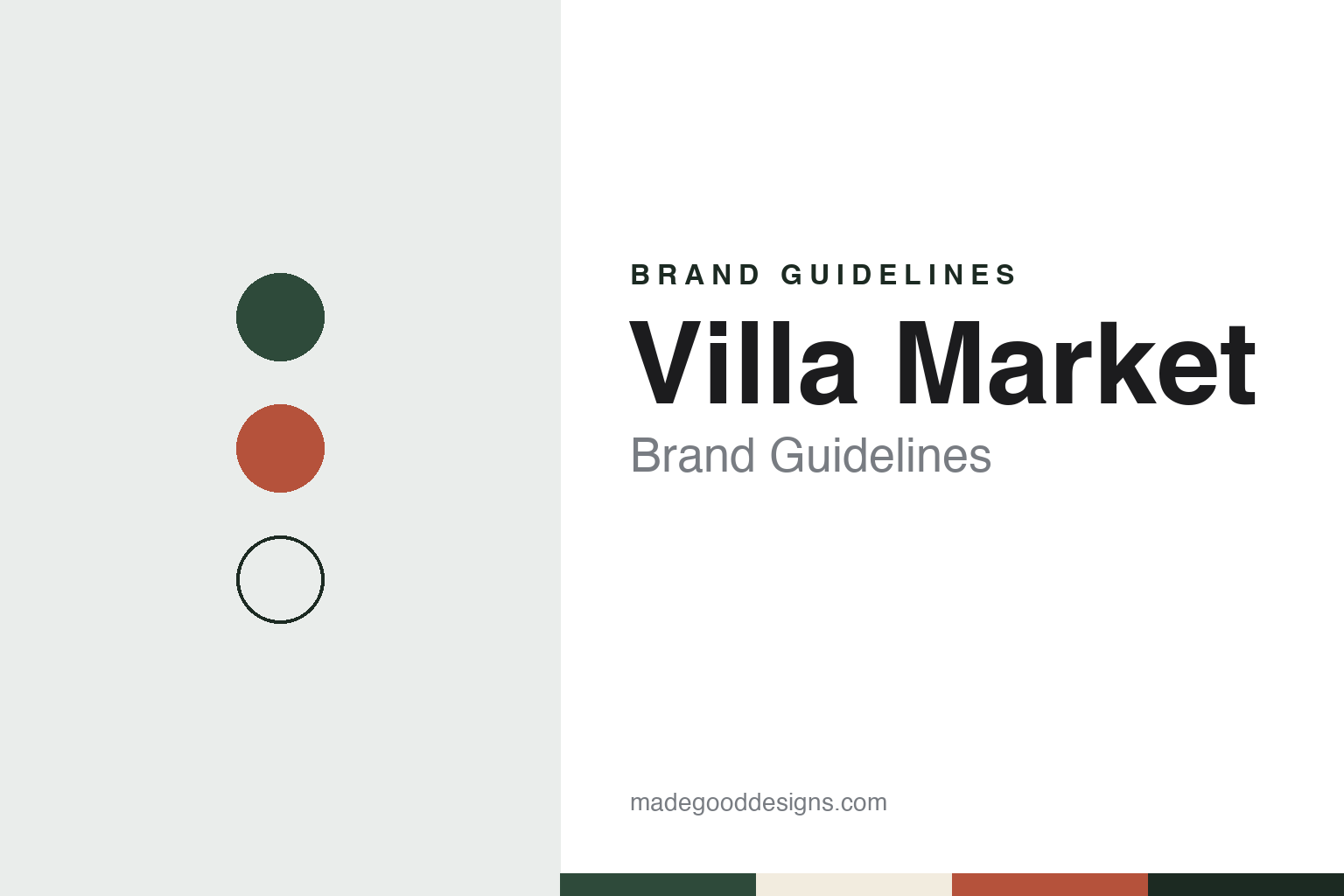
Villa Market Brand Guidelines
Bangkok’s 1974 Sukhumvit Soi 33 imported-food grocer.
Aa
Two constants: a green, cream and terracotta palette and a grocer’s serif register. Abstract homage — not a Villa Market product or mark; no sign, logo or packaging is reproduced.
Soi 33
A grocer’s son and a gap on Sukhumvit Road.
Villa Market began in Bangkok in 1974, when its first store opened on Sukhumvit Road, near Soi 33. The Nation reported in August 2016 that the family business had opened that first shop 42 years earlier, and Thai Wikipedia and the Thai magazine The People, in a 2019 profile, both give 1974. The founder was Surapong Poosanakhom, the son of a grocery-shop owner, The People says.
The idea was a supermarket for imported food. Writing in April 2018, the Thai marketing magazine Brand Buffet said that supermarkets in Thai department stores at the time sold mostly Thai-made goods, with a stress on dry groceries and non-food lines, and that Surapong saw that no Thai shop or supermarket focused on imported products. Bangkok was also spreading east from the Sathorn and Silom districts towards Sukhumvit, which drew Thai residents, foreign workers and visitors to the area, the magazine added.
The first store set the pattern. The People describes a shelf mix in which seventy to eighty per cent of goods were food ingredients, with hard-to-find imports such as American peanut butter, New Zealand lamb and a range of cheeses and wines, some of them sold only at Villa Market. Meat was aged before it went on sale, the magazine says. Early stores also had a notice board where customers could pin up their own announcements, from household-help wanted ads and cars for sale to rooms to let and coming events, so that the shop worked as a meeting point for the neighbourhood as well as a place to buy food.
The Soi 33 store is still trading. Both The People in 2019 and Thai Wikipedia say the first branch remains open and is the chain’s only branch that opens around the clock. Thai Wikipedia gives the operating company as Villa Market JP Co, a private limited company.
Colour
A family chain of about 1,000-square-metre stores.
The second generation took over from the founder. The Nation named Pisit Poosanakhom, Surapong’s son, as chief executive of Villa Market JP in 2016; Brand Buffet in 2018 and the Thai business site Business Today in January 2020 called him executive chairman. Under him the chain grew from 21 branches in 2012, according to Thai Wikipedia, to 33 in August 2016, when The Nation reported that the 33rd store had just opened at the UD Town complex in Udon Thani, in the north-east. Earlier openings that year were at Hua Hin and at The Circle shopping mall on Ratchaphruek Road in Bangkok.
The stores follow one size. The Nation wrote in 2016 that each Villa Market store had about 1,000 square metres of retail space and 25 to 30 staff, and Brand Buffet repeated the single 1,000-square-metre format in 2018. Some stores stand alone, such as those on Sukhumvit Soi 33 and Soi 49; others sit in community malls and shopping centres, among them K Village on Sukhumvit Soi 26, La Villa in Ari and Paradise Park, the magazine said. Outside Bangkok, The People listed branches in Pattaya, Hua Hin, Phuket and Udon Thani in 2019, and Brand Buffet named Phuket sites at Boat Lagoon and Laguna.
Behind the shelves sits a distribution centre. The Nation reported in 2016 that Villa Market JP had opened a 10,000-square-metre main distribution centre near Suvarnabhumi Airport, in Samut Prakan province, two years earlier.
The range stayed import-led. In April 2018 Brand Buffet put food at seventy to eighty per cent of what Villa Market sold, with non-food lines making up the rest, and counted at least 2,500 imported items from around the world. Fresh and chilled imports, such as lamb, beef and cheese, alongside dry goods such as yeast, remain the core, according to Thai Wikipedia.
Typography
Signs, own labels and store formats.
Supermarket and convenience chains across East and South-East Asia present themselves through a few fixed things: the name on the sign, the colours of the fascia and the carrier bag, the layout of the shop floor and the names of their own-label ranges. In Japan, Kobe Bussan’s Gyomu Super has built a recognisable store out of logistics, stacking fast-selling goods in the cardboard boxes they arrive in, a practice Japanese Wikipedia calls “hakochin”.
Names and signs do not always travel unchanged. FRIDAY DIGITAL reported in December 2024 that Gyomu Super stores are called “Gyomu Super” in Hong Kong but “GYOMU Japan” in Vietnam and Malaysia, where Japanese text cannot be shown on the sign. Chains in Korea, Indonesia, Thailand, Hong Kong, Malaysia and Singapore make similar choices about script, language and lettering, and this guide describes them as each company or a dated source shows them.
Ownership is often layered. Some chains are run directly by a listed retail group; others are franchised, licensed to local partners or held inside a larger conglomerate with interests far beyond food. Gyomu Super, for example, is almost entirely a franchise network: Japanese Wikipedia says that only three of its 1,007 stores were company-run at the end of October 2022. Where a chain has changed hands, this guide gives the buyer and the date from a dated source, and describes any deal not completed as pending.
Store counts, formats and own-label ranges are given in the companies’ own terms and with their dates, because networks change quickly. Founders, owners and retail groups are named as the companies’ corporate pages and the press record them. Colours and typefaces are treated as an unofficial interpretation unless a source documents them, and no sign, logo or package is reproduced.
Aa
A grocer’s serif — set for a shop that began on Sukhumvit Road in 1974. (Specimen set in Libre Baskerville, a serif STAND-IN; NOT the Villa Market logo.)
Villa Market
Thirty-six branches and a digital wallet.
The chain added digital channels late in its fifth decade. Brand Buffet reported in April 2018 that Villa Market had worked with Siam Commercial Bank on two platforms: VPlus Wallet, an app that let customers top up an e-wallet and collect points, and an online shop for its groceries. Business Today reported in January 2020 that both had launched during 2019 and that most customers still shopped in the stores.
The store count kept rising slowly. Brand Buffet gave 34 branches in April 2018. As of January 2020, Pisit told Business Today that Villa Market had 36 branches around Thailand. The same interview described the newest store at the time, on Langsuan Road in central Bangkok, inside the Velaa Sindhorn Village complex, as a prototype whose layout was drawn from customer feedback and kept flexible so that it could be changed again.
Branches also move. Thai Wikipedia records that the Phahonyothin Place branch closed on 29 October 2021 and moved to Market Place Ari. The company remains a family business: The Nation quoted Pisit in 2016 saying that Villa Market was not under pressure to open new stores aggressively and that store numbers were not its main target.
The customer base, as Brand Buffet described it, was also changing. The magazine wrote in 2018 that most regular shoppers were adults in their thirties and older, and that the online shop was meant partly to reach younger customers. Pisit told the magazine that his father had known every customer by name when the chain was a single shop, and that he saw the digital tools as a way to get back some of that closeness at a larger scale.
For a design guide, Villa Market shows how a single neighbourhood shop’s idea, a supermarket for imported food, can carry a chain for half a century without a change of name or owner. Compare Cold Storage, another long-running Asian supermarket name, and Jaya Grocer. For this guide we use green, cream and terracotta with a serif, an unofficial interpretation; no product or logo is reproduced.
Explore & save
Keep Villa Market’s identity on hand — save it to a board in the Made Good inspiration library.
Villa Market identity set
Save the Villa Market green, cream and terracotta palette and the grocer’s serif register to your own board.
Source & notes
Frequently Asked Questions
What font can I use to match the Villa Market look?
This guide describes Villa Market’s type as “A grocer’s serif — set for a shop that began on Sukhumvit Road in 1974”. Its type specimen is set in Libre Baskerville from Google Fonts as a stand-in; Libre Baskerville is not Villa Market’s own lettering.
What colours are in the Villa Market palette?
This guide’s Villa Market palette is Soi green #2E4A3A, Deep forest #1C2A22, Rice paper #F2ECDF, Terracotta #B5523B and Pale linen #FAF7F1. The tones are the guide’s own unofficial interpretation, not official Villa Market hex codes.
When was Villa Market founded?
Villa Market was founded in 1974 (Sukhumvit, near Soi 33), in Bangkok, Thailand.
Who founded Villa Market?
Villa Market was founded by Surapong Poosanakhom in 1974 (Sukhumvit, near Soi 33).