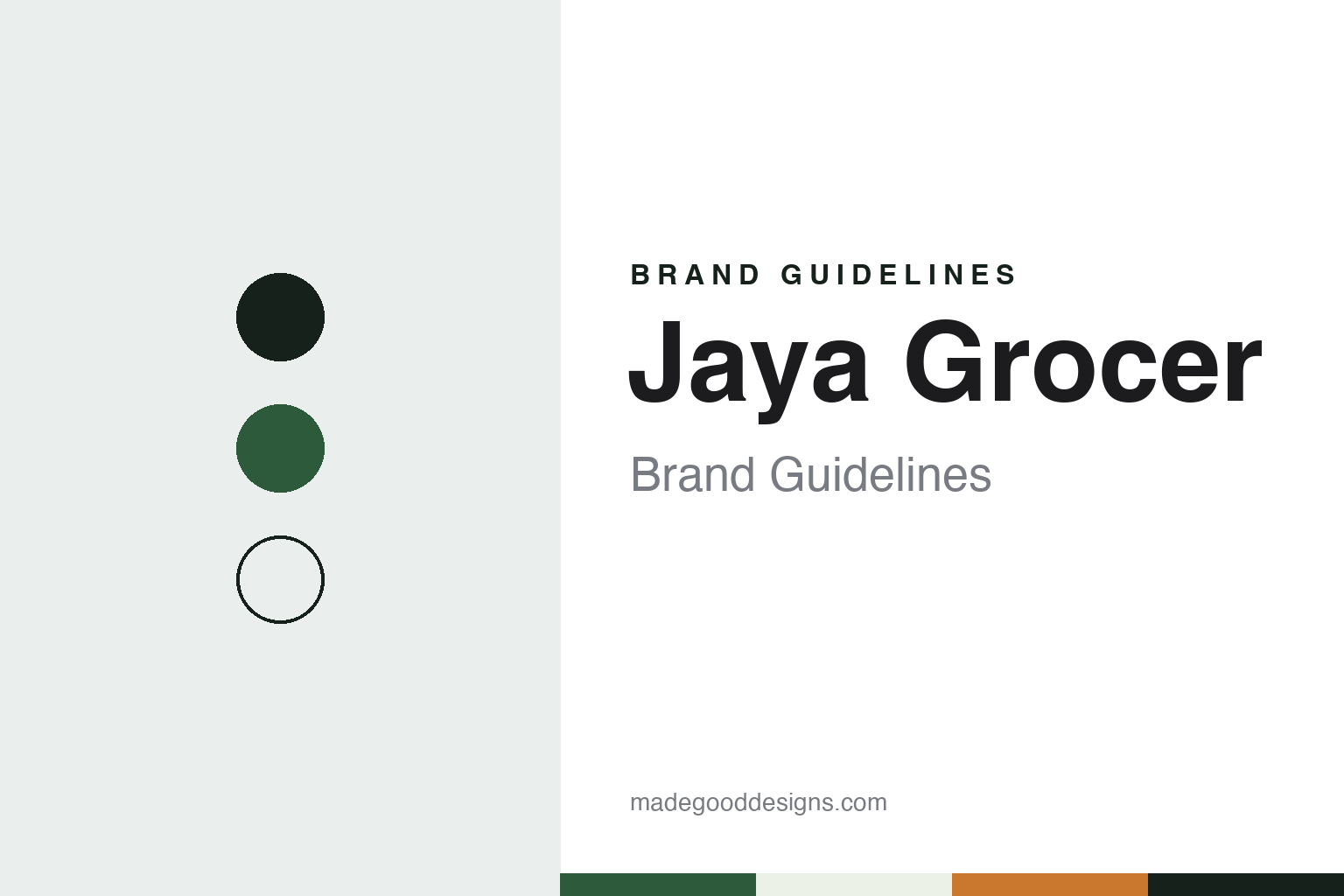
Jaya Grocer Brand Guidelines
A 2007 Teng family supermarket, a store at Jaya 33 and a Grab takeover.
Aa
Two constants: a Jaya Grocer market green and amber palette and a Market serif register. Abstract homage — not a Jaya Grocer product or mark; no logo, fascia or packaging is reproduced.
A family in retail
From a Sentul sundry shop to a supermarket brand.
Jaya Grocer is a supermarket chain in Malaysia, and its story starts long before its own founding. According to The Edge Malaysia, writing in December 2021, the Teng family’s retail history begins with a sundry shop on Jalan Sentul in Kuala Lumpur, opened in 1944 by Teng Sek How. His son Teng Yew Huat and his brothers later opened the Teng Minimarket Centre, known as TMC, in Lucky Garden, Bangsar, and the family also founded the Giant grocery chain. TMC and Giant were later sold to the Hong Kong group Dairy Farm International, The Edge reported.
The family then started again. Jaya Grocer “was founded in 2007 by the Teng family with the aim of establishing a premium supermarket brand,” The Edge Malaysia wrote, and English Wikipedia gives the same year and the same family. The company’s own account says its story “began way back in the mid 2000’s” and that its first store was at Jaya 33 in Petaling Jaya, in Selangor. The company says it served local communities with four outlets in its early years.
On its website, Jaya Grocer names its operating company as Trendcell Sdn. Bhd., trading as Jaya Grocer, with an office in Petaling Jaya. Its about page carries the heading “50 Years of Heritage” above the story of the chain.
Colour
Shophouses, neighbourhood malls and city malls.
Growth came with an outside investor. In 2016, AIGF Advisors, the Singapore-based manager of the ASEAN Industrial Growth Fund, a private equity fund sponsored by Mitsubishi Corporation, took a 45% stake, with Teng Yew Huat holding the remaining 55%, according to The Edge Malaysia and English Wikipedia. In a statement reported by The Edge in November 2021, AIGF said that during its investment the chain grew “from just over 10 stores to more than 40,” with an extensive network in Kuala Lumpur and expansion beyond the capital.
The chain trades in several sizes. Marketing-Interactive reported in September 2023 that its formats ranged from shophouse clusters to neighbourhood malls and large city malls. Its flagship at Empire Subang, the company says, introduced a “Grocerant” idea, in which shoppers pick ingredients in the store and have them cooked by its chefs on site.
Expansion reached beyond the Klang Valley. The chain opened its first outlet in Johor in 2018, and in September 2023 it marked Merdeka Day by opening a store at Eco Galleria in Taman Eko Botan, its fourth in the state, Marketing-Interactive reported, adding that the chain then had more than 45 outlets. The same report described imported Australian products sold through a collaboration with Coles, and a sambal sold under Grab’s Signature Brand label.
On 31 January 2024 the chain opened its 50th outlet, at Seremban Prima Mall, its second in Negeri Sembilan, The Vibes reported in February 2024. As of November 2026, the company’s website says it serves customers through 50 stores across Malaysia, and it runs an online shop, Jaya Grocer Online, alongside delivery through GrabMart.
Typography
Design and documentation.
Supermarket and convenience chains across East and South-East Asia present themselves through a few fixed things: the name on the sign, the colours of the fascia and the carrier bag, the layout of the shop floor and the names of their own-label ranges. In Japan, Kobe Bussan’s Gyomu Super has built a recognisable store out of logistics, stacking fast-selling goods in the cardboard boxes they arrive in, a practice Japanese Wikipedia calls “hakochin”.
Names and signs do not always travel unchanged. FRIDAY DIGITAL reported in December 2024 that Gyomu Super stores are called “Gyomu Super” in Hong Kong but “GYOMU Japan” in Vietnam and Malaysia, where Japanese text cannot be shown on the sign. Chains in Korea, Indonesia, Thailand, Hong Kong, Malaysia and Singapore make similar choices about script, language and lettering, and this guide describes them as each company or a dated source shows them.
Ownership is often layered. Some chains are run directly by a listed retail group; others are franchised, licensed to local partners or held inside a larger conglomerate with interests far beyond food. Gyomu Super, for example, is almost entirely a franchise network: Japanese Wikipedia says that only three of its 1,007 stores were company-run at the end of October 2022. Where a chain has changed hands, this guide gives the buyer and the date from a dated source, and describes any deal not completed as pending.
Store counts, formats and own-label ranges are given in the companies’ own terms and with their dates, because networks change quickly. Founders, owners and retail groups are named as the companies’ corporate pages and the press record them. Colours and typefaces are treated as an unofficial interpretation unless a source documents them, and no sign, logo or package is reproduced.
Aa
A market serif — fresh produce and imported shelves. (Specimen set in Fraunces, a serif STAND-IN; NOT the Jaya Grocer logo.)
Jaya Grocer
From family firm to Grab subsidiary.
A sale had been in the air for some time. The Edge Malaysia reported in December 2021 that the chain had been up for sale for more than a year, that earlier approaches from the private equity firms Carlyle and CVC Capital Partners had not gone ahead, and that the owners had also looked at other routes, including a listing on the stock exchange. Then the ownership changed twice in a few weeks at the end of 2021. On 24 November 2021, The Edge Malaysia reported that the Teng family had bought back AIGF’s entire stake, giving the family the whole shareholding. Seventeen days later, on 13 December 2021, the technology group Grab, which had begun trading on Nasdaq earlier that month, told the US Securities and Exchange Commission that it had signed an agreement to buy all of Jaya Grocer’s ordinary shares and 75% of its preference shares, The Edge reported the next day.
The deal closed early in 2022. On 31 January 2022, The Edge Malaysia reported that Grab Holdings had completed its acquisition of a majority stake in Jaya Grocer Holdings Sdn Bhd, and that GrabPay and GrabRewards were being rolled out across all Jaya Grocer stores. Since then the two businesses have been tied together in the shop as well as on the balance sheet: the chain’s membership programme is run through the Grab app, and its stores offer online orders through GrabMart, The Vibes reported in 2024.
The brand’s public face is that of a mid-sized neighbourhood supermarket with an emphasis on imported goods and fresh produce, the focus Marketing-Interactive described in 2023. Its tie-up with Coles brings Australian products onto Malaysian shelves, and its Grab-branded sambal sits beside them. The Teng family’s earlier chains, TMC and Giant, had already been sold to Dairy Farm International, The Edge reported.
For a design guide, Jaya Grocer shows how a family retail history can be folded into a new chain with its own place name. Compare Cold Storage, another supermarket chain with a long history in the region, and AEON, the Japanese retail group that also trades in Malaysia. For this guide we use a market green and a produce amber with a serif, an unofficial interpretation; no product or logo is reproduced.
Explore & save
Keep Jaya Grocer’s identity on hand — save it to a board in the Made Good inspiration library.
Jaya Grocer identity set
Pin the Jaya Grocer market green and amber palette and the Market serif register to your own board.
Source & notes
Frequently Asked Questions
What font can I use to match the Jaya Grocer look?
This guide describes Jaya Grocer’s type as “A market serif — fresh produce and imported shelves”. Its type specimen is set in Fraunces from Google Fonts as a stand-in; Fraunces is not Jaya Grocer’s own lettering.
What colours are in the Jaya Grocer palette?
This guide’s Jaya Grocer palette is Market green #2E5A3C, Ink #15211A, Leaf pale #ECF1E8, Produce amber #C9782E and Paper #FAFAF5. The tones are the guide’s own unofficial interpretation, not official Jaya Grocer hex codes.
When was Jaya Grocer founded?
Jaya Grocer was founded in 2007, in Petaling Jaya, Selangor.
Who founded Jaya Grocer?
Jaya Grocer was founded by the Teng family in 2007.
Who owns Jaya Grocer?
Jaya Grocer is owned by Grab (majority, since January 2022).