ASA Brand Guidelines
A Dhaka NGO of 1978 that standardised the microcredit branch.
Aa
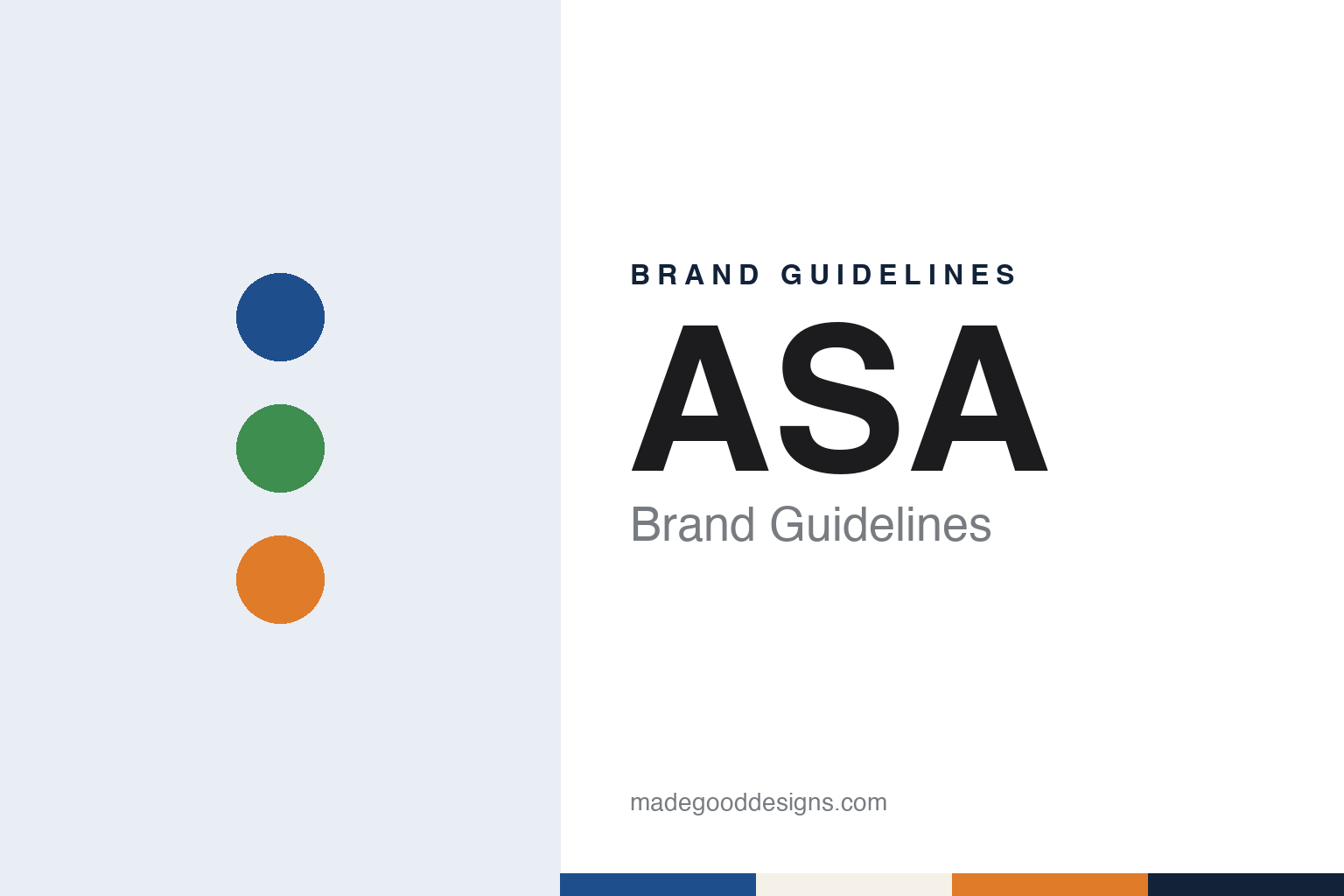
Two constants: a blue, green and marigold palette and a plain grotesque register. Abstract homage — not an ASA product or mark; no logo, badge or document is reproduced.
Association for Social Advancement
A rights movement that became a lender.
ASA stands for the Association for Social Advancement. It was founded in Bangladesh in 1978 by Md. Shafiqual Haque Choudhury, English Wikipedia says, together with a team of people who were then working for other non-governmental organisations and who argued for a more radical approach to rural development. ASA International, the separate group its founder later co-founded, says the association first concentrated on civil rights and community development programmes in rural areas.
The early model was organising rather than lending. English Wikipedia describes the founding aim as working with landless villagers from the “bottom up” through “people’s organisations,” run by volunteers who held that solidarity among the village poor would lead to collective action. For years ASA tried to combine social development work — in education, nutrition and sanitation, among other fields — with credit.
The turning point came in 1991. Both English Wikipedia and ASA International date ASA’s shift to microfinance to that year; Wikipedia says the other programmes were dropped so that ASA could end its “donor dependence” and become specialised and financially self-sufficient. It traces the money behind the lending through four stages: donor funds first, then small commercial bank loans, then low-cost loans from a subsidised wholesaler, and finally client deposits and retained earnings.
ASA is still a non-governmental organisation, with its head office in Dhaka, English Wikipedia says, and it names Md. Ariful Haque Choudhury as president. Bangladesh’s non-governmental lenders are licensed by the Microcredit Regulatory Authority, set up under an act of 2006; the economist Mustafa K Mujeri, writing in The Daily Star in 2025, counted 731 licensed institutions as of June 2023. ASA’s own website, branded “ASA – Bangladesh,” links to that authority and to Bangladesh Bank, and to ASA University and the ASA MATS institute.
Colour
The Ford Motor model of microfinance.
ASA’s reputation rests on a system rather than a single product. A 2002 Asian Development Bank paper by Meyer and Fernando, cited by English Wikipedia, described it as “the Ford Motor model of microfinance” for its standardised, low-cost operations. Wikipedia says the core service has stayed the same for decades: a low-value loan over a year with weekly repayments, alongside small business credit, regular weekly savings, voluntary savings and life insurance.
The organisation is deliberately flat. English Wikipedia describes three tiers — a fairly small central office in Dhaka, district offices and branch offices — with the branch as the main channel for loans. Each branch is a self-sufficient unit run by six people: a branch manager, an assistant branch manager and four loan officers. The branch manager may approve all transactions that meet the guidelines of an operating manual, and each branch is run as a profit centre expected to cover its costs within its first year.
ASA International, which applies the same approach abroad, calls it the ASA Model: decentralised, standardised and based on individual loans rather than joint liability. Its website describes branches of around 1,400 clients within a 15-kilometre radius, weekly or fortnightly collections, and collateral-free loans for income generation, with most of a loan repaid before a larger one is offered. That individual approach is what English Wikipedia means when it calls ASA an alternative to the Grameen Bank model of group lending.
Outside recognition has come mainly through rankings and sector data. English Wikipedia says ASA placed first in a Forbes list of 50 microfinance institutions published in December 2007. Citing The Financial Express of August 2011, it says ASA, Grameen Bank and BRAC together served 62 per cent of Bangladesh’s 18.5 million micro-borrowers. In 2025 Mujeri wrote in The Daily Star that the two largest institutions, BRAC and ASA, held half the sector’s clients and portfolios. English Wikipedia gives ASA 20,259 staff and more than 4.85 million clients as of June 2014.
Typography
How microfinance lenders present themselves.
Microfinance lenders present themselves less through products than through method. Grameen Bank’s website opens on its line “A bank for the poor” and describes loans made without collateral, with all transactions except disbursement handled at village-level centres. ASA International sets out the “ASA Model” on a page of its own, from the size of a branch to the rhythm of weekly or fortnightly collections. For these institutions the method is the brand.
Their websites are built around networks and products. They publish branch, client and village counts as dated figures, offer branch locators, and list named loans for small businesses, crops, livestock, housing and education, alongside savings accounts, pension schemes and insurance. Newer pages describe digital wallets and digital financial services, sometimes launched market by market. Where a lender’s pages show small shops, farms or field officers at work, this guide describes them in words rather than reproducing them.
Documentation is a large part of the look. Lenders publish annual reports, monthly reports, governance pages and pages on social performance or impact, and listed groups add investor sections and regulatory news. Regulators are part of the picture too: in Bangladesh, the economist Mustafa K Mujeri wrote in The Daily Star in 2025, non-governmental lenders are licensed by the Microcredit Regulatory Authority, set up under an act of 2006. Claims about what microcredit achieves are the lenders’ own, or those of prize committees and researchers, and are contested in the research literature.
This guide reads each lender from its own pages and from dated outside sources: who founded it, how its lending works, and how its name is used. The palettes here — warm oranges, greens and blues — are our own unofficial interpretations, not the lenders’ published values, and no logo, photograph or document is reproduced.
Aa
A plain grotesque for a lender built on manuals and standard forms. (Specimen set in Work Sans, a sans STAND-IN; NOT the ASA logo.)
ASA
A model exported under its own name.
The ASA name travelled through a separate company. ASA International says its two founders, ASA’s founder Md. Shafiqual Haque Choudhury and the Dutch investment banker Dirk Brouwer, set up Catalyst Microfinance Investors in 2006 to raise capital and founded ASA International in 2007 to take the ASA Model to Asia and Africa. Its history page lists a first institution in the Philippines in 2007; Ghana, India and Pakistan in 2008, with an acquisition in Sri Lanka; Nigeria in 2009; and later Kenya, Uganda, Myanmar, Tanzania, Rwanda, Sierra Leone and Zambia.
In 2018, the group says, it completed a premium listing on the Main Market of the London Stock Exchange. English Wikipedia lists ASA International as a subsidiary of ASA, while ASA International describes itself as founded by its two co-founders; the two bodies keep separate websites, asa.org.bd and asa-international.com. ASA International describes itself as one of the largest international microfinance institutions, according to its own website, and reports 2.7 million clients and 2,163 branches as at 30 June 2026, on unaudited figures, across 13 markets.
The group’s recent milestones are mostly about systems. It says it moved more than 600,000 clients in Pakistan to a new core banking system in 2024 and more than 350,000 in Ghana in 2025, when it also launched a digital financial services platform there and a microinsurance product in Uganda, Kenya and Nigeria. Brouwer, chief executive until June 2023, stepped down from the board on 4 June 2026 and became founder and chair emeritus, the company says.
The name itself is a trap. ASA is a common acronym, used by many unrelated bodies; the Bangladeshi organisation, ASA International and BRAC Bank are three different institutions, and only the first is the subject of this guide.
For a design guide, ASA shows how a lender can make standardisation itself the brand — the same branch, the same staff of six and the same weekly loan. Compare Grameen Bank, the Dhaka lender built on group meetings, and Bank Rakyat Indonesia (BRI), the Indonesian bank known for village lending. For this guide we use a field blue, a rice green and a marigold on paper with a plain grotesque sans, an unofficial interpretation; no product or logo is reproduced.
Explore & save
Keep ASA’s identity on hand — save it to a board in the Made Good inspiration library.
ASA identity set
Save the ASA blue, green and marigold palette and the plain grotesque register to your own board.