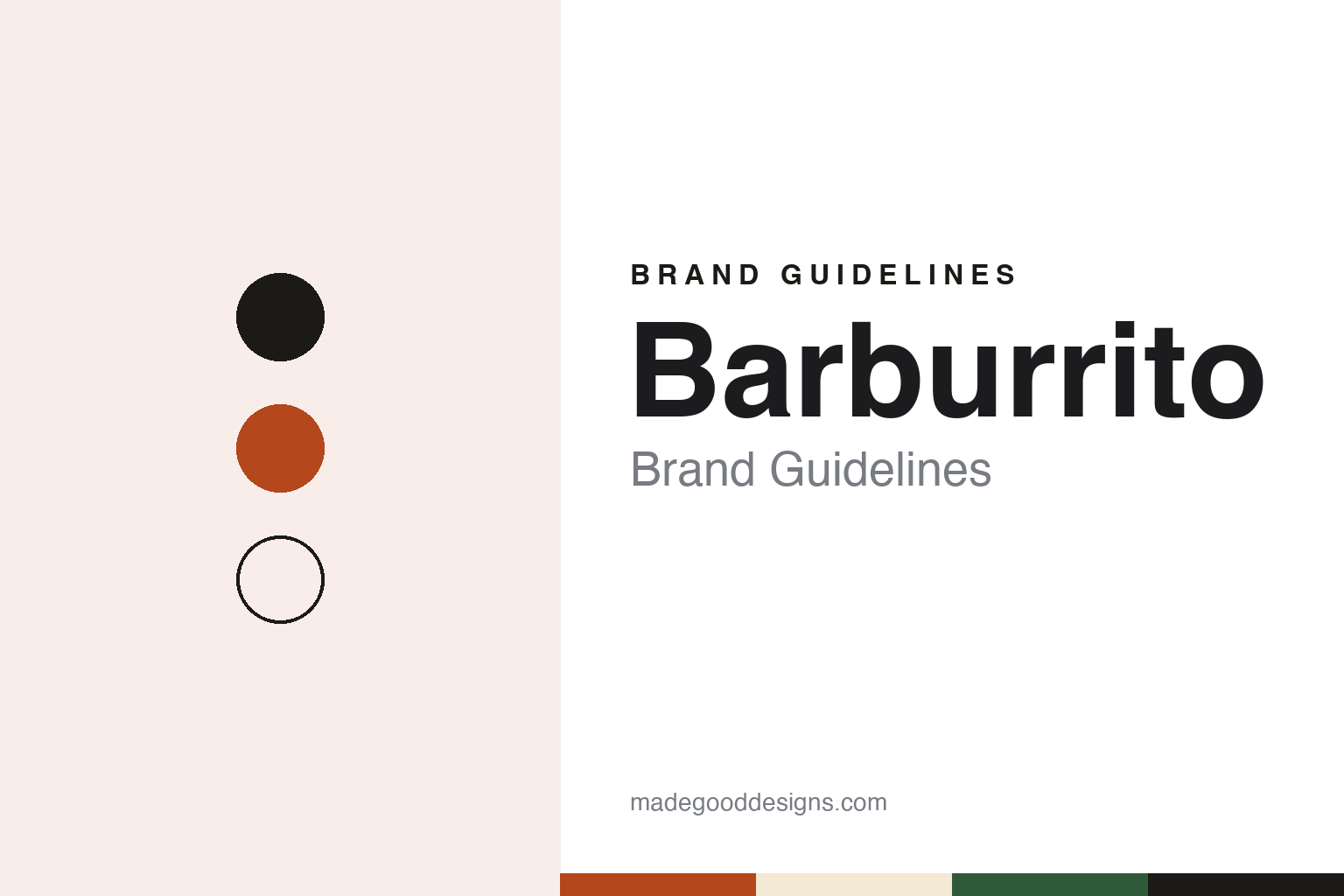
Barburrito Brand Guidelines
A 2005 Manchester burrito bar that went national.
Aa
Two constants: a Barburrito ember orange, green and cream palette and a Rounded sans register. Abstract homage — not a Barburrito product or mark; no food, logo or signage is reproduced.
Piccadilly Gardens, 2005
Two founders and one shop in Manchester.
Barburrito is a Manchester-based chain of burrito restaurants. It was founded in 2005 by Morgan Davies and Paul Kilpatrick, who opened a single shop in Manchester’s Piccadilly Gardens, the Manchester Evening News reported in 2013; The Caterer gave the same founders, city and year in December 2020. Davies had been a management consultant before the business began, the Manchester Evening News noted. The Piccadilly Gardens shop is still trading: in June 2025 the Bolton News reported a 20th-birthday party held outside it.
Growth in the early years was quick and northern. Davies told Restaurant magazine in June 2013 that the pair soon took on investment to open at the Trafford Centre, then in Liverpool and Leeds, going “from one to three and then three to six sites,” before easing off to build the foundations for further expansion. In 2010 the Manchester Evening News reported a fourth outlet opening on Deansgate in Manchester, alongside the Piccadilly, Trafford Centre and Liverpool shops, and described funding from the founders themselves, a bank loan, a business angel and the Liverpool-based Rapid Realisation Fund.
The larger investment came in April 2012, when the Business Growth Fund, the investment company set up by Britain’s big banks, took a minority stake. The Manchester Evening News reported that it was the first deal done by the fund’s Manchester office, that a non-executive director who had sat on the boards of Pret a Manger and EAT joined the Barburrito board, and that the money was meant to pay for a national roll-out starting in London. At that point Barburrito had six sites: two in Manchester city centre, two at the Trafford Centre, and one each in Leeds and Liverpool.
Colour
Burritos for northern cities.
The format is a counter where burritos are assembled in front of the customer. The company’s website today lists burritos, bowls, nachos and sides, made fresh and “built exactly how you like it.” In 2013 Davies told Restaurant magazine that the chain had decided early on to keep a standardised product so that it could concentrate on consistency, and that it had worked hard on purchasing, the supply chain and staff scheduling to make the model pay outside London.
The brand also picked up local colour. In the same interview Davies said customers in Liverpool had invented their own slang for the product, talking about going down “the bar for a buzza,” and that the Liverpool shops had a livelier atmosphere than the rest, while Manchester drew a mixed crowd and Leeds mostly office workers and students.
London arrived in 2013. Restaurant magazine visited the new site at Paddington station in June that year, when eight of the chain’s nine sites were in north-west England, and English Wikipedia says a second London shop opened on Cowcross Street the same month. Davies said he was talking to Network Rail about further station sites, and by 2022 the estate included transport hubs as well as shopping centres and city-centre streets. In July 2013 the Manchester Evening News counted nine outlets, including a second in Leeds and one in Nottingham. Later openings took the name to Cardiff, Sheffield’s Meadowhall, Glasgow and Edinburgh, among other cities, according to the Bolton News and The Caterer.
Typography
The category.
Mexican and burrito fast-casual chains tend to present themselves through the counter as much as the sign. The format is usually the same in outline: a menu of burritos, bowls, tacos and nachos, a kitchen line where each order is made up in front of the customer, and a choice of eating in, taking away or ordering ahead. The Caterer described one Australian chain’s signature dishes in 2025 simply as “customisable burritos and bowls,” and companies in the category describe their own kitchens in terms of speed and made-to-order assembly.
Names in the category often borrow Spanish words or invented surnames, and the shortened form can matter as much as the full one. Guzman y Gomez, named after two of a founder’s childhood friends according to English Wikipedia, is generally shortened to three initials. The same company calls its head offices Hola Central, and Zambrero’s UK chief executive called the chain’s franchise partners the “Zam Fam” in 2025, so the naming habit often reaches past the menu into the business itself.
Visual identities in the category often lean on bright colour and hand-made graphic details, as the companies describe them. Guzman y Gomez says its logo letters are drawn to look like sticky tape, a nod to street art in Mexico, and Inside Retail reported in 2023 that Zambrero had moved to a brighter, more upbeat look for posters, decals, signage and menus while keeping its green colourway. In both cases a small set of colours and one recognisable graphic idea are meant to carry from the shop front to the menu board.
Behind the counters sit very different businesses: founder-owned franchisors, private-equity-backed groups, chains that have been through administration or Chapter 11, and companies listed on a stock exchange. Their corporate pages set out founding stories, founders and timelines of openings, while dated press and official records fill in owners, listings and closures.
Aa
A rounded, friendly sans for a counter-service menu board. (Specimen set in Rubik, a sans STAND-IN; NOT the Barburrito logo.)
Barburrito
A restructuring, then The Restaurant Group.
The years after 2019 brought two changes of control. In December 2020 The Caterer reported a restructuring deal under which Barburrito closed three sites permanently — Union Square in Aberdeen, Lothian Road in Edinburgh and Deansgate in Manchester — while its remaining 14 stores in London, Liverpool, Leeds, Sheffield, Nottingham, Glasgow and Edinburgh kept trading. The chain’s chairman led a new investment alongside other private investors, and Davies stayed on as founder and chief executive.
In July 2022 The Restaurant Group, the owner of Wagamama, bought Barburrito from its shareholders, The Caterer reported. At the time Barburrito ran 16 sites in shopping centres, city centres and transport hubs, and The Restaurant Group already operated two Barburrito sites as franchises in UK airports through its concessions business. The chain was folded into the group’s leisure and concessions division, with its key operating team kept on, and the new owner said it saw room to grow the brand, particularly in the south of England, where it had few sites.
The Restaurant Group itself then changed shape. English Wikipedia says that in 2023 it sold most of its portfolio, apart from Wagamama, Brunning & Price and Barburrito, to The Big Table Group, and that in December 2023 the US private equity firm Apollo completed its purchase of the group; it now lists Wagamama and Barburrito as the principal trading brands. The chain marked its 20th birthday on 10 June 2025 with free burritos for app members at nine city locations, including Cardiff, Glasgow and Nottingham, and a party at Piccadilly Gardens, the Bolton News reported.
For a design guide, Barburrito shows how a regional name can travel intact from a single city-square shop to station concourses and shopping centres under three kinds of owner: founders, investors and a restaurant group. Compare Chilango, which Restaurant magazine named among the London burrito chains in 2013, and Chipotle. For this guide we use an ember orange, a pepper green and a corn cream with a rounded sans, an unofficial interpretation; no product or logo is reproduced.
Explore & save
Keep Barburrito’s identity on hand — save it to a board in the Made Good inspiration library.
Barburrito identity set
Save the Barburrito ember orange, green and cream palette and the Rounded sans register to your own board.