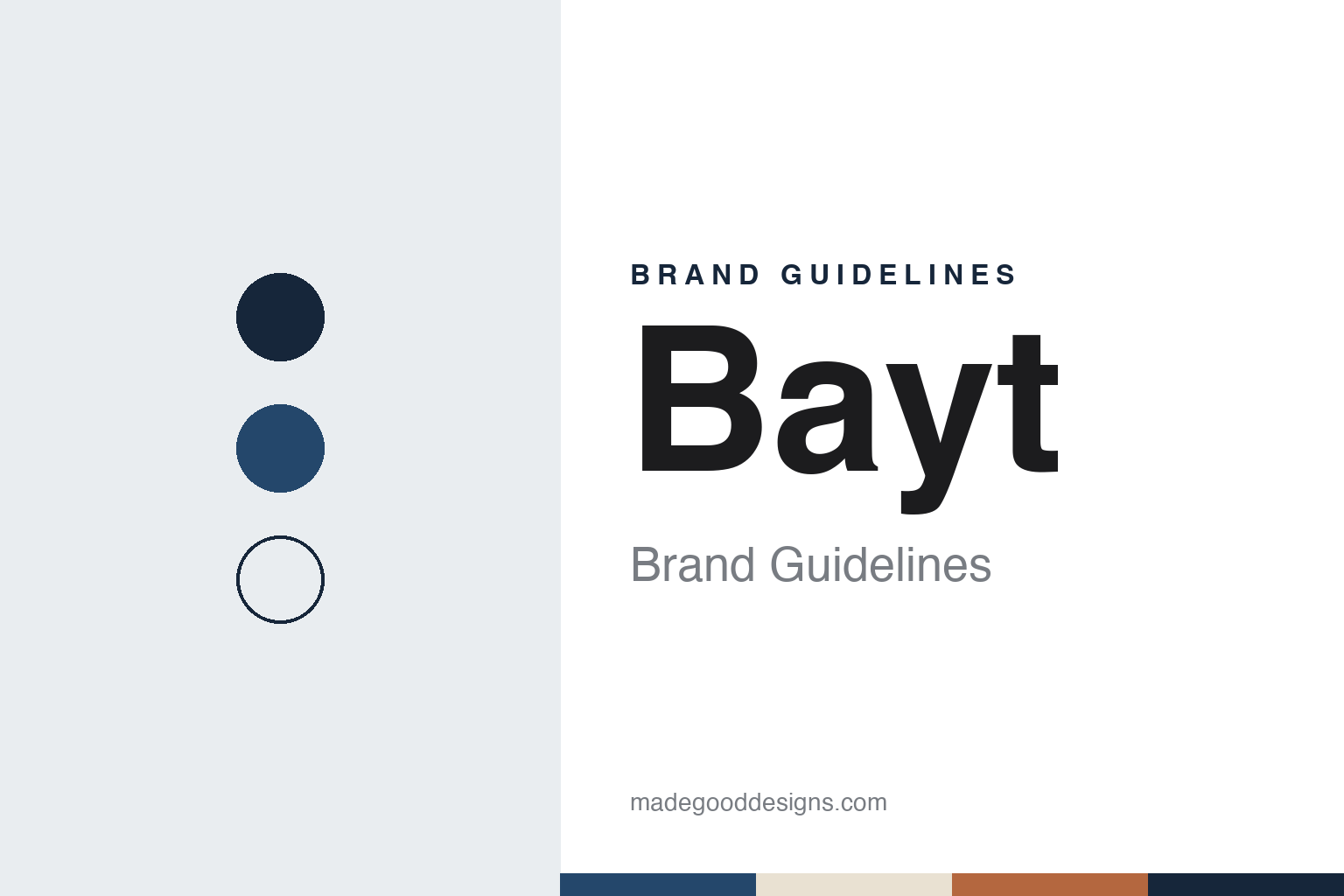
Bayt Brand Guidelines
A Dubai job site named after the Arabic word for house.
Aa
Two constants: a blue, sand and clay palette and a bilingual sans register. Abstract homage — not a Bayt asset; no logo, app screen or wordmark is reproduced.
A house online
A Dubai start-up from 2000 with an Arabic name.
Bayt.com is a job search and recruitment site for the Middle East and North Africa. It was founded in 2000 in Dubai, English Wikipedia says, and its head office is still there. The person most closely tied to it is Rabea Ataya, its founder and chief executive. In November 2010 the regional start-up publication Wamda ran an interview with him about the challenges he faced in founding and building the platform, and in its November–December 2019 issue the Harvard Business Review published an article by him, signed as the chief executive of Bayt.com. The magazine’s introduction notes that he studied electrical engineering at Stanford in the early days of the internet.
The name is a plain Arabic word. Wiktionary gives bayt as a house or a building, and also as a household or family, a commercial house and, in classical poetry, a line of verse.
The site grew in two directions at once: language and geography. English Wikipedia says an Arabic version of Bayt.com launched in 2001, and that the company then opened offices in Abu Dhabi, Riyadh and Saudi Arabia’s Eastern Province, followed by Kuwait, Bahrain and Jeddah. The same article now lists operations in eleven locations, including Abu Dhabi, Kuwait City, Amman, Beirut, Cairo, Doha, the Eastern Province, Jeddah, Riyadh and Lahore, with the headquarters in Dubai.
Early press coverage followed those additions. In December 2003 Arab News reported the launch of BaytLearning, an online directory of training courses, seminars, conferences and workshops for professionals and organisations, reached from the Bayt home page. Ataya told the paper that the company wanted to give users in the region the tools and knowledge to “build their lifestyle of choice,” from finding the right job to keeping their skills up to date. English Wikipedia adds that a CV and cover-letter writing service, run by career consultants, followed in 2004, and that Ataya was named e-Entrepreneur of the Year by Arabian Business in October 2002.
Colour
Job site, recruitment software and video assessments.
Bayt’s products fall into two groups: the public job site that candidates use, and software sold to employers. On the job-site side, English Wikipedia says the platform was relaunched in March 2012 with a mobile app, a CV builder and new tools for tracking job searches and analysing CVs, and that in June 2013 the company added an online network for human-resources professionals.
The employer side carries its own names. English Wikipedia says Talentera was launched in 2010 as a subsidiary offering recruitment software that companies can run in the cloud or on their own servers, for small, medium-sized and large employers. It describes Talentera as a suite of tools to source, track, assess and hire candidates, and lists AfterHire, onboarding software for new staff, alongside it.
The third name is Evalufy. In February 2019 the trade site Online Marketplaces reported that Bayt.com had launched it as a video assessment platform for candidates and employers. Instead of first-round phone calls or assessment centres, employers send customised video assessments to many candidates at once; several evaluators grade the answers, and each candidate’s report card is plotted against a benchmark based on the hiring criteria. English Wikipedia describes Evalufy as a candidate evaluation platform with analytics on the talent market.
Bayt also publishes workplace research. English Wikipedia says the company has written a number of HR and recruitment studies with the polling firm YouGov, and in October 2022 The National, the Abu Dhabi newspaper, reported a Bayt.com and YouGov survey on how employees in the UAE saw their career prospects for the following year, with finding a job, learning new skills and earning more among the goals respondents named. The same encyclopedia entry says that in 2022 Bayt partnered with the consultancy Mercer on software that lets employers test skills and check pay information before they hire.
In the way English Wikipedia lists them, Bayt.com is the name candidates use, while Talentera, Evalufy and AfterHire are product names aimed at employers and HR teams.
Typography
How job boards present themselves.
For a designer, a job board is mostly a search box and a list: a field for the job, a field for the place and a button, followed by a column of job cards giving the title, the employer, the location and the date. Where that pattern is shared, the brand has to work in the small places: the wordmark at the top of the page, the colour of the button, the app icon on a phone and the tone of the alerts that arrive by email.
The names do a lot of the work. Many are plain words or short compounds that say what the site is for, and some companies build their advertising directly on the name: SEEK, for example, has long used the line “SEEK and you shall find,” according to the trade title Campaign Brief. Others keep separate names market by market: SEEK’s group runs Jobstreet and Jobsdb sites in Asia alongside SEEK itself, according to its own website.
The second audience is the employer. Job sites sell advertising, résumé search and matching tools to hirers, and their corporate pages speak to recruiters as much as to candidates, with products for job posting, candidate search and employer branding presented next to the public job search.
Ownership is part of the story too. Many of these brands belong to larger groups, and their corporate pages list the countries and sites they run: SEEK’s about page names marketplaces in eight countries, and after the 2025 sale of CareerBuilder + Monster, the new owner BOLD listed CareerBuilder and Monster among its brands, HR Dive reported. This guide sets out who founded each brand, who owns it now and what has changed hands, and treats colours and type as an unofficial interpretation rather than an official specification.
Aa
A bilingual sans for a site in Arabic and English. (Specimen set in IBM Plex Sans, a sans STAND-IN; NOT the Bayt logo.)
Bayt
Awards, research and a regional footprint.
Bayt’s recognitions include regional business awards. English Wikipedia says the site won a website prize at the 2006 UAE Web Awards. In December 2011 Wamda reported that Bayt.com had taken two prizes at the SME Advisor Stars of Business Awards in Dubai, an offshoot of the Gulf magazine SME Advisor Middle East: Business Star of the Year and the award in the technology and online category. English Wikipedia adds that in 2014 the World Economic Forum selected Bayt.com, along with Al Hilal Bank and Air Arabia, as one of three UAE companies in its Global Growth Companies group.
Ataya’s 2019 article for the Harvard Business Review opens with a meeting in Saudi Arabia in 2018, where the director of a large transport and distribution company told him he could see how Bayt helped employers hire office staff but not how it would work for the drivers his business relied on.
For a design guide, Bayt shows how a single everyday Arabic word can carry a job site across two languages and many markets, with separate product names for employers kept apart from the main brand. Compare LinkedIn, a professional network with its own recruiting tools, and Naukri.com, an Indian job site. For this guide we use a deep harbour blue, sand and a clay accent with a sans, an unofficial interpretation; no product or logo is reproduced.
Explore & save
Keep Bayt’s identity on hand — save it to a board in the Made Good inspiration library.
Bayt identity set
Pin the Bayt blue, sand and clay palette and the bilingual sans register to your own board.