bitFlyer Brand Guidelines
The Tokyo exchange that softened its wing without losing it.
Aa
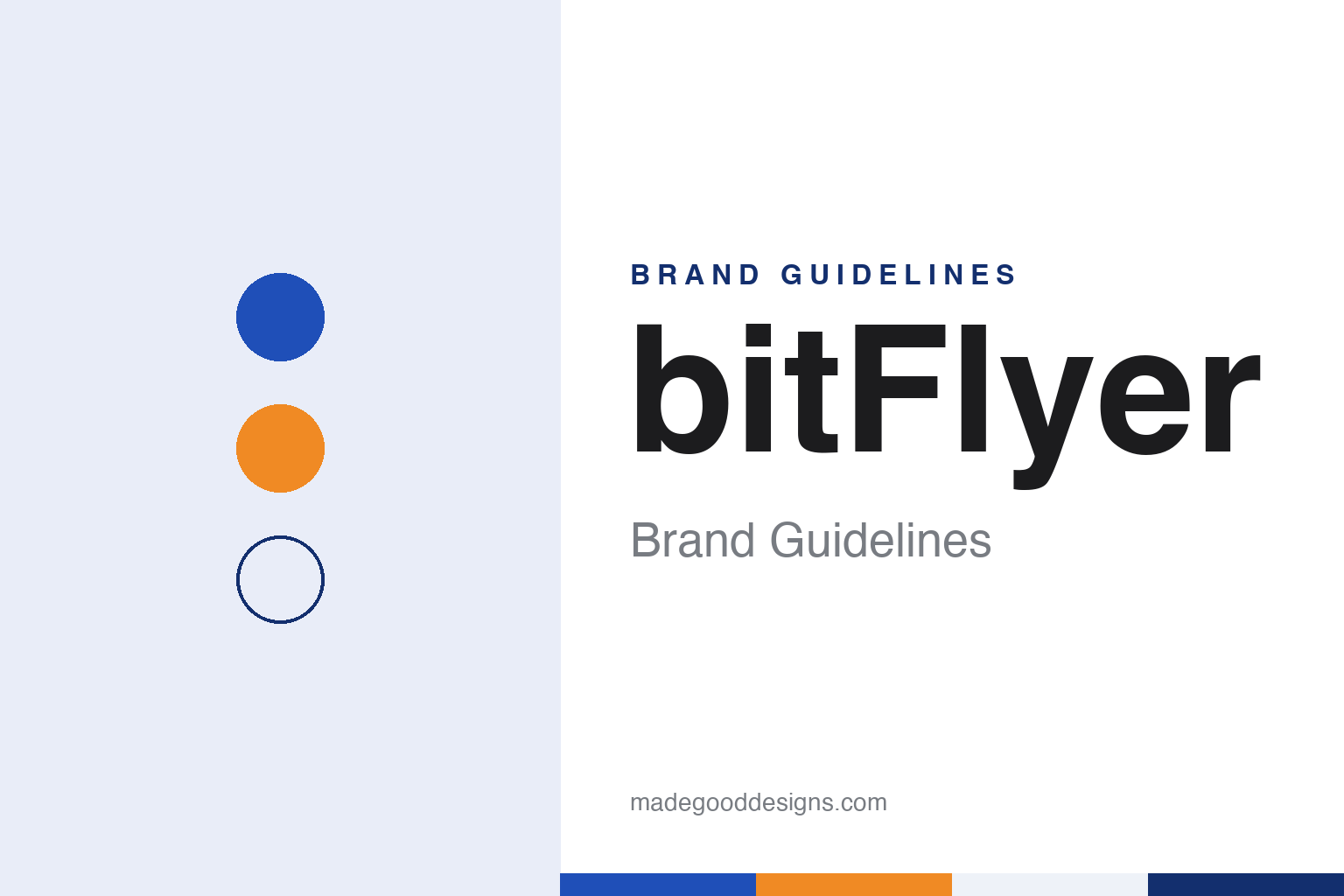
Two constants: an unofficial blue, orange and white palette and a rounded geometric sans register. Abstract homage — not a bitFlyer product or mark; no logo, coin or app screen is reproduced.
bitFlyer, 2014
Two traders start a bitcoin exchange in Tokyo.
bitFlyer, written with a lower-case b and a capital F, is a cryptocurrency exchange based in Tokyo. Japanese Wikipedia dates the company, bitFlyer, Inc., to 9 January 2014, with Yuzo Kano as representative director, and English Wikipedia says the exchange launched in April that year, a few months before Mt. Gox, then the dominant bitcoin exchange, went out of business. Nippon.com reported in January 2022 that bitFlyer was the creation of Kano and Takafumi Komiyama, who were both working at Goldman Sachs at the time, and that Kano had moved there from an engineering role to trading.
The early business mixed trading with everyday uses for bitcoin. Japanese Wikipedia lists chainFlyer, a tool for visualising the blockchain, in April 2015; deals with point-exchange sites such as Moppy and PeX in 2015 and 2016 that let members swap loyalty points for bitcoin; and a business tie-up with the household-finance company Money Forward in February 2016. English Wikipedia says bitFlyer had 100,000 users by February 2016, and that it later added futures contracts and other bitcoin derivatives to the exchange. Japanese Wikipedia’s timeline also refers to its Lightning spot and Lightning FX markets in January 2018.
Technology was part of the pitch from the start. bitFlyer introduced its own blockchain technology, Miyabi, in 2016, English Wikipedia says, and Japanese Wikipedia describes it as a next-generation private blockchain that also supports smart contracts. Retail payments followed, among them bitcoin payment for the Marui department-store group in August 2017. Kano also led the founding of the Japan Blockchain Association, an industry body, according to both Nippon.com and Japanese Wikipedia.
Colour
Licences on three continents.
Licences came as Japan began to regulate the trade. bitFlyer announced on 29 September 2017 that its registration as a crypto-asset exchange operator was complete, Japanese Wikipedia says. In November 2017 its American unit, bitFlyer USA, announced that it had obtained a New York BitLicense and was starting business in the United States, and in January 2018 bitFlyer Europe announced a payment institution licence and the start of its European business, according to the same article.
Regulatory action followed in 2018. bitFlyer was one of six exchanges that Japanese regulators ordered that year to improve their procedures against money laundering and terrorist financing, and it stopped taking new customers while it put new systems in place, English Wikipedia says. In May 2023 the New York Department of Financial Services issued a penalty against bitFlyer for failing to meet the state’s cybersecurity requirements, according to the same article.
The group widened over the following years. English Wikipedia says bitFlyer created a subsidiary focused on blockchain technology and services in 2019 and introduced bvote, a blockchain-based voting service, in June 2020, alongside a blockchain consulting arm. In December 2021, Japanese Wikipedia says, it launched the bitFlyer credit card, issued by Aplus, on which spending earns bitcoin. Leadership changed hands too: other executives held the representative director post from January 2019 until Kano returned to it on 30 March 2023, according to the same article.
Typography
How crypto exchanges present themselves.
Crypto exchanges sell access to something customers never hold in their hands, so their brands are carried by screens, numbers and paperwork. Across the category, wordmarks appear in black, yellow, blue and bright neon tones, and the app screens that exchanges publish in stores and on their own sites put price charts, order books and coin icons at the centre of the picture.
Listing pages form a second layer. Each coin or token an exchange supports gets a page of its own, with a ticker symbol, a chart and a short description, and new listings are announced as news. Alongside them sit proof-of-reserves pages, where an exchange publishes snapshots comparing the assets it holds with what it owes customers, and security pages that explain how funds are stored, for example in internet-connected hot wallets and offline cold storage. The Journal of Accountancy noted in November 2026 that such a proof is a self-prepared, point-in-time comparison rather than an audit.
Regulation shapes the look as much as marketing does. Footers and legal pages list licences and registrations country by country, and the same brand can offer different products, or none, depending on where a visitor lives. Under the EU’s Markets in Crypto-Assets rules, exchanges name the national supervisor that authorised them, and a market exit reaches customers as a dated notice with deadlines for withdrawals.
Two more channels carry the names further. Sports sponsorships put exchange logos on football shirts, tournament boards and arena signs, far from any trading screen. Help centres do the quieter work: guides to identity checks, deposits, fees and withdrawals, written for people new to the product. The guides in this collection look at how individual exchanges put those parts together.
Aa
A rounded geometric sans, echoing the softened corners of the 2026 mark. (Specimen set in Outfit, a sans STAND-IN; NOT the bitFlyer logo.)
bitFlyer
Blocks, a coin, an F and a flying wing.
The fullest design record comes from the company itself. On 13 July 2026 bitFlyer renewed its service, reworking the smartphone app’s screen design, information layout and buying steps, and replacing its brand logo, official website and outdoor advertising, it said in a press release. The new logo keeps the three ideas that the company says lay behind the old symbol — blocks and a coin, the letter F and the shape of a flying-wing aircraft — and gives the corners of the symbol and the logotype a slight rounding, for a softer and less formal impression. The blue and orange were changed to more vivid tones, and the logotype’s typeface and colour were adjusted to make it easier to read. A new commercial, “We are Flyer,” launched with a concept message that translates roughly as “making crypto assets more fun and more free.” Earlier television spots, Japanese Wikipedia says, chanted the company name to the rhythm of the Russian folk song Korobeiniki.
Today the group is led by bitFlyer Holdings in Minato, Tokyo, with Kano as chief executive. In a second release on the same day it announced bitFlyer Prime, a prime-brokerage service for institutional investors and businesses planned for 2027, with over-the-counter trading through bitFlyer and custody through its sister company Custodiem; it says both are registered as type-one financial instruments businesses and crypto-asset exchange operators. The company says it ranked first in Japan for bitcoin trading volume in each of the ten years from 2016 to 2025, by its own reading of industry-association and company data, and that the group works from bases in Japan, the United States and Europe.
For a design guide, bitFlyer shows how an exchange can redraw a mark without dropping its meaning: the same blocks, coin, F and wing, softened at the corners and brightened in colour. Compare Coincheck, another Tokyo exchange, and Coinbase. For this guide we use a strong blue, a warm orange and white with a rounded sans, an unofficial interpretation; no product or logo is reproduced.
Explore & save
Keep bitFlyer’s identity on hand — save it to a board in the Made Good inspiration library.
bitFlyer identity set
Save the unofficial bitFlyer blue, orange and white palette and the rounded geometric sans register for your own reference.