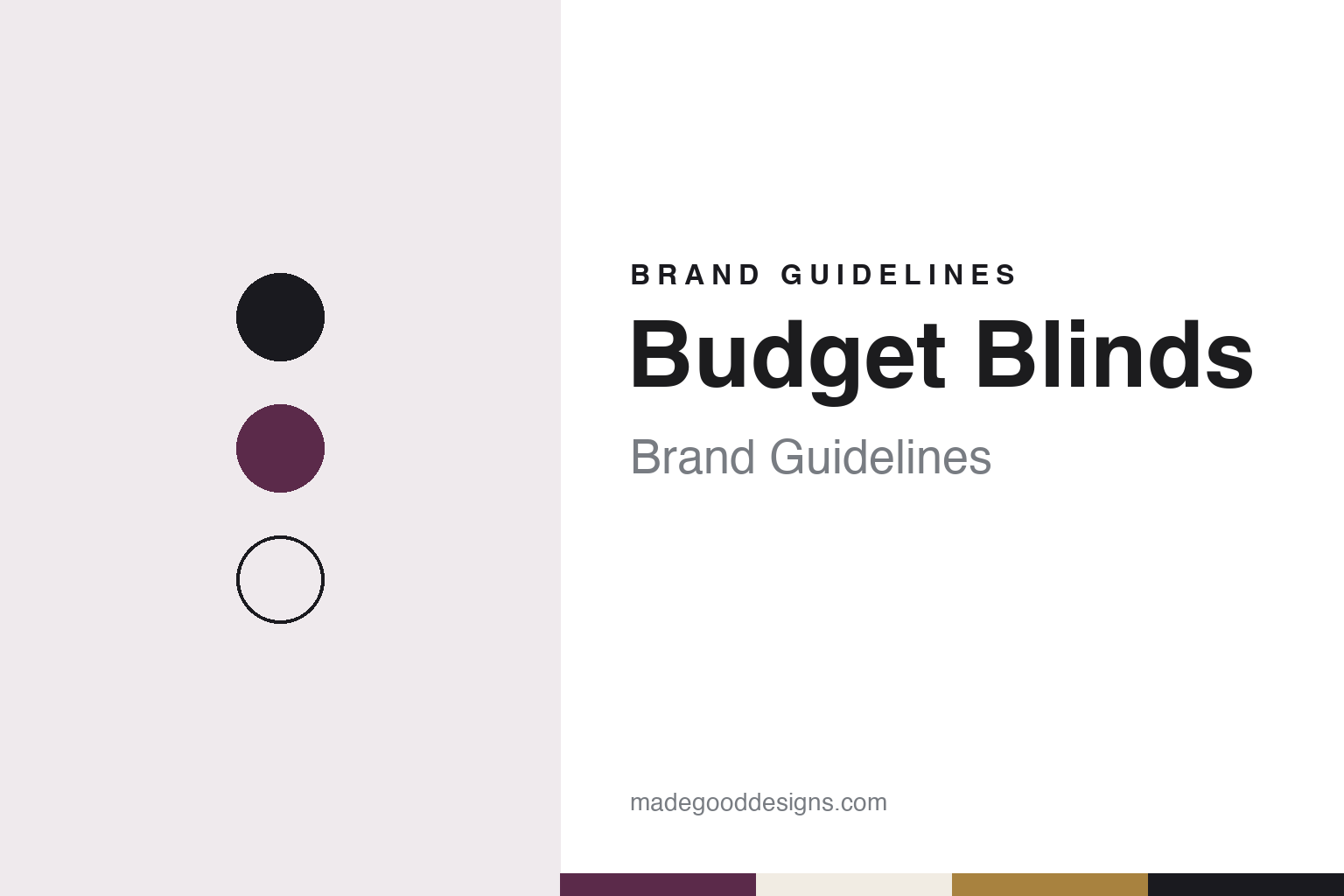
Budget Blinds Brand Guidelines
Orange County’s 1992 shop-at-home window-covering franchise.
Aa
Two constants: a drapery plum, linen and brass palette and a domestic serif register. Abstract homage — not a Budget Blinds product or mark; no blind, logo or van livery is reproduced.
Five friends in Orange County
A door-to-door start and a franchise from 1994.
Budget Blinds began in 1992 in Orange County, California. The company’s own account says it was started by five friends who each put money into a business of their own and built it by knocking on doors. It does not name them on its franchise site, and the story it tells is about the model rather than the people: each founder, it says, brought different strengths, and together they laid the groundwork for something that could be repeated in other towns.
That repetition began quickly. By 1994, the company says, Budget Blinds had started franchising. Its website states that each franchise is independently owned and operated and may not offer every product shown, and that the name is a trademark of Budget Blinds, LLC.
The selling method gives the brand its character. Budget Blinds calls it the Shop-at-Home experience: a consultant visits the customer’s house with samples, measures the windows, and the franchise returns to install the finished order. The company describes complimentary in-home consultations, measuring and professional installation as the core of the model, and says franchisees can run their businesses from a home office with a mobile set-up rather than a shop.
Scale is given in the company’s own figures. Its franchise site said in 2026 that Budget Blinds had grown to nearly 1,500 franchise territories serving more than 10,000 cities across the United States and Canada, and that franchisees install more than 50,000 blinds, shades, shutters, drapes and smart-home products every week.
Colour
Home Franchise Concepts, Trilantic and JM Family.
Budget Blinds became the founding brand of a larger franchise group. Home Franchise Concepts (HFC) says it was founded in 2006 and marked its 20th anniversary in 2026, while tracing its franchising roots back to Budget Blinds in 1992. By 2019 HFC was based in Irvine, California, and franchised four brands: Budget Blinds window coverings, Tailored Living home organising, Concrete Craft decorative concrete and AdvantaClean, a remediation business it had bought in January that year, according to the Orange County Business Journal.
The ownership changed twice in four years. The Orange County Business Journal reported on 8 July 2019 that HFC had been bought by JM Family Enterprises of Deerfield, Florida, on undisclosed terms, from the private equity firm Trilantic, which had owned it since 2015. The paper described JM Family as a privately held company that distributes Toyota parts and provides automotive finance, marketing and insurance products in the south-eastern United States. Budget Blinds’ franchise site confirms the 2019 purchase.
JM Family was founded by Jim Moran in 1968, according to its own website, and HFC sits within JM Family Holdings. Under its new owner HFC kept adding brands. In December 2020 JM Family announced that HFC had agreed to buy Kitchen Tune-Up, a kitchen-updating franchise founded in Aberdeen, South Dakota, in 1988, making it the fifth brand in the group; HFC’s April 2026 announcement describes Kitchen Tune-Up as acquired in 2020.
By 2026 HFC listed a portfolio that included Aussie Pet Mobile, Bath Tune-Up, Kitchen Tune-Up, Lightspeed Restoration, PremierGarage, The Tailored Closet and Two Maids alongside Budget Blinds. Its April 2026 announcement named Corey Benish as president and chief executive.
Typography
Design and documentation.
Blinds, shutters and awnings are sold on how a room looks once they are up, so the companies that make and sell them lean heavily on room-set photography. A typical product page shows a finished window in a kitchen, bedroom or conservatory, often in several light conditions, before it shows the mechanism. Ranges are usually grouped by blind type, such as roller, Roman, Venetian, pleated or vertical, and then again by room, feature and colour, so the menu itself becomes a kind of style guide.
Fabric is the second language of the category. Retailers publish swatches and sample cards, and many offer free samples by post so that customers can hold a fabric against their own walls and daylight. In the UK, the Competition and Markets Authority noted in 2017 that most made-to-measure blind and shutter sales involve a visit to the customer’s home, where an adviser brings product books and samples; online sellers instead rely on posted samples and measuring guides.
Shutters and awnings bring their own imagery. Shutter pages tend to dwell on louvres, frames and finishes in painted or natural wood, shown open, half-tilted and closed. Awning makers photograph patio canopies extended over terraces and gardens, with the fabric, frame and arm in view, and often show the same canopy retracted against the wall.
Behind the product pages, most of these companies keep a corporate side: a short history of a founder and a first workshop, a list of the brands a group owns, and notes on where things are made. Ownership in the category often runs through larger groups, so a brand page may sit inside a family of sister names that share factories, suppliers or a parent company.
Aa
A warm domestic serif for a brand sold in the customer’s living room. (Specimen set in Lora, a serif STAND-IN; NOT the Budget Blinds logo.)
Budget Blinds
A retailer of other makers’ products, plus its own lines.
Budget Blinds is a seller and installer rather than a factory. Its franchise site says owners can offer products from Hunter Douglas alongside exclusive lines and proprietary collections, and its consumer website lists the manufacturers whose products qualify for its warranty. The same site names lines that are its own: Inspired Drapes, which it says is sold only through Budget Blinds and is a Budget Blinds trademark; Enlightened Style; and a Smart Home Collection.
The range on the consumer website is broad and plainly labelled. Blinds come in wood, faux wood, composite, vinyl and aluminium; shades include roller, Roman, cellular, pleated and woven-wood styles; shutters include plantation and café designs; and there are drapes, panels, valances and drapery hardware. Its motorisation pages name Somfy and Lutron systems, and an outdoor section covers awnings, outdoor shades, outdoor drapes and rugs. The franchise site adds home décor accents such as pillows and bedding, and says franchisees also take on outdoor and light commercial projects.
Service promises sit close to the products. The website describes a No-Questions-Asked Warranty available only through Budget Blinds on most new window treatments: within five years of purchase, it says, the manufacturer will make a one-time repair or replacement if the product is damaged after installation, with exceptions for some manufacturers and for motorised, automated and exterior products, and a lifetime version for Enlightened Style products.
The brand’s tone is local. Its pages repeat that Budget Blinds is “in your neighborhood,” describe its franchisees as local window-covering experts, and run a community programme under the name Budget Blinds Cares.
For a design guide, Budget Blinds shows how a franchise brand has to stay consistent across many independently owned businesses while each owner sells in a stranger’s living room, so the name, the plain product menus and the in-home visit carry the identity. Compare Next Day Blinds, another American window-covering business, and Hunter Douglas, one of the makers whose products it sells. For this guide we use drapery plum, linen and brass with a serif, an unofficial interpretation; no product or logo is reproduced.
Explore & save
Keep Budget Blinds’s identity on hand — save it to a board in the Made Good inspiration library.
Budget Blinds identity set
Pin the Budget Blinds drapery plum, linen and brass palette and the domestic serif register to your own board.