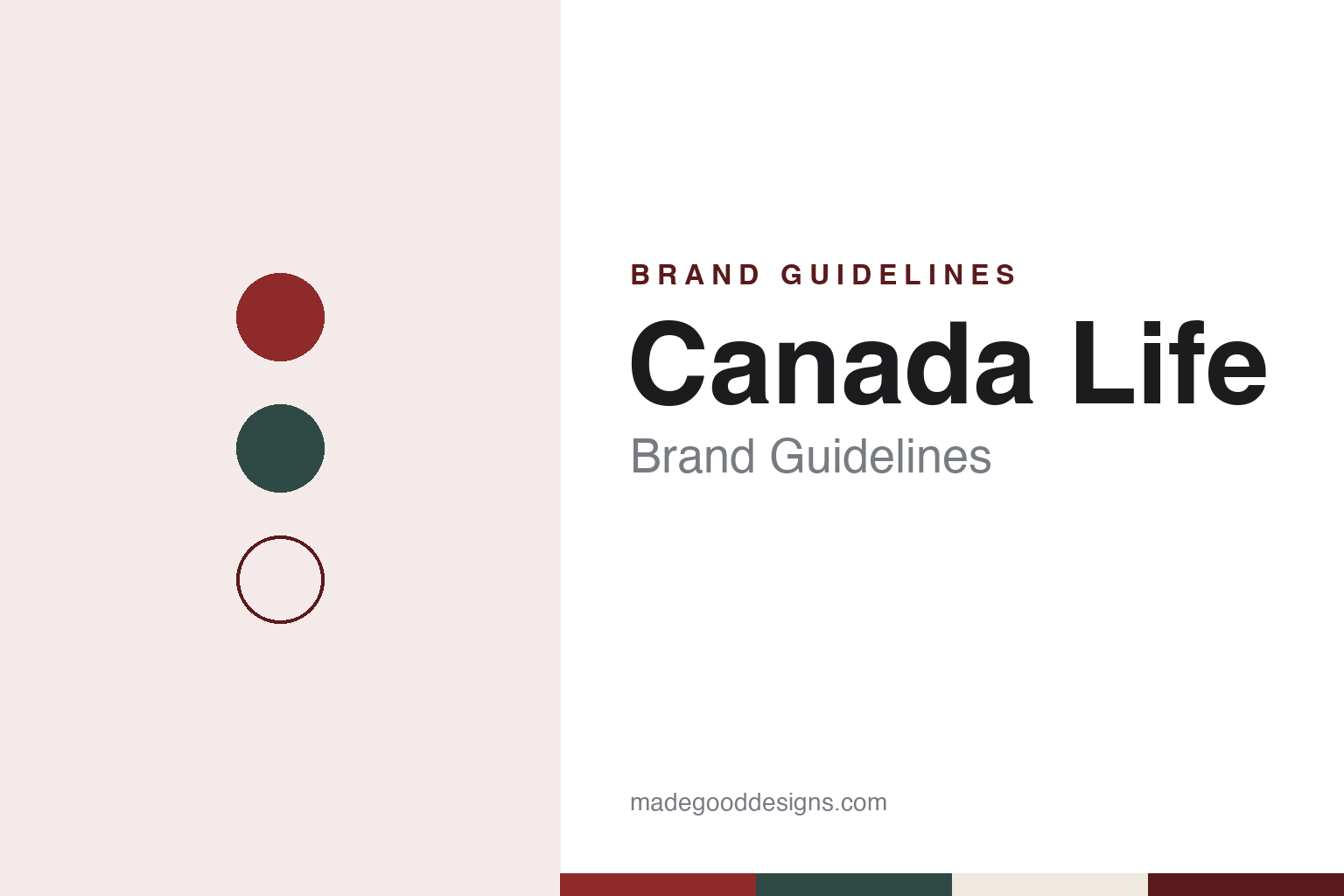
Canada Life Brand Guidelines
The 1847 Hamilton insurer whose name absorbed two others.
Aa
Two constants: a brick red, beacon green and limestone palette and a Civic serif register. Abstract homage — not a Canada Life product or mark; no logo, building or wordmark is reproduced.
Hamilton, 1847
A life insurer from a Hamilton meeting hall.
Canada Life’s name goes back to 1847. English Wikipedia says Hugh Cossart Baker Sr. established The Canada Life Assurance Company in Hamilton, Ontario, on 21 August 1847, and calls it the first life insurance company in Canada; the company itself describes it as Canada’s first domestic life insurance company. It was incorporated in 1849, and Baker served as its president until 1859.
Its first head office, English Wikipedia says, was on the top floor of the Mechanics’ Institute on James Street in Hamilton. The company built its own office in the city in 1855, to a design by Sage and Barger of Buffalo, and moved to King Street East in 1883. Like Sun Life, it put its name on a building in Montreal: a Canada Life Building there was completed in 1895. In 1900 the new president, George Cox, moved the head office to Toronto.
Toronto gave the company its landmark. Work on a new headquarters on University Avenue began in 1929, and the building opened in 1931, English Wikipedia says. Designed by Sproatt and Rolph in the Beaux-Arts style and faced in Indiana limestone, it was the fourth building to serve as Canada Life’s head office, and one of the tallest in the city when it was completed. It was planned as the first of a series of grand buildings along the avenue, a plan the Great Depression halted. The building is a designated heritage property under the Ontario Heritage Act, and later additions include the Canada Life Tower of 2005, designed by Kuwabara Payne McKenna.
Its roof carries the company’s most public piece of design. A weather beacon, completed on 9 August 1951 and described by English Wikipedia as the first of its kind in Canada, shows a short forecast in light: steady green for clear skies, steady orange for cloud, flashing orange for rain and flashing white for snow, with white lights on the tower running up or down as temperatures rise or fall. Environment Canada updates it four times a day.
Colour
Great-West Life, London Life and Power.
Today’s Canada Life is built from three companies. The second is Great-West Life, founded in Winnipeg in 1891 by Jeffry Hall Brock, a local insurance agent, and incorporated on 28 August that year, English Wikipedia says. In 1969 it was bought by Power Corporation of Canada, and in 1984 Power Financial Corporation was created as a holding company for Great-West and its businesses. Its offices on Osborne Street in Winnipeg, opened in 1960, now carry the Canada Life name.
The third is London Life, founded in London, Ontario, in 1874. English Wikipedia says it merged with Great-West Life in 1997, and that its Freedom 55 campaign, launched in 1984, became widely known for the idea of saving enough to retire at 55; the phrase was later given to its sales organisation, renamed Freedom 55 Financial in 2000. Canada Life’s own website still describes Freedom 55 Financial as a division of the company.
Canada Life itself grew too. It bought Crown Life, a Toronto insurer founded in 1900, in 1998, and had begun working in the United Kingdom in 1903. In 2003, English Wikipedia says, Great-West Lifeco acquired Canada Life Financial after Canada Life had rejected a hostile takeover bid from Manulife. The three insurers then sat side by side for more than fifteen years as sister companies within Great-West Lifeco, the Toronto-listed holding company each with its own name.
Canada Life also has a long international reach. The company says it provides insurance, wealth management and benefit products in Canada, the United Kingdom, the Isle of Man and Germany, and in Ireland through Irish Life. In December 2024, English Wikipedia says, Chesnara acquired the UK bonds and legacy pensions business of Canada Life. Its home bases are spread across the country: English Wikipedia lists regional offices in Winnipeg, London, Toronto, Montreal and Regina.
Typography
How Canadian insurers present themselves.
Canadian insurers work in two official languages, and their names often show it. Canada Life is Canada Vie in French, and Great-West Life had a French name of its own before it was folded into Canada Life in 2020. Companies based in Quebec, such as Desjardins, lead with French, while national insurers run their websites, forms and statements in both languages, so a wordmark has to read well in English and in French.
Colour does much of the work. Across the sector, wordmarks and symbols come in reds, blues, yellows and greens: Manulife and Desjardins both use green, Sun Life’s mark is built around a sun, and the weather beacon on Canada Life’s Toronto building signals in green, orange and white. Maple leaves and northern landscapes are a familiar visual shorthand for the country, and they sit easily beside those colours.
The names themselves have shifted. Sun Life and Mutual Life were mutual companies, owned by their policyholders, until they demutualised in 1999 and 2000 and became listed companies, Mutual Life under the new name Clarica; later mergers folded older names such as Great-West Life, London Life and Clarica into bigger brands. Much of the selling still happens through advisor networks and employers, and the websites are organised by need: pages on life, health, home, auto and group cover, and on investment and retirement products.
Insurers also publish a great deal about themselves, from annual reports to sustainability reports and public accountability statements, and those documents carry the brand as much as any advertisement. This guide sets out what can be checked about each insurer: who founded it, who owns it, how its name has changed, and what rests only on the company’s own word.
Aa
A civic serif — one brand, one company. (Specimen set in Libre Baskerville, a serif STAND-IN; NOT the Canada Life logo or wordmark.)
Canada Life
One brand. One company. Canada Life.
The three names became one in two steps. On 3 April 2019, Global News reported, the company announced at London Life’s offices in London, Ontario, that London Life, Great-West Life and Canada Life would amalgamate and rebrand under the name Canada Life, with the London name dropped; the new brand was shown to staff at a live unveiling at Centennial Hall. The report said the merger, which also took in the holding companies Canada Life Financial Corporation and London Insurance Group Inc., still needed board, regulatory and policyholder approvals. English Wikipedia says federal approval came in November 2019.
On 1 January 2020, the company says, the insurers and their two holding companies amalgamated into one company, The Canada Life Assurance Company, under the line “One brand. One company. Canada Life.” In French the brand is Canada Vie, which also appears on customers’ bank statements. The parent company kept its own name, Great-West Lifeco Inc. The company warned that replacing the older names on its websites, forms and materials would take three to five years.
Where Canada Life is based depends on the source. English Wikipedia’s article gives its headquarters as Winnipeg in one place and Toronto, at the Canada Life Building on University Avenue, in another; Global News in 2019 named main offices in London, Toronto and Winnipeg. The brand keeps a foot in each of its three founding cities, and its history includes buildings in Hamilton, Montreal, Toronto and Winnipeg. Its website loads the Foco and Source Sans typefaces, though the company has published no brand guidelines that say so.
For a design guide, Canada Life shows how the oldest of three names, and the plainest, can absorb the others, and how a building can carry a brand in public. Compare Sun Life, another nineteenth-century insurer that moved from Montreal to Toronto, and Manulife, which bid for Canada Life in 2003. For this guide we use a brick red, a beacon green and a limestone with a serif, an unofficial interpretation; no product or logo is reproduced.
Explore & save
Keep Canada Life’s identity on hand — save it to a board in the Made Good inspiration library.
Canada Life identity set
Pin the brick red, beacon green and limestone palette and the Civic serif register to your own board.