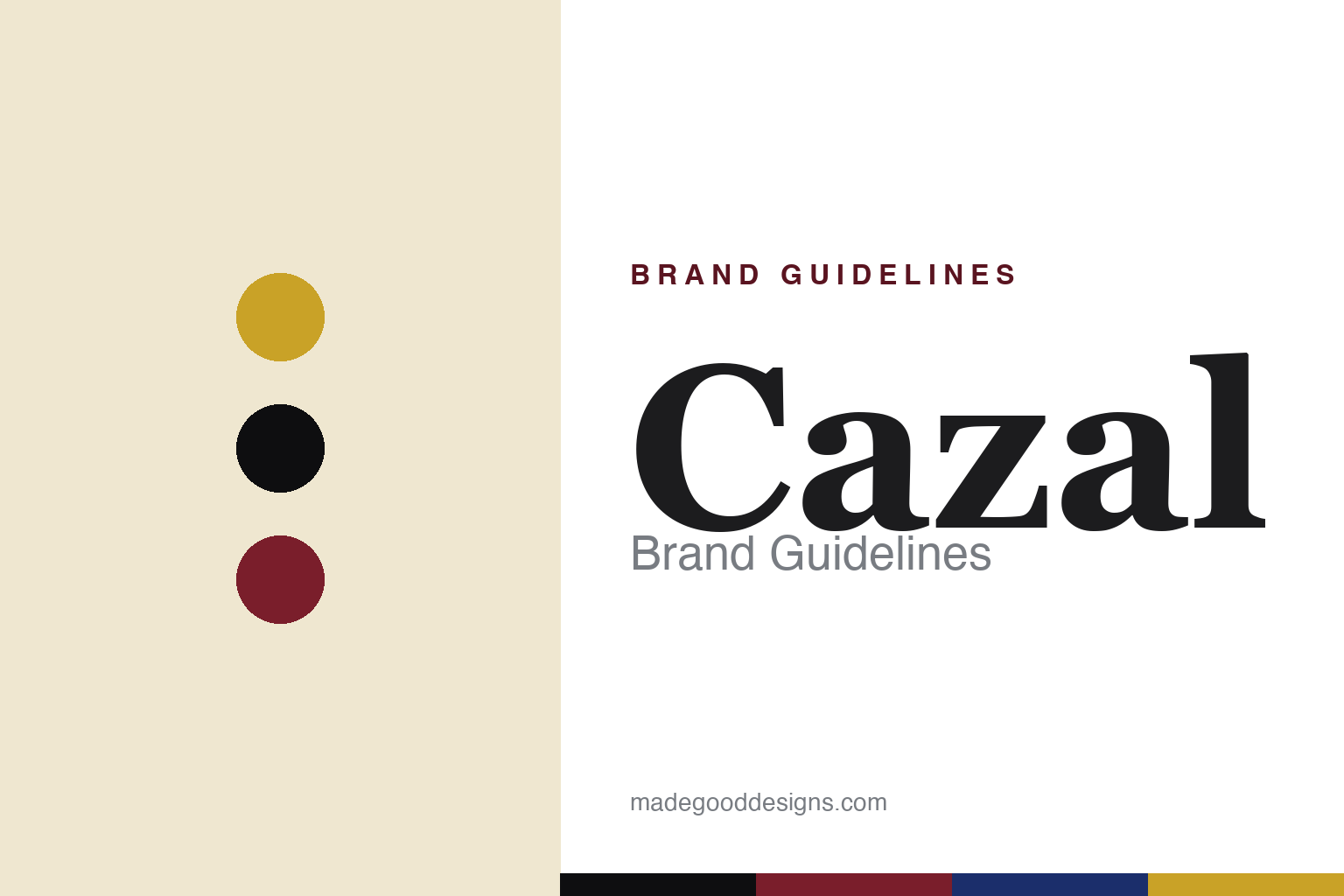
Cazal Brand Guidelines
Bold German eyewear that became a 1980s hip-hop icon — gold, black and jewel tones.
Aa
Two constants: a gold-and-black palette with jewel tones, and a Roman-caps spirit. Abstract homage — not the Cazal wordmark or logo.
From Passau to the block
Cazal became a hip-hop icon from Germany.
Cazal is a lesson in a product adopted by a culture. It was founded in 1975 in Passau, Germany, by designer Cari Zalloni together with business partner Günter Böttcher; the name is simply CAri ZALloni. Zalloni — an Austrian-trained designer born in Athens — gave the brand a bold, avant-garde look: oversized, angular frames with decorative temples, distinctive colour combinations, and even signature asymmetric touches.
Its defining chapter was cultural, and not planned by the company. Through the late 1970s and 1980s, Cazal’s heavy, gold-accented frames — especially models like the 607, 616 and 951 — became a massive hip-hop icon in 1980s New York. “Cazals” were so coveted that they were the reported cause of street robberies, and they were worn across the era’s music and film — Spike Lee wore the 616 in She’s Gotta Have It (1986), and artists from Run-DMC to the Fat Boys made them a status symbol.
Cari Zalloni died in 2012, but the brand continues, reissuing its 1980s classics through the “Cazal Legends” line and trading on its collectible, vintage-luxury heritage. It remains an independent German company (held today by OWP Brillen GmbH in Passau). (Honest notes: Cazal is based in Passau, not Munich; the designer is Cari Zalloni, born in Athens, not simply “Austrian-born,” and it was co-founded with Günter Böttcher, not by Zalloni alone; the hip-hop robberies are well-reported but hard to pin to exact figures; it is an independent company, not owned by a big conglomerate like Luxottica; and no official brand hex is published.)
Colour
Cazal lives in a gold-and-black palette with jewel tones. Click a swatch to copy the hex.
Cazal’s identity is bold, luxurious and 1980s — a jet black, a signature Cazal gold, and jewel tones of ruby, emerald and sapphire. The palette reads like the 607: black frames with gold accents, glamorous and unmistakable, extended with rich jewel colours on temples and lenses. It signals status and boldness rather than restraint — the look that a culture chose as a symbol. The honest caveat: with no published brand hex, these tones are an original, unofficial interpretation, not first-party values.
The lesson is a gold-and-black palette with jewel tones signals bold status. Cazal’s world reads as glamorous and confident. For designers, it is a reminder that black plus gold, lifted with jewel accents, reads as luxury and boldness — matching frames that became a 1980s status symbol. The takeaways: pair black with gold for status; add jewel tones for richness; and treat any single hex as unofficial when there is no published spec.
Typography
The wordmark spirit is bold Roman caps — glamorous and confident.
Cazal’s identity carries a bold, glamorous, 1980s spirit — a “CAZAL” wordmark in confident capitals whose weight matches oversized, status-symbol frames. A bold Roman-caps letterform captures the mood: it is glamorous and assured, the register of a gold-accented luxury frame rather than something quiet. Set against a gold-and-black palette, the caps feel rich and commanding — exactly the 607, hip-hop-icon personality Cazal carries. It is bold rather than understated, mirroring frames a culture wore as a badge. (Cazal’s real wordmark is a trademark we describe but do not reproduce, and the exact typeface is not something we assert.) Because the specific mark is not ours to use, the honest description is “a bold Roman-caps spirit,” not the Cazal logo. The type behaves like the brand: bold, glamorous and confident.
Aa
A bold Roman-caps spirit — glamorous and confident. (Specimen set in Cinzel, a Roman-inspired caps serif; NOT the Cazal logo, which is a trademark.)
A cultural icon as the difference
Cazal stands for bold heritage.
Cazal is a lesson in the power of being adopted by a culture. The company designed bold, avant-garde German luxury frames, but its most valuable asset was earned outside the boardroom: in 1980s New York, hip-hop made Cazals a status symbol, turning models like the 607 into cultural icons whose meaning went far beyond eyewear. That authentic cultural moment — impossible to manufacture — is exactly what the “Cazal Legends” reissues now draw on, giving the brand a collectible heritage that newer names cannot buy. Bold design plus genuine cultural history is a rare, durable position.
For designers and brand-builders, Cazal offers a clear takeaway: a genuine cultural moment can define a brand for decades. The lessons: make a product distinctive enough to be adopted as a symbol (bold, unmistakable frames); honour the culture that embraced you rather than erasing it; and let reissues and heritage lines carry that story forward honestly. It is also a reminder to keep the facts precise: Cazal was founded in 1975 in Passau by Cari Zalloni and Günter Böttcher, became a 1980s hip-hop icon through models like the 607, and continues as an independent German brand — with the palette here an unofficial interpretation. Cazal was chosen by a culture — proof that becoming an icon can be the difference.
Explore & save
Keep Cazal’s identity on hand — save it to a board in the Made Good inspiration library.
Cazal identity set
Pin the gold-and-black palette and the Roman-caps spirit to your own board.


