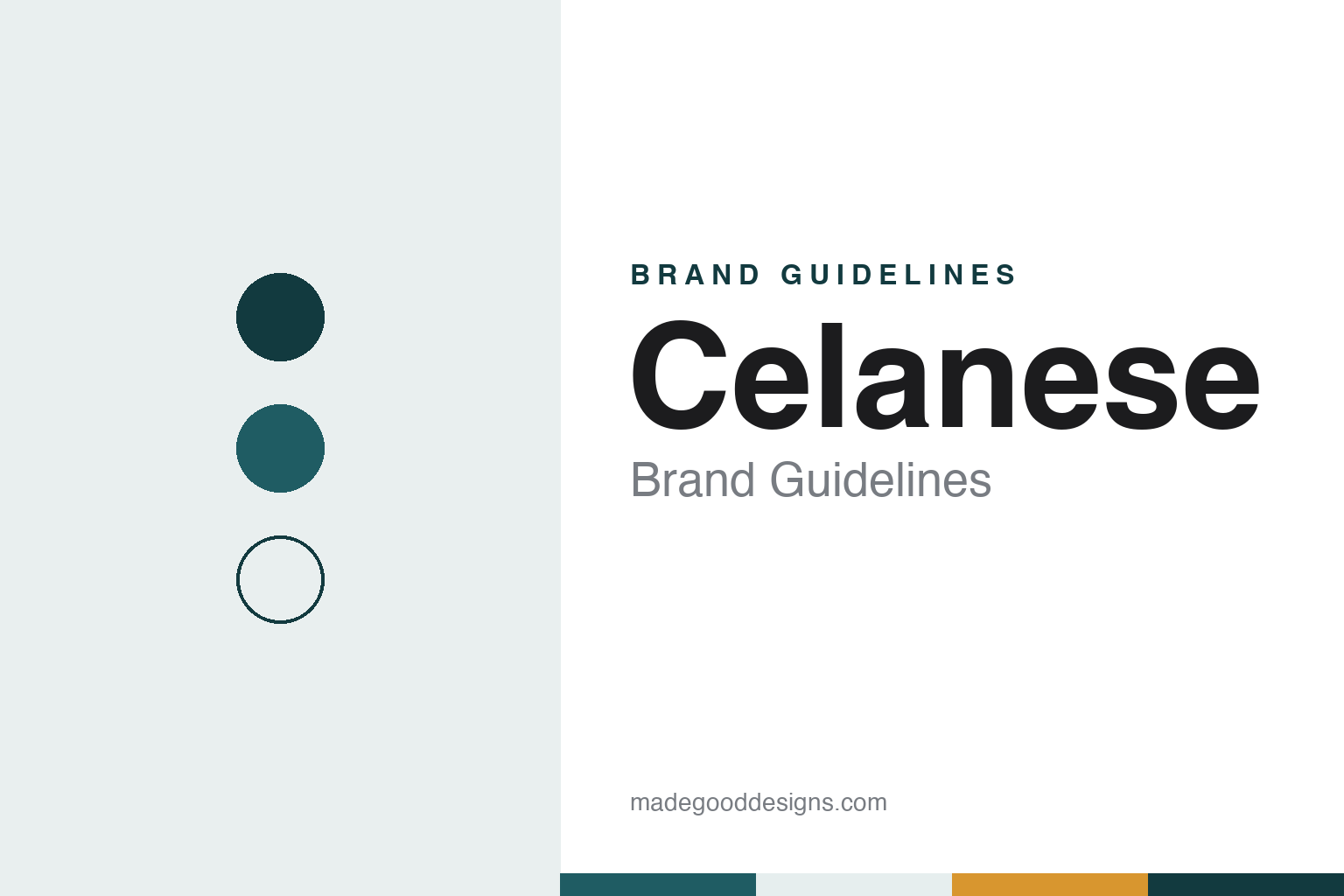
Celanese Brand Guidelines
The acetate maker that named itself after cellulose and ease.
Aa
Two constants: a deep teal, slate and warm amber palette and a technical sans register. Abstract homage — not a Celanese product or mark; no logo, label or material sample is reproduced.
Amcelle
A cellulose acetate venture of 1918.
Celanese traces its start to 1918, when the Swiss chemist Camille Dreyfus founded the American Cellulose & Chemical Manufacturing Company, known as Amcelle, in New York City, English Wikipedia says. Its plant at Cumberland, Maryland, was planned during the First World War to make a cheaper fabric for aircraft, and the site was chosen for its access to water from the Potomac River, coal supplies and railway lines. After a series of delays, production began on Christmas Day 1924, with cellulose acetate fabrics and yarns meant as alternatives to silk. The Cumberland plant closed in 1983.
The name came from marketing. In 1925 the company introduced the word “Celanese”, a blend of “cellulose” and “ease”, to stress how easy its acetate yarn fabrics were to clean and look after, and in 1927 it officially took the name Celanese Corporation of America, according to the same source. In 1947 it began making acetate fibre near Ocotlán, in Jalisco, Mexico, a plant that closed in 2019; by 1958 it had 13 plants in the United States, three research and development centres, some 30 groups of products and about 13,000 employees.
The company also used architecture to show off its materials. In 1959 it commissioned the architect Edward Durell Stone to build the “Celanese House”, a model home in New Canaan, Connecticut, that showcased its new materials and styles. In 1982 it bought certain operations of the British group ICI, and in 1986 it spun off its pharmaceutical business as Celgene, English Wikipedia says.
Colour
Hoechst, Blackstone and a return to the stock market.
In 1987 the German group Hoechst AG bought Celanese and merged it with its American subsidiary, American Hoechst, to form Hoechst Celanese. Hoechst had been founded in 1863 at Höchst, near Frankfurt. From 1925 it was part of the IG Farben conglomerate, whose managers, including those in charge of Hoechst, were tried at Nuremberg after the Second World War in the IG Farben trial, which covered the exploitation of enslaved labourers; Hoechst was re-founded in Frankfurt on 7 December 1951, when IG Farben was split into its founding companies, English Wikipedia says.
In 1998 Hoechst Celanese sold its Trevira polyester division to KoSa, a venture of Koch Industries and Mexican partners. In the same year Hoechst combined most of its industrial chemical operations into a new company, Celanese AG, and in 1999, as part of the restructuring around its merger with France’s Rhône-Poulenc, spun it off as a German company listed in Frankfurt and New York. The businesses it carried included Ticona, the engineering polymers arm, according to English Wikipedia’s article on Hoechst.
The private equity firm Blackstone announced a takeover offer on 16 December 2003; shareholders approved it in June 2004, the company left the New York Stock Exchange, and Blackstone changed its name back to Celanese Corporation. On 21 January 2005 Celanese returned to the exchange through a public offering under the symbol CE, English Wikipedia says. Later moves included selling its polyvinyl alcohol business to Sekisui Chemical in June 2009 and, in late 2020, selling its 45% stake in the Japanese plastics maker Polyplastics to Daicel, which already owned the rest.
Its record also includes litigation. In 1985 Hoechst Celanese was named, with Shell Oil and US Brass, as a defendant in a class action over leaks in polybutylene plumbing systems, for which it had supplied acetal resins used in pipe fittings; the case was settled in 1995, according to English Wikipedia.
Typography
Design and documentation.
Specialty chemicals makers sell mostly to other companies, so their brands rarely appear on a shelf. What they make ends up inside shampoo, paint, crop sprays, plastics and circuit boards under someone else’s name. Their identities have to work for buyers, chemists, investors and job seekers at once, and most of them settle on a similar, restrained toolkit.
The marks tend to be precise sans-serif wordmarks, often a coined or shortened name set in lower case or in a clean capital form, sometimes paired with a small symbol that suggests a molecule, a droplet, a leaf or a ring. Colour usually runs through blues, greens and teals, the shades a reader links with water, science and the outdoors, with one brighter accent kept for highlights and charts. Photography leans on laboratories, gloved hands, pilot plants and pipework, alongside close-ups of the everyday products that the chemistry ends up in.
Websites in the category are organised by end market rather than by chemical family. A visitor picks personal care, home care, coatings, adhesives, agriculture, mining, energy or electronics, and lands on pages of named product ranges. Product finders, technical data sheets, certificates and sample requests sit close to the top of the navigation, because that is what formulators come for. Many groups also run regional sites and separate pages for each business unit.
The rest of the site carries the corporate story. Sustainability reports, innovation pages, purpose statements and annual reports explain strategy to investors and the wider public, while careers pages show researchers, plant teams and graduate programmes. For a designer, the category is a study in clarity: a calm palette, a readable sans and a structure that lets very technical material stay easy to find.
Aa
A technical sans for an engineered-materials register. (Specimen set in IBM Plex Sans, a sans STAND-IN; NOT the Celanese logo.)
Celanese
From acetate yarn to engineered materials.
The largest recent change came in 2022. Celanese announced in February 2022 that it would buy most of DuPont’s Mobility & Materials business, and on 1 November 2022 said the purchase was complete, adding a portfolio of engineered thermoplastics and elastomers, brands, intellectual property and production sites, according to its press release. Its own acquisitions timeline also lists the Santoprene thermoplastic vulcanizate business from ExxonMobil in December 2021, the Elotex redispersible polymer powders from Nouryon in March 2020 and, in September 2023, the formation of Nutrinova, a food ingredients joint venture with Mitsui & Co.
Today Celanese describes itself as a global chemical and specialty materials company. Its website groups the business into the acetyl chain, engineered materials, cellulose acetate and food ingredients, and carries the line “The Chemistry Inside Innovation”. English Wikipedia puts its headquarters in Irving, Texas, and lists products from acetic acid, acetic anhydride and vinyl acetate to the Sunett sweetener and Clarifoil cellulose acetate film. It says the company runs 25 production plants and six research centres in 11 countries, mainly in North America, Europe and Asia, with acetic acid plants in the Clear Lake area of Pasadena, Texas, on Jurong Island in Singapore and in Nanjing.
For a design guide, Celanese shows how a coined product word can outlast the fabric it was made for and stay in use through German, private equity and public ownership. Compare DuPont, whose materials business it bought in 2022, and Eastman, another American maker that grew up on cellulose acetate. For this guide we use a deep teal, a slate and a warm amber with a sans, an unofficial interpretation; no product or logo is reproduced.
Explore & save
Keep Celanese’s identity on hand — save it to a board in the Made Good inspiration library.
Celanese identity set
Save the Celanese deep teal, slate and warm amber palette and the technical sans register to your own board.