Chex Mix Brand Guidelines
A homemade ‘party mix’ from a 1952 cereal-box recipe — turned into a bag, on a checkerboard heritage.
Aa
Two constants: a warm, savory palette and a bold, chunky wordmark. Abstract homage — not the Chex Mix wordmark or checkerboard.
A party mix from the box
Chex Mix started as a homemade recipe.
Chex Mix is a lesson in a brand born from a recipe, not a product. The real origin is homemade: “Chex Party Mix” — Chex cereal tossed with pretzels, nuts and a seasoned butter-and-Worcestershire coating, then baked — first appeared in a 1952 Chex advertisement in Life magazine, published by Ralston Purina. (A nice detail: the original 1952 recipe used only Wheat Chex and Rice Chex with Worcestershire, butter, garlic salt and nuts — no pretzels or bagel chips; those came later.) For roughly three decades the recipe lived on the back of Chex cereal boxes, a beloved homemade party snack, before Ralston finally launched the ready-made packaged Chex Mix in 1985. The brand’s heritage is a recipe people made themselves. (Honest caveats: no official brand hex or wordmark typeface is published, so the colours and type here are approximate.)
The name comes from the cereal. Chex — the checkerboard-square cereal (Wheat Chex from 1937, Rice Chex from 1950, Corn Chex later) — descends from Ralston Purina, and the “Chex” name and its square shape trace to Ralston’s famous red-and-white checkerboard logo, adopted back in 1902 by founder William H. Danforth. That checkerboard heritage is baked into the brand’s identity, from the square cereal pieces to the packaging motifs.
Ownership moved over time. Ralston Purina spun its cereal business into Ralcorp (1994), and the Chex line was sold to General Mills — announced in 1996 and closed in 1997. So both Chex cereal and Chex Mix are owned today by General Mills (Ralston created them; General Mills acquired them — an important distinction). The packaged snack is the familiar mix of square Chex pieces, pretzels, breadsticks and rye/bagel chips in a savoury seasoning, sold in flavours like Traditional, Cheddar, Bold Party Blend and Hot & Spicy. A homemade classic, turned into a bag.
Colour
Chex Mix lives in warm, savory tones. Click a swatch to copy the hex.
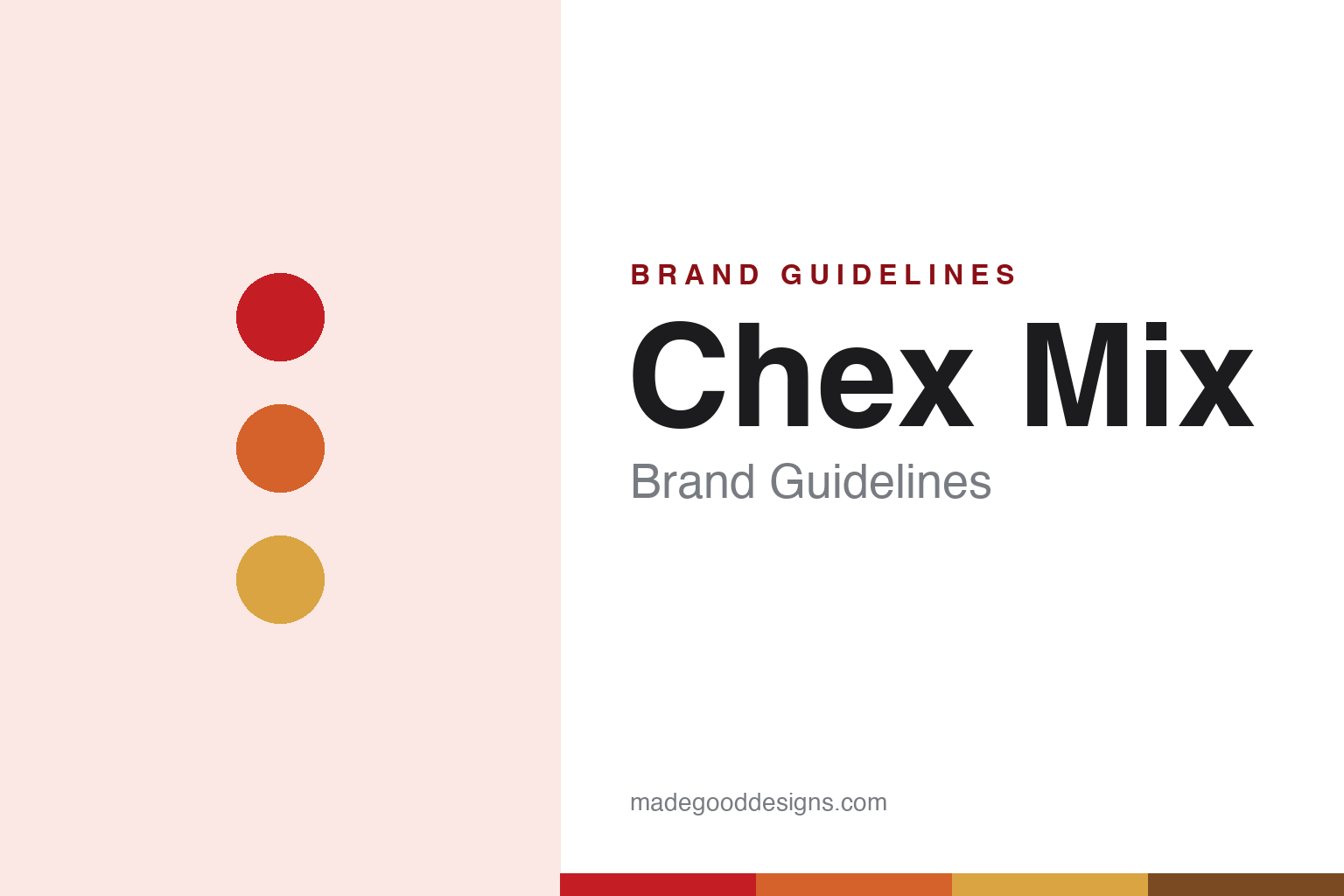
Chex Mix’s palette is warm and savoury — a party red, a savoury orange, golden tan and pretzel brown, echoing the toasted, seasoned mix inside and the red-and-white checkerboard heritage. The red reads as festive and appetising (this is a “party” snack), the orange and tan signal savoury seasoning and the baked mix, and the browns ground it in real, hearty food. It’s a warm, snacky, gathering-friendly scheme that suits a shareable bowl of party mix. The honest caveat: Chex Mix publishes no official public brand hex — the red, orange and tans here are observed approximations, not a confirmed spec.
The lesson is a warm, savoury, party palette. Chex Mix’s reds, oranges and tans read as festive and appetising, matching a shareable party snack. For designers, it’s a reminder that a palette can signal “gathering” and “savoury” as clearly as it signals a flavour. The takeaways: use festive warm colour to signal a shareable, party product (the red); pull savoury oranges and browns from the toasted mix; and treat specific hexes as approximate when no official spec is published.
Typography
The wordmark is a bold, chunky type — fun and snacky.
Chex Mix’s bold, chunky wordmark is fun and snacky — heavy, rounded, high-impact letters that feel festive and appetising, matching a shareable party snack. The type is loud and friendly rather than refined, the visual equivalent of a big bowl of mix at a gathering, and it pairs naturally with the warm, savoury red-and-orange palette and the checkerboard heritage. It reads as casual, hearty and fun — exactly the “grab a handful” personality Chex Mix owns. (Because the exact face is custom and undocumented, the honest description is “a bold, chunky type,” not a named font.) The type behaves like the brand: fun, chunky and snacky.
Aa
A bold, chunky type — fun and snacky. (Specimen set in Titan One, a heavy rounded display face in the spirit of the Chex Mix wordmark; the real lettering is custom.)
From recipe to brand
Chex Mix turned a homemade classic into a product.
Chex Mix is a lesson in turning a beloved homemade recipe into a packaged brand. For decades, “Chex Party Mix” was something people made — a recipe on the back of the cereal box, tied to holidays and gatherings. That deep, homemade, nostalgic association was the brand’s greatest asset when Ralston finally bagged it in 1985: buyers already knew and loved the mix, so the packaged product felt like a familiar friend, not a new invention. It’s a reminder that a brand can grow out of a shared ritual, and that heritage — even a recipe — is something you can package.
For designers and brand-builders, Chex Mix offers a clear takeaway: a shared ritual or recipe can become a powerful brand. The lessons: recognise and package the equity in a beloved habit (the homemade party mix); carry the heritage into the identity (the checkerboard, the “party mix” idea); and keep the design warm, festive and shareable to match how the product is used. It’s also a reminder to keep the facts precise — the Chex Party Mix recipe dates to a 1952 Ralston Purina ad (originally without pretzels), lived on cereal boxes for decades, and became the packaged Chex Mix in 1985; the “Chex” name and square come from Ralston’s 1902 red-and-white checkerboard; and Chex was created by Ralston Purina and acquired by General Mills (announced 1996, closed 1997). Chex Mix turned a recipe into a brand — proof that a shared ritual can be packaged.
Explore & save
Keep Chex Mix’s identity on hand — save it to a board in the Made Good inspiration library.
Chex Mix identity set
Pin the savory party palette and the chunky-wordmark spirit to your own board.