China Merchants Port Brand Guidelines
An 1872 steamship lineage and a Hong Kong port network.
Aa
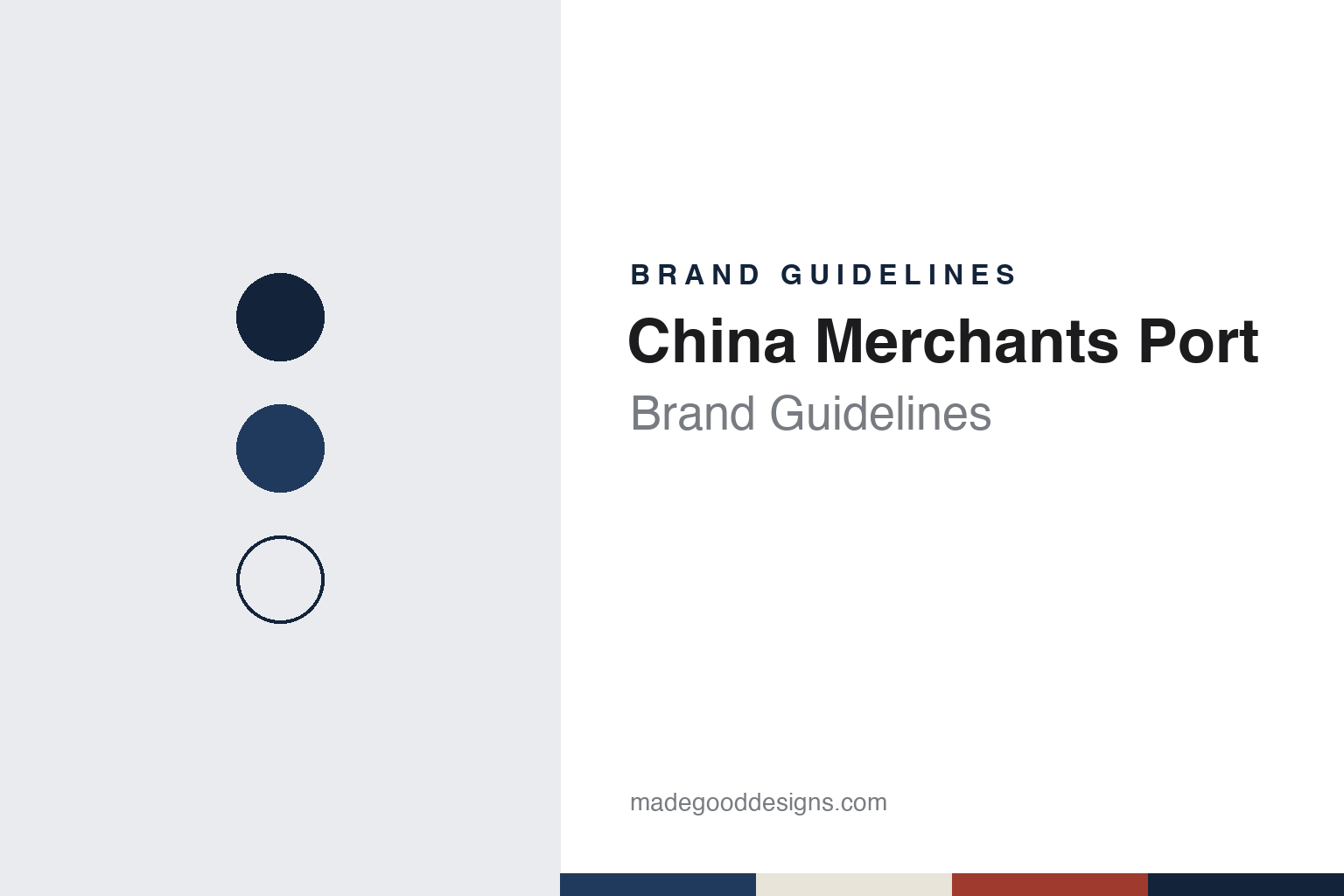
Two constants: a navy, cream and brick-red palette and a heritage serif register. Abstract homage — not a China Merchants Port asset or mark; no logo, crane or vessel is reproduced.
From steamships to quays
A Shanghai shipping company of 1872 and a Hong Kong port arm.
China Merchants Port Holdings is the port business of China Merchants Group, and both trace their name to the China Merchants Steam Navigation Company, set up in Shanghai in December 1872. English Wikipedia says the company was founded by Li Hongzhang, then Viceroy of Zhili, to win a share of coastal trade then carried mostly by foreign firms, and that its first steamship, the Aden, was bought from P&O in 1872. The group’s own history says it opened for business in Shanghai in January 1873 and set up a Hong Kong branch the same year. In 1877, English Wikipedia adds, it bought the whole 17-ship fleet of the Shanghai Steam Navigation Company from Russell & Co.
The company was nationalised and reorganised in 1935, according to English Wikipedia. During the Sino-Japanese War it sold four ships to Jardine Matheson in Hong Kong, and other ships were scuttled; its head office moved for a time to Hong Kong and to Chongqing. After 1945 it took over enterprises and ships that had been under Japanese control. In 1949 the company divided: the head office moved to Taiwan, where that arm later merged into Yang Ming Marine Transport in 1995, while the Hong Kong subsidiary kept the China Merchants name under the mainland side.
The modern revival began in 1979, when the group developed the Shekou Industrial Zone in Shenzhen. The group describes Shekou as China’s first open industrial park and credits it with the slogan “Time is money, and efficiency is life.” English Wikipedia says the approach became known as the Port-Park-City model, or Shekou Model, and that the group founded China Merchants Bank in 1987.
Colour
A 1991 company, two renamings and a global network.
The listed port company is younger than the group. English Wikipedia dates its predecessor to 28 May 1991 in Hong Kong, gives its renaming as China Merchants Holdings (International) in June 1997, and dates its Hong Kong Stock Exchange listing to July 1997; the company’s own profile says it has been listed since 1992. In August 2016 it took its present name, China Merchants Port Holdings, and its company history records the change. China Merchants Group remains the controlling shareholder.
At home, English Wikipedia describes a port network spread across the Pearl River Delta, the Bohai rim, Xiamen Bay, the Yangtze River Delta and Southwest China, with coastal hubs that include Hong Kong, Shanghai, Qingdao and Xiamen Bay. By 2020, it adds, the company had a network of 41 ports in 25 countries, including the Lomé Container Terminal in Togo.
The company describes its core business as port investment, port operations, port logistics and smart technology, and says it now works at 46 ports in 26 countries and regions. Its timeline marks several steps abroad. In December 2015 a consortium of China Merchants, COSCO Pacific and CIC Capital completed a purchase of 65% of Kumport in Turkey. In 2017 it acquired Hambantota International Port Group and Shantou Port Holdings, and announced a 90% stake in the Paranaguá container terminal in Brazil, which the company says took its business to all five continents. PortNews reported in November 2026 that China Merchants Port controls the holding company that owns TCP, the operator of that terminal. Its Sri Lankan investment, Colombo International Container Terminals, is also on the company timeline.
Size figures come from the company and from rankings. English Wikipedia says Lloyd’s List placed China Merchants Port fifth among global port operators in 2018. The company reports container throughput across its domestic and overseas ports of 78.21 million TEU in the first half of 2026. It also says its terminal operating system has been deployed in 38 projects in seven countries, so software now sits beside cranes and berths in how it presents itself.
Typography
How port operators present themselves.
Container lines, box lessors and port operators sell capacity rather than consumer products, and they present themselves mostly to shippers, carriers, investors and job seekers. Their identities travel on large objects. A line’s colours and name are repeated on hulls, on the containers it owns and on terminal equipment. Corporate photography tends to show ships at sea, stacked containers and cranes over quays, often lit at night.
Websites carry much of the practical work. Carriers publish schedules, route maps and booking or tracking tools; lessors such as Triton run sales portals, product sheets and pages on container conditions; terminal operators list their ports, berths and services. Fleet pages and dated timelines matter a great deal: Seaspan’s site, for example, sets out its history as a year-by-year list of ship deliveries, designs and orders.
Fuel and emissions now have pages of their own. Shipowners and lines describe dual-fuel ships, retrofits and new fuels such as LNG and methanol, usually in their own words and with their own figures, alongside sustainability reports and the certificates and policies they choose to publish. Those pages are statements by the companies, and this guide reports them as such.
Ownership changes often. Many companies in this group were formed by merger, are owned by infrastructure or private-equity investors, or are partly held by the carriers they serve, and their annual reports, preference shares and investor pages remain public even after a take-private. This guide sets out what can be checked about each company — when it was founded, who owns it and how it describes its business — and marks clearly what rests only on its own word.
Aa
A heritage serif for a company with an 1872 lineage. (Specimen set in Noto Serif, a serif STAND-IN; NOT the China Merchants Port logo.)
China Merchants Port
We connect the world, the company says.
The company sets out its brand in plain terms on a Brand Philosophy page. Its positioning line presents China Merchants Port as a port service provider at the front of its industry, and the company says that line doubles as its corporate slogan and its strategic goal. Its brand vision is the phrase “WE CONNECT THE WORLD”, set in capitals on the page, which it explains as bringing places and goods closer through its terminals and logistics links. Three strategic drivers are named beside it: “Global Presence,” “Lean Management” and “Innovative Transformation.”
That language leans on the parent group’s age. The company says its positioning inherits China Merchants Group’s historic mission, and the group presents itself as a company founded in 1872 that helped start China’s modern shipping industry. For a port operator whose physical assets are quays, yards and cranes spread across many countries, the 1872 date gives one thread that runs through every terminal name and annual report.
For a design guide, China Merchants Port shows how a young listed company can borrow the depth of a group history that runs back to the steamship era while speaking in the short, global phrases of modern logistics. Compare Yang Ming, the Taiwanese line into which the Taipei arm of the old steamship company merged, and COSCO Shipping, whose ports arm joined it in the Kumport purchase. For this guide we use harbour navy, cream and brick red with a serif, an unofficial interpretation; no product or logo is reproduced.
Explore & save
Keep China Merchants Port’s identity on hand — save it to a board in the Made Good inspiration library.
China Merchants Port identity set
Save the China Merchants Port navy, cream and brick-red palette and the heritage serif register for your own reference.