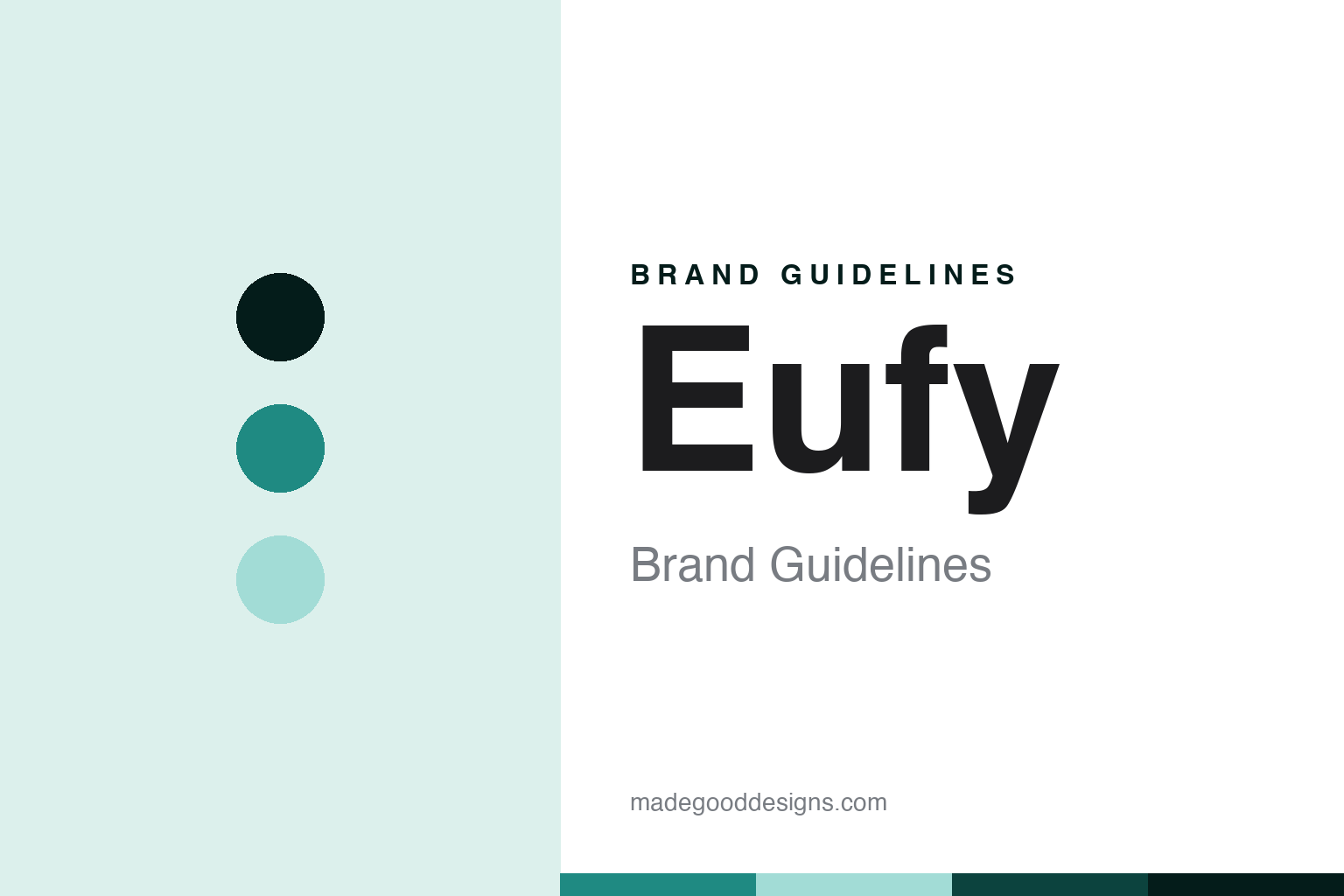
Eufy Brand Guidelines
The no-fee local pitch.
Aa
Two constants: a local-teal palette and a local-first-sans register. Abstract homage — not a Eufy product or mark; no camera, base or logo is reproduced.
The no-fee local pitch
Eufy is Anker’s smart-home brand built on a local-storage, no-monthly-fee pitch that a 2022 episode tested, and that it moved to remedy.
Eufy brings the round its privacy-pitch node — Anker’s smart-home brand that sold cameras on the promise of local storage and no monthly fee, a pitch that a 2022 episode put to the test and that the company then moved to make good on. Its answer to a round about who owns the camera and where it is made is a Chinese one, under Anker, made in China, competing on a local-first, no-subscription message.
Its identity is the no-fee local pitch. The local-storage promise, the Anker ownership and the documented, since-remedied 2022 privacy episode are the story here. A camera, local and no-fee. The no-fee local pitch.
(Honest notes, so the ownership, the pitch and the 2022 controversy are framed with real care and proper bounds. Eufy sells cameras as its heroes — battery eufyCam, wired, doorbell, floodlight and indoor models — with a signature selling point of local storage on its HomeBase and no monthly fee, alongside optional cloud; we report its language as the brand’s own. On ownership: eufy is a sub-brand of Anker Innovations, a Chinese company founded in 2011 in Shenzhen by Steven Yang, later headquartered in Changsha, and publicly listed in China, made in China. On the 2022 episode, kept to what is documented: in late 2022 a security researcher showed that a eufy doorbell uploaded thumbnail images, tagged with identifiers and containing face data, to eufy’s cloud servers even when cloud storage was not enabled, contradicting the local-only marketing, and The Verge independently confirmed the cloud uploads, reported it could view a camera stream through a third-party player, which undermined eufy’s end-to-end encryption claims, and noted eufy had quietly removed privacy-commitment language from its site. On the nuance, attributed rather than overstated: The Verge’s stream access required specific address and credential details and was not a feed open to anyone on the internet. On resolution: eufy first downplayed the thumbnails, then over early to mid 2023 acknowledged the failings to The Verge, apologised, and committed to end-to-end encryption, third-party audits and a bug-bounty programme, so we frame it as acknowledged and remedied, not ongoing. Importantly, there is no US federal ban or NDAA Covered-List entry for Anker or eufy, so we do not claim any government action. Its designs, the eufy and Anker names and HomeBase are IP we describe but do not reproduce; there is no official brand hex; these tones are an unofficial interpretation.)
Colour
Eufy lives in a local teal. Click a swatch to copy the hex.
Eufy’s identity is local-first, value-minded and privacy-pitched — a local teal, an ink, a pale aqua, a deep pine, and a paper. The palette leans local teal and pale aqua: a calm, reassuring register that nods to a local-storage, no-fee message rather than a loud logo colour. It signals the no-fee local pitch — local-first, value-minded and privacy-pitched. The honest caveat: with no official brand hex, these values are an original, unofficial interpretation, not first-party colours.
The lesson is a local teal signals a local-first, privacy-pitched identity. Eufy’s world is a camera that keeps footage on a base at home, with no subscription. For designers, it is a reminder that a calm teal and a soft aqua can carry a value brand built on a promise — a reassuring tone held as an accent, not a product shot. Because a mid hue can fail as small text, keep type dark and let the colour live in the accents, palette and band. The takeaways: attribute eufy to Anker, a Chinese company; keep the local, no-fee pitch central; frame the 2022 episode as documented but acknowledged and remedied, with the stream nuance attributed to The Verge; and claim no government ban.
Typography
The register is a local-first sans — local-first, value-minded, privacy-pitched.
Eufy’s identity carries a local-first, value-minded, privacy-pitched spirit — a value brand built on a promise, not a premium flagship. A local-first sans captures the mood: clean, plain and reassuring, the register of a camera sold on keeping footage at home. Set in a local-teal palette, the local-first sans feels local-first and value-minded — exactly the personality eufy carries. It behaves like a made, functional thing rather than a loud logo, mirroring a lens aperture and a privacy shield. (Eufy’s real products, the names and HomeBase are things we describe but do not reproduce, and the exact typeface is not ours to use.) Because it is not ours to use, the honest description is “a local-first-sans brand,” shown here in a stand-in. The type behaves like the brand: local-first, value-minded and privacy-pitched.
Aa
A local-first-sans brand — local-first and value-minded. (Specimen set in Manrope, a local-first-sans STAND-IN; NOT the eufy logo or products.)
The security camera
Eufy stands for the no-fee local pitch.
Eufy brings the round its privacy-pitch node. A local-teal palette, a local-first sans and Anker ownership make one thing — the no-fee local pitch — the whole identity: local-first, value-minded and privacy-pitched. The local-storage promise is the pitch, and the documented, remedied 2022 episode is the test it had to pass. The point is a value brand whose whole message is keeping footage at home, in a round about who owns the camera and where it is made.
Put to work, the identity is the brand told straight, the ownership named and the controversy bounded. A brand in this spirit would attribute eufy to Anker, keep the local no-fee pitch central, and frame the 2022 episode as documented but acknowledged and remedied. A reader in this spirit would keep the facts right: eufy sells local-storage cameras with no monthly fee as heroes; it is Anker’s sub-brand, a Chinese company, made in China; in 2022 a researcher and then The Verge documented cloud uploads that contradicted the local-only marketing and undermined its encryption claims; the stream access was credentialed, not open to all; eufy acknowledged, apologised and committed to fixes in 2023; and there is no US ban on Anker or eufy. Eufy sits third in the round, after Blink. The honest editorial moves are to attribute eufy to Anker, to keep the pitch central, to bound and attribute the 2022 episode as remedied, and to claim no government ban.
For designers and brand-builders, eufy continues the security camera: build an identity on a promise — and report the test of that promise accurately and in bounds. The lessons: a brand can differentiate on a message, here local storage and no fee; a documented controversy is reported precisely — what was shown, by whom, and with what nuance — and attributed to the outlets that found it; a company’s acknowledgement and remediation are part of the honest telling, not an afterthought; and a foreign-ownership fact does not become a government ban that does not exist. It is also a reminder to stay precise: eufy is Anker’s smart-home brand built on a local-storage, no-monthly-fee pitch that a 2022 episode tested, and that it moved to remedy — with the palette here an unofficial interpretation. The hook is that tension: eufy sold cameras on the promise that footage stays home, then in 2022 was shown to upload thumbnails to the cloud even with cloud off — a documented episode it acknowledged and moved to fix, and one that is a privacy story, not a government action. Read that way, eufy is less a slogan than the no-fee local pitch: local-first, value-minded, privacy-pitched. The lesson for a brand is that a promise and honest reporting of its test reinforce each other, and bounding the 2022 episode as remedied keeps the story earned. Eufy made the-no-fee-local-pitch the identity — proof that a promise, honestly tested, can carry a round.
Explore & save
Keep Eufy’s identity on hand — save it to a board in the Made Good inspiration library.
Eufy identity set
Pin the local-teal palette and the local-first-sans register to your own board.


