Franz von Lenbach painted faces as if a spotlight had found them in a dark room. Coats, hats and backgrounds dissolve into brown and black, while eyes, foreheads and beards catch the light. In late nineteenth-century Germany this look became the official image of power, and the Kemper Art Museum at Washington University calls him the “Bismarck painter” of the decades after 1871. For designers, his portraits are a lesson in contrast and focus. More public-domain portraits are in the MGD museum inspiration collection.

Who was Franz von Lenbach?
The Metropolitan Museum of Art records him as born in Schrobenhausen in Bavaria in 1836 and as dying in Munich in 1904; the Art Institute of Chicago and the Cleveland Museum of Art give the same years. Britannica records that he became a pupil of the history painter Karl von Piloty in Munich in 1857.
His real training, though, came from copying. The Bavarian State Painting Collections, which now look after the Schack Collection in Munich, record that he painted copies of Old Masters for the collector Adolf Friedrich von Schack, including a Salome after Titian made in the Prado in Madrid in the winter of 1867–68. The same source says these copies acquainted him with portraits by Titian, Rubens and Velázquez, all of which shaped his own portraiture. Britannica similarly names Titian, Rembrandt, Velázquez and Joshua Reynolds as influences on his chiaroscuro, colour and handling. For two of those models, see our guides to Titian and Diego Velázquez.
Britannica names Bismarck and the British prime minister William Gladstone among his sitters. According to the Lenbachhaus in Munich, the architect Gabriel von Seidl built his villa and studio in 1887–90. His widow, Lolo von Lenbach, sold the property to the City of Munich in 1924, and it opened as the city’s art gallery in 1929.
Key works by Franz von Lenbach
These works carry firm museum dates:
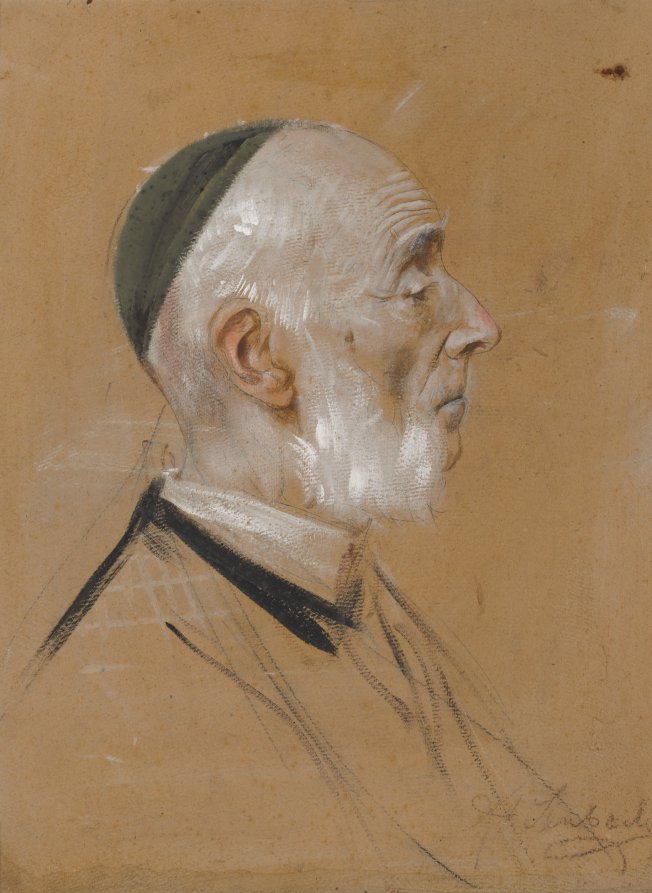
- Karl Eduard von Liphart, about 1875, paint over graphite (as catalogued, with a query), Cleveland Museum of Art.
- Prince Otto von Bismarck, 1896, oil on canvas, 125.6 × 94.3 cm, Art Institute of Chicago.
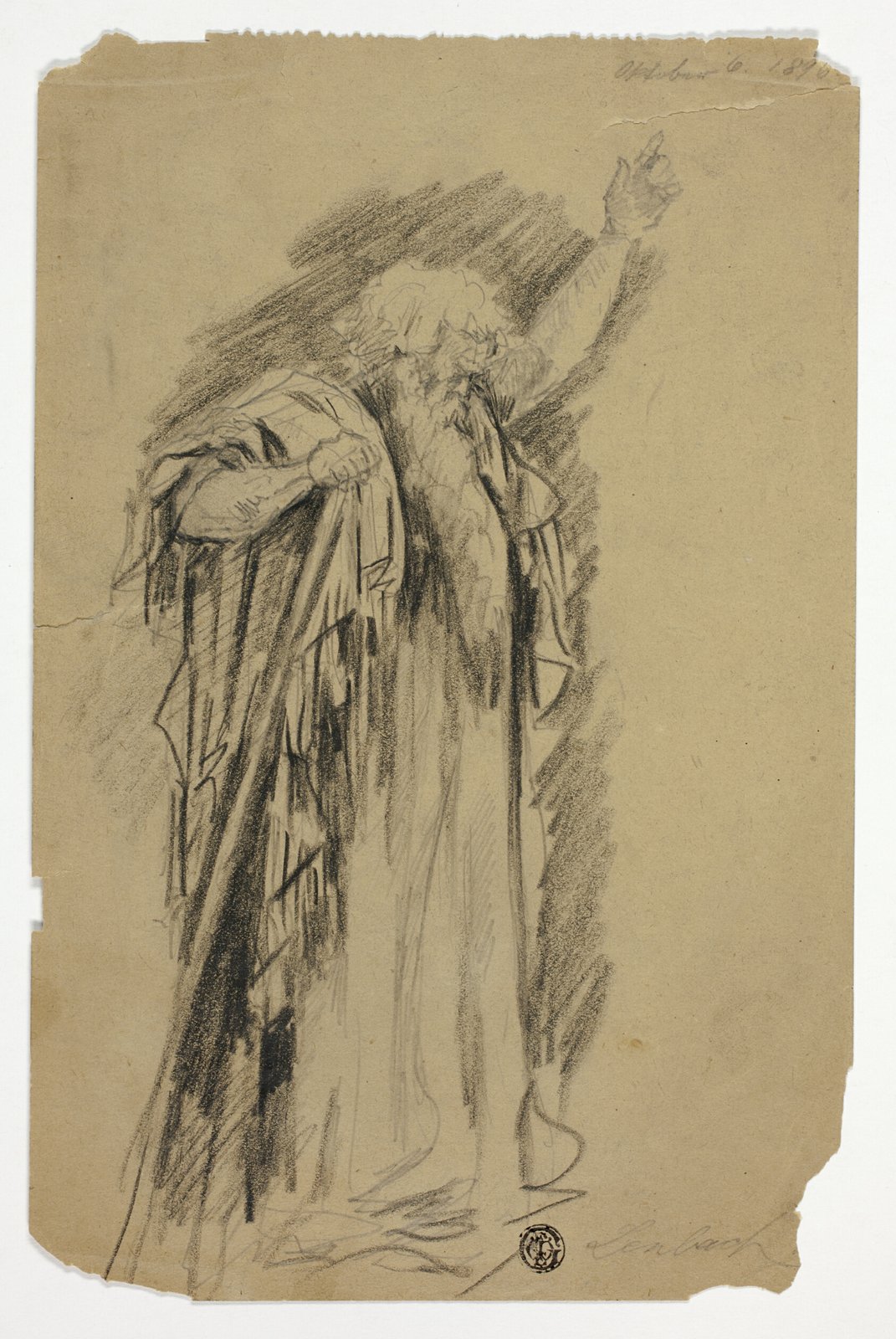
- Standing Prophet with Arm Raised, 1896, graphite and black crayon on tan wove paper, Art Institute of Chicago.
- Marion Lenbach (1892–1947), the Artist’s Daughter, 1900, oil on canvas, 149.5 × 105.4 cm, Metropolitan Museum of Art.
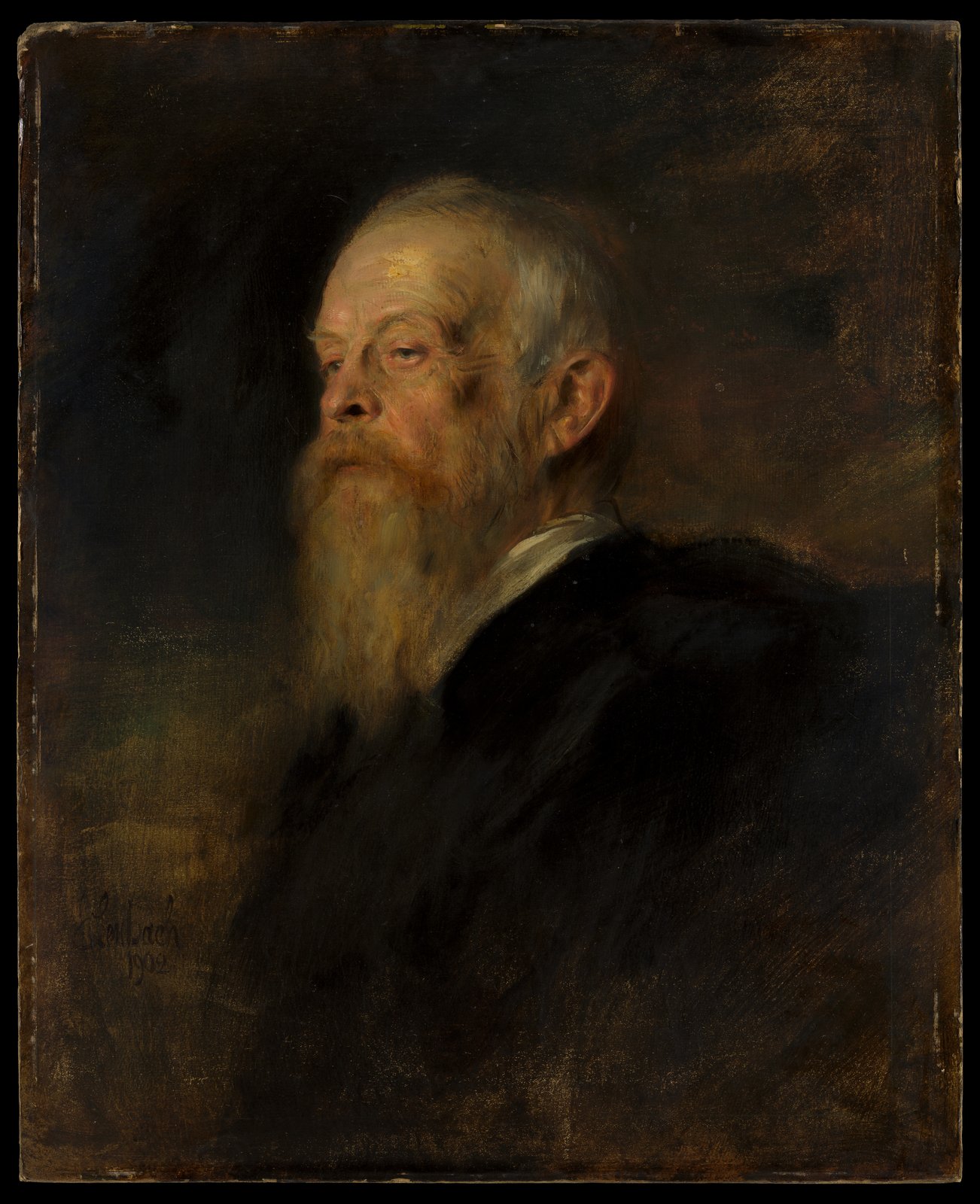
- Prince Regent Luitpold of Bavaria (1821–1912), 1902, oil on board, 76.2 × 61.5 cm, Metropolitan Museum of Art.
What to look at: the lit face in a dark field
Start with Bismarck in Chicago. He stands in three-quarter length in a long dark coat and cap, and the coat almost merges with the background. In the museum’s online image, which is in greyscale, the brightest areas are the face, the white moustache and the two hands; the rest is a range of near-blacks. The eye travels face, hand, hand, and back to the face. There is no furniture, no column, no curtain, none of the props of older state portraits. Power is shown through the head and posture alone.
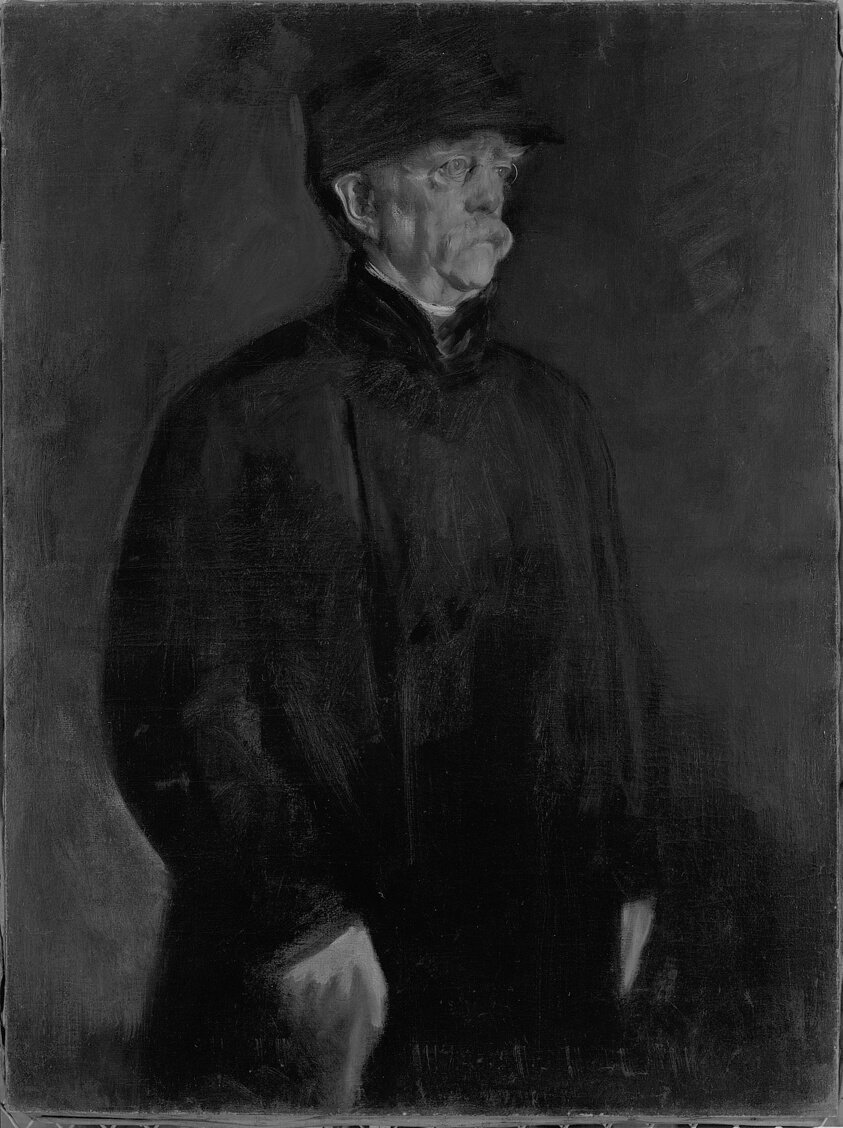
The Kemper Art Museum essay on its own Lenbach portrait of Bismarck repeats the remark that the painter had no idea how many portraits of the chancellor he had made. Repetition is part of the design: the same head, angle and dark coat became a recognisable image, more like a logo than a one-off likeness.
The Met’s Prince Regent Luitpold of 1902 tightens the frame further. It is a bust on board, the head turned to one side, a long grey-brown beard catching the light against a background that is almost black at the edges. The brushwork is loose in the clothing and tighter in the face, so detail itself becomes a way of directing attention.
Palette: brown shadow and one warm accent
The portrait of his daughter Marion shows how he used colour when he chose to. Measured from the Met’s scan of the painting, the background sits around #201c1a and #2f251e, warm near-blacks, with a lighter ochre around #996c38 in the hair and lit areas. The red of the dress measures near #8c3c21. These are screen values from a photograph of a canvas more than a century old, not the original pigments, but the proportions are clear: a large field of dark, a single saturated colour, and a pale scarf that leads the eye up to the face. A signature and the date sit quietly at lower right.
The pose is informal for a full-length portrait. One hand reaches towards the dark foliage, the feet are turned out, and the hair frames the face in a bright halo. The figure fills most of the height of the canvas, so the dark space works as a frame rather than as a setting.
Technique: oil sketches, tan paper and photographs
Lenbach’s drawings show the same thinking in fewer materials. The Cleveland Museum of Art’s Karl Eduard von Liphart, of about 1875, is paint over graphite on a tan sheet. The head is in sharp profile, the skull cap a dark shape, the beard and temple flicked in white. The tan paper is the middle tone, so a few strokes of dark and light are enough. Measured from Cleveland’s scan, the paper sits around #a2815d, the white highlights near #b8ada3 and the darks near #50473a.
He also worked from photographs. An article in the scholarly journal Nineteenth-Century Art Worldwide traces how he had sitters’ movements photographed and then “fleshed out” those photographs in paint rather than copying them, and a 2019 essay published by the University of Göttingen examines his use of photography alongside the large output of his studio. For a designer, this is a familiar workflow: reference image first, then selection, simplification and emphasis.
The Art Institute of Chicago’s Standing Prophet with Arm Raised, dated 1896, is a quick graphite and black crayon study of a bearded figure in a long robe. The drapery is a set of fast vertical strokes, while the raised arm breaks the column into a dynamic diagonal. It is a gesture study, closer to a storyboard frame than to a finished portrait.
Lenbach and Munich
Lenbach’s career was tied to Munich, from his studies with Piloty to the villa that became the Lenbachhaus. For a younger Munich artist of those years, see our guide to Franz von Stuck.
How designers can borrow from Franz von Lenbach
Make one thing bright
In every portrait the face is the lightest area. In a layout, give one element the highest contrast, a headline, a product or a face, and drop everything else towards the background value.
Use warm darks, not pure black
His backgrounds are brown-black rather than neutral. Sample them with the image colour picker and use them for dark-mode interfaces or packaging that should feel rich rather than stark.
Ration saturated colour
Marion’s red dress works because it is the only strong colour in the painting. Pair one saturated accent with a field of muted darks.
Repeat the image until it becomes a mark
Lenbach painted Bismarck again and again in the same dark coat and pose. Consistent crops, angles and lighting turn portrait photography into a recognisable brand asset.
Frequently asked questions
What is Franz von Lenbach known for?
He is known for portraits of political and society figures in late nineteenth-century Germany, above all Otto von Bismarck, painted with dark backgrounds and strongly lit faces.
When did Franz von Lenbach live?
He was born in Schrobenhausen in 1836 and died in Munich in 1904, according to the Metropolitan Museum of Art.
Did Lenbach use photographs?
Yes. Nineteenth-Century Art Worldwide and the University of Göttingen both discuss his use of photographs as references for his portraits.
Where can I see his work?
The Lenbachhaus in Munich occupies his former villa. In the United States, the Metropolitan Museum of Art, the Art Institute of Chicago and the Cleveland Museum of Art hold portraits and drawings by him.