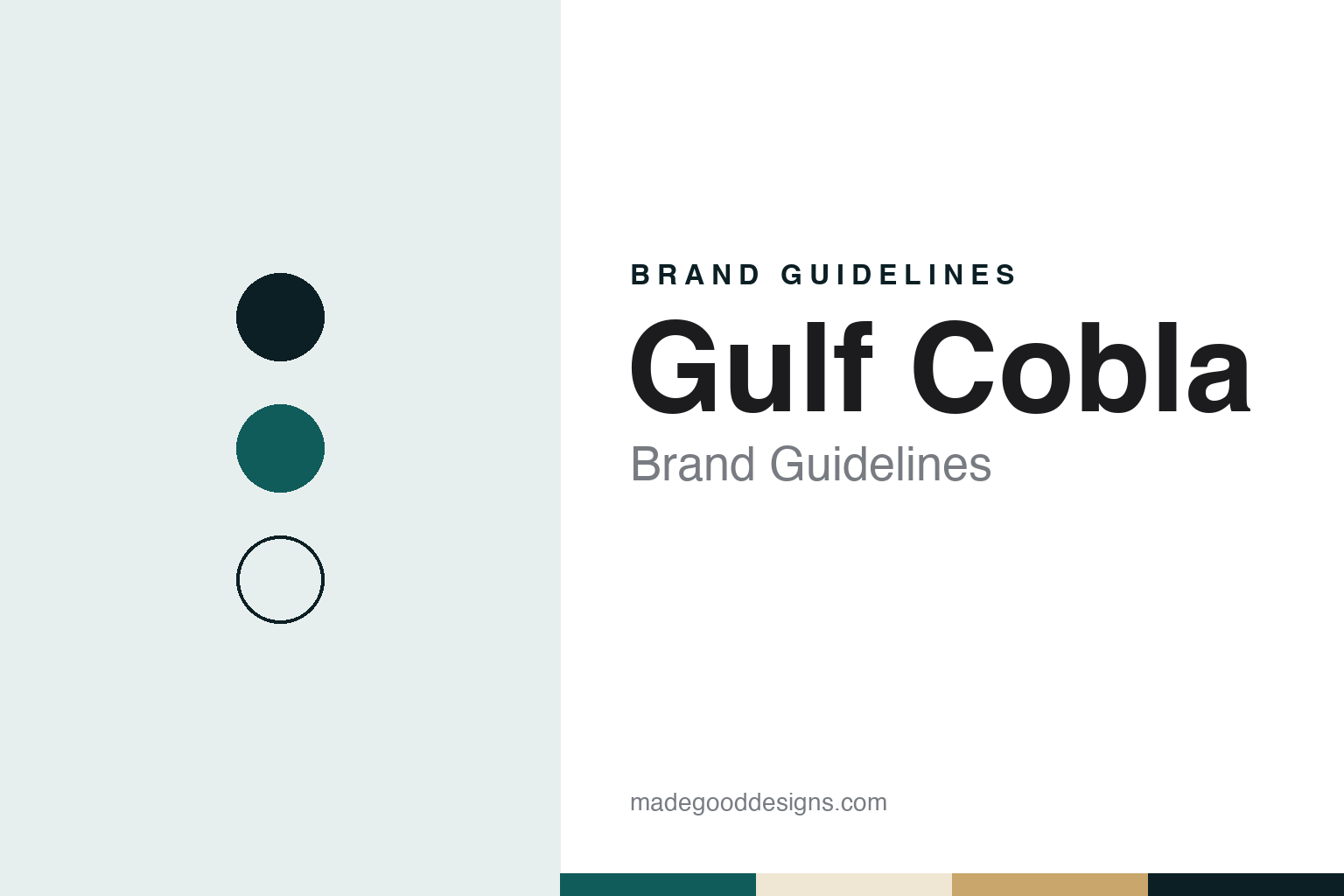
Gulf Cobla Brand Guidelines
A 1977 Dubai dredging firm and its fleet named for bays.
Aa
Two constants: a gulf teal, sand and dune gold palette and a coastal serif register. Abstract homage — not a Gulf Cobla product or mark; no vessel, logo or nameplate is reproduced.
Costain, Blankevoort and Dutco
An Anglo-Dutch partnership and a Dubai trading house.
Gulf Cobla is a dredging and land-reclamation contractor based in Jebel Ali, Dubai. It was established in 1977 by order of Sheikh Rashid bin Saeed Al Maktoum, then Ruler of Dubai, according to a July 2026 announcement published by Zawya; the company’s own website says it was formed that year as a limited liability company by decree, to carry out dredging, reclamation and associated marine operations.
The company says its founding members were the British contractor Costain and the Dutch firm Blankevoort, working together as an Anglo-Dutch partnership, and Dubai Transport Company, the Dubai business now known as Dutco. By the company’s account, they had already worked together on dredging and reclamation in Dubai since 1970, and on other regional urbanisation projects since 1965. The Zawya announcement dates Dutco itself to 1947.
Its first large job came at once. The company’s project list dates its capital dredging for Jebel Ali Port to 1977–1982 and says purpose-built vessels were designed and bought for it; the company calls it one of the largest projects of its kind in the industry. By the company’s account, large dredging works followed in Dubai, Abu Dhabi, Sharjah, Ajman and Ras Al Khaimah in the late 1970s and early 1980s, among them the Mussafah South Channel, with three reclaimed islands, in 1981–1983.
The company describes the late 1980s, a period of an oil glut, as a “lost decade” for much of the private sector, and says it was reorganised then. In the 1990s, it says, work picked up again with the help of Dutco, by then its Dubai-based main shareholder, and in the 2000s its record in the Emirates led to contracts in Saudi Arabia and Oman.
Colour
Six cutter suction dredgers, named for bays.
Gulf Cobla is a specialist. Its website calls it “a medium sized dredging company focused on Cutter Suction Dredging Projects” in the Middle East and surrounding areas, and lists four services: dredging of port and harbour basins, channels and trenches; land reclamation, from islands and land expansion to runways and shoreline works; marine charter of tugboats, landing craft, barges and work boats; and hydrographic survey with multibeam echosounder vessels.
The fleet is the centre of the brand. The website presents six cutter suction dredgers, each named after a bay: Khaleej Bay, Deira Bay, Baniyas Bay, Garhoud Bay, Hamriyah Bay and Jumeirah Bay, rated by the company’s figures from 1,200 to 7,000 horsepower. Several are listed on the site as IHC Beaver models.
The flagship, Khaleej Bay, was named at a ceremony at the Jebel Ali Hotel marina on 9 March 2004, Khaleej Times reported that month, calling it the first heavy-duty cutter suction dredger built in the UAE. The newspaper said it was built by Abu Dhabi Ship Building and designed by Damen Shipyards of the Netherlands, and that it would sail to Fujairah for dredging on the Fujairah Naval Port project. The company’s website gives a slightly different account, saying the dredger was designed in the Netherlands and built by Damen; it describes a short hull and an electric cutter drive suited to narrow channels and to cutting rock and sand.
The project list is the other half of the story. The company says it has recorded 255 contracts from 1977 to the present, most of them in the UAE, with others in Bahrain, Oman, Saudi Arabia, Qatar, Jordan, Iraq and the Maldives. Its selected projects include the Al Mamzar and Al Khan lagoons in 1992–1997, the Amwaj Islands in Bahrain in 2001–2003, a cofferdam for the Palm Jumeirah tunnel in 2005, and reclamation and shore works for Velana International Airport in the Maldives in 2016–2017. The Zawya announcement names Jebel Ali Port, Aqaba New Port in Jordan and the airport at Malé among its major works.
Typography
Design and documentation.
Dredging and marine contracting is a business mostly seen from the shore. A trailing suction hopper dredger working a port channel, or a cutter suction dredger anchored off a reclamation site, is often the only public sign of a contractor, so the hull itself does much of the brand work: a strong field colour such as orange, red or blue, with the company’s wordmark painted large along the side so it reads from a quay or a news photograph.
The companies’ own websites tend to follow a shared pattern. Photographs of dredgers at work, as the firms publish them, sit beside fleet pages that sort the vessels by type, hopper dredgers, cutter suction dredgers, backhoe dredgers and support craft, each with a specification sheet of length, hopper capacity and dredging depth. Ship names are part of the identity too, whether a numbered series or a run of river and place names.
Project-reference pages carry the rest of the story. Rather than advertising, these firms describe what they have built or deepened: land reclamation, port deepening, channel maintenance, beach nourishment and coastal works, usually grouped by region or by type of work and illustrated with aerial views. Larger groups that also build roads, bridges and buildings sort a very mixed portfolio into categories so that a dredging job and a bridge contract sit side by side.
Because many clients are port authorities and governments, the most practical pages are often the plainest: tender notices, archives of completed contracts, investor and stock-exchange filings, and annual reports. For a designer, the useful lesson is how much of a marine contractor’s identity lives in operational material, vessel livery, fleet lists and contract pages, and how a restrained palette and a clear sans can hold that material together.
Aa
A coastal serif for a contractor whose dredgers are named for bays. (Specimen set in Source Serif 4, a serif STAND-IN; NOT the Gulf Cobla logo.)
Gulf Cobla
A new majority owner, agreed in 2026.
A change of majority owner was agreed in 2026. On 1 July 2026 the investment firm BlueFive Capital, founded in late 2024 and incorporated in Abu Dhabi Global Market, announced an agreement to take a 70% stake in Gulf Cobla, in a release published by Zawya. Under the agreement, BlueFive would buy the entire 49% holding of Advanced Dynamics Investments, an affiliate of Saudi Binladin Group, and 21% from Dutco, which would keep 30%. BlueFive described the deal as its first move into infrastructure and real assets. The company’s website now lists BlueFive Capital as majority shareholder with 70% and Dutco Investment as founder member with 30%.
Its presentation is plain and practical. The website opens with the line “Shaping coasts, defining horizons,” signs off as “engineering the Middle East’s coastlines since 1977,” and builds its pages around numbers: years on the water, cubic metres dredged, dredgers owned and contracts delivered. Each dredger has its own page with dimensions and power, and the project list can be filtered by country and decade, with a written account for each job. The company says its staff come from European, Arab and Asian backgrounds, that it holds ISO 9001:2015 certification covering dredging, reclamation, charter and survey, and that it keeps a branch office in Manila.
For a design guide, Gulf Cobla shows how a mid-sized contractor can build an identity around a small named fleet and a long, filterable record of jobs. Compare Damen, the Dutch shipbuilder named in the story of the Khaleej Bay, and Royal IHC, whose IHC Beaver name appears in the fleet list. For this guide we use a gulf teal, a warm sand and a dune gold with a serif, an unofficial interpretation; no product or logo is reproduced.
Explore & save
Keep Gulf Cobla’s identity on hand — save it to a board in the Made Good inspiration library.
Gulf Cobla identity set
Pin the Gulf Cobla gulf teal, sand and dune gold palette and the coastal serif register to your own board.