Hatlapa Brand Guidelines
A family winch works from Uetersen whose name outlived the company.
Aa
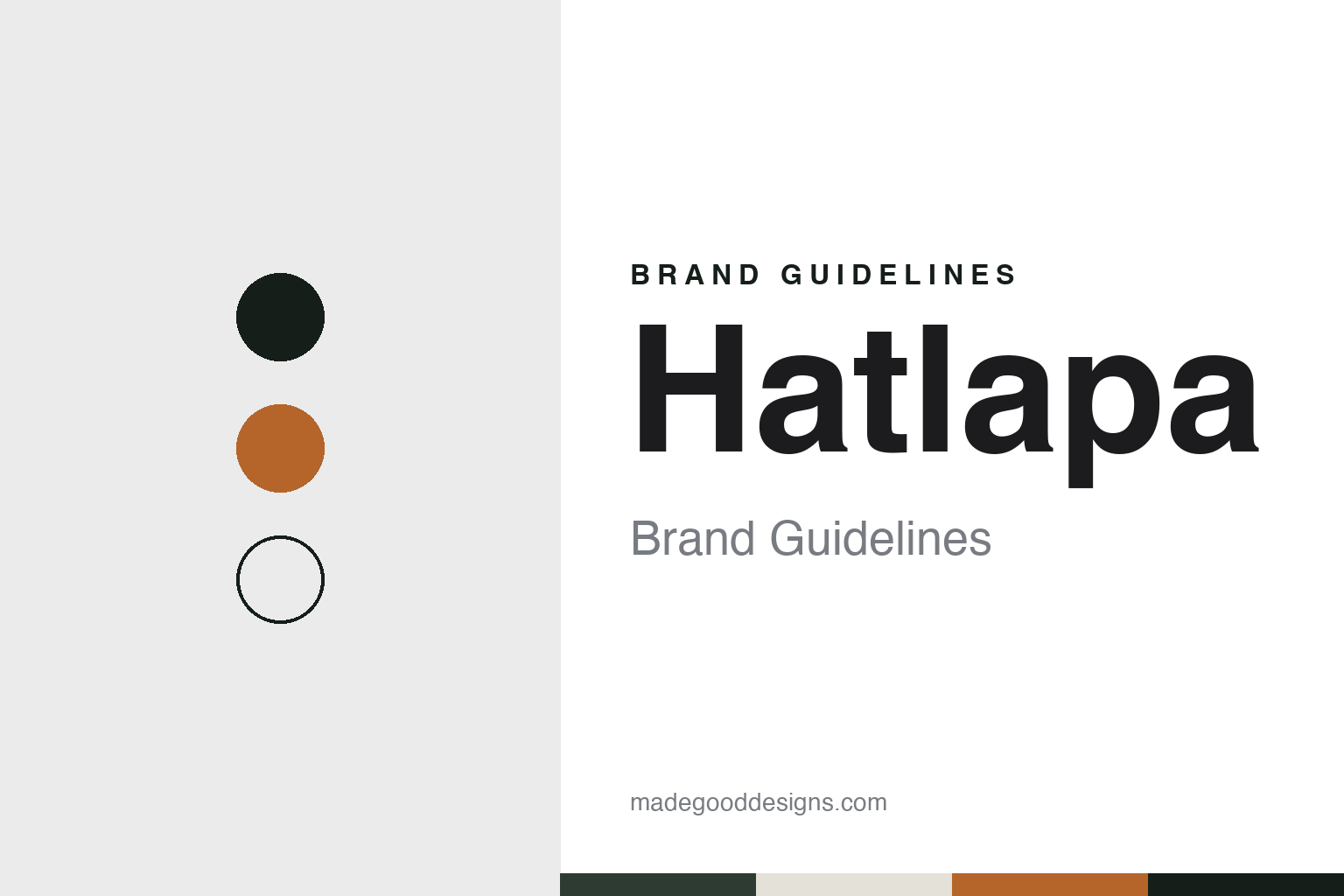
Two constants: a Hatlapa green and rust palette and a Condensed industrial sans register. Abstract homage — not a Hatlapa or MacGregor product or mark; no logo, nameplate or machine is reproduced.
A works in Uetersen
Locomotives, winches and the war years.
Hatlapa was a German maker of ship machinery based in Uetersen, a small town on the Pinnau north-west of Hamburg. German Wikipedia says the engineer Max Hatlapa, a mining engineer from the area around Katowice, founded the business on 11 November 1919. It first built bakery and farm machinery, then small diesel locomotives, and soon winches, compressors and generators for the shipbuilding industry. Citing an article by Sven Bardua in the journal Industriekultur, the encyclopaedia gives a workforce of 20 in 1920 and 40 in 1923. German Wikipedia’s article on the Hamburg firm Ad. Strüver says the two companies built small “Schienen-Kuli” rail locomotives together in Uetersen from 1938 to 1942.
German Wikipedia says Johanna Hatlapa led the company during the war years. The collection site landtechnik-historisch.de, in a page dated February 2022, says the firm took part in armaments production during the Second World War. A memorial stone laid in Uetersen on 15 February 2019, at the initiative of the town’s history workshop, marks a prisoner-of-war and forced-labour camp of the Uetersener Maschinenfabrik Hatlapa from 1941 to 1945; according to German Wikipedia’s list of these stones, its inscription records men and women, with children, from Italy and the Soviet Union, and describes them as degraded and exploited. More widely, the historians Gerhard Hoch and Rolf Schwarz counted some 1,650 prisoners of war and civilian prisoners from 21 countries quartered in Uetersen, part of them forced to work in industry and farming, as German Wikipedia’s article on the town reports from their 1985 study.
After the war, landtechnik-historisch.de says, the works faced dismantling. The founder’s son Hans-Heinrich Hatlapa took over, German Wikipedia says, and because the Allies had sharply limited shipbuilding in Germany the company at first built only locomotives. When those rules were eased in 1952 it went back to marine products.
Colour
Deck machinery, steering gear, compressors.
From then on Hatlapa was a ship-equipment specialist. German Wikipedia describes it as a developer, maker and seller of ship equipment such as winches and steering gear, and the encyclopaedia’s article on Uetersen lists deck machinery, compressors and rudder systems. Citing Bardua, it gives a workforce of almost 600 by the mid-1990s. On 1 April 2006, German Wikipedia says, Hatlapa bought the marine division of the Schwerin engineering firm KGW, which made winches and steering gear; it ran the business first as KGW Marine GmbH and then folded it into the company as its Schwerin branch.
The shipping crisis that followed the financial crisis of 2007–2008 hit Hatlapa as a supplier of equipment for new ships and conversions, German Wikipedia says, and staff numbers had to be reduced; it gives a workforce of 356 for 2011, from the company’s published accounts.
In 2013 Hatlapa joined MacGregor, the cargo- and load-handling business then owned by the Finnish group Cargotec. MacGregor’s own history says it acquired Hatlapa in October 2013 to strengthen its position in merchant shipping with a wide range of deck machinery, and that Triplex equipment came with it; German Wikipedia dates the takeover to 1 November 2013 and says the company then traded as MacGregor Hatlapa GmbH & Co. KG. MacGregor notes that Hatlapa marked its 100th anniversary in 2019.
The same year, German Wikipedia says, the Uetersen company filed for insolvency. Parts of it were taken over by a Kaltenkirchen investment company and run as Uetersener Zerspanungstechnik und Vorrichtungsbau GmbH, which the Hamburger Abendblatt reported on 8 January 2020 had been wound up after less than a year. The Hatlapa company therefore no longer trades.
Typography
How marine equipment makers present themselves.
Marine equipment makers sell to shipyards, shipowners and operators rather than to the public, and their identities reflect that. Their marks have long histories of their own: Schottel’s square S has been in use since the 1980s, its centenary history says, and Becker Marine Systems introduced its present logo with its new name in 2001, by the company’s account. The palettes in this guide are our own interpretation, in sea-going blues with warm accents, and none is taken from a company’s files.
The products themselves carry much of the visual weight. Thrusters, rudder propellers, rudders, deck machinery and bridge systems appear in this guide only as the companies publish and describe them, and their scale is part of the story: a regional magazine described one Schottel drive in Wismar in 2021 as twelve metres long once assembled.
Products are presented by vessel type as well as by name. Schottel says its RudderPropeller is used in more than 120 vessel types, from harbour tugs to ferries and offshore ships, and Becker presents rudders, nozzles and steering gear as parts of a single manoeuvring system for a given ship. Service matters as much as sale: both companies describe networks of subsidiaries and offices across Europe, Asia and the Americas, and German Wikipedia lists fourteen Schottel sales and service companies, from Brazil to South Korea.
Newer pages cover data. Schottel lists condition monitoring and data platforms among its products, and Becker sells monitoring systems for steering and rudder bearings. Trade fairs remain a fixed point in the calendar: Becker’s own history records a meeting at Nor-Shipping in Oslo that changed its management in 2001, and in 2022 Schottel’s holding company announced an agreement there, a trade paper reported.
Aa
A condensed industrial sans for a capitalised surname. (Specimen set in Barlow Condensed, a sans STAND-IN; NOT the Hatlapa logo or typeface.)
Hatlapa
A surname on a steering-gear plate.
The name is simply the founder’s surname: German Wikipedia notes that Hatlapa is a Polish and Czech family name, and that the company styled itself in capitals as HATLAPA. That surname is what survives. MacGregor, which since 31 July 2025 has been owned by funds managed by Triton and is headquartered in Gothenburg, according to its own history, says it offers a complete steering gear portfolio under the Hatlapa and Porsgrunn brands, and presents its deck machinery as bringing together the Hatlapa, Pusnes and TTS names under one umbrella. Its steering-gear page describes three types — rotary vane, ram and piston — and says the Hatlapa and Porsgrunn ranges cover vessel segments from roll-on, roll-off ferries to the largest tankers and container ships.
So the word appears today as a product brand inside a larger company rather than as a business of its own. Readers should keep the two apart: the family firm that ran the Uetersen works from 1919 ended in insolvency in 2019, while the Hatlapa name on new steering gear and deck machinery belongs to MacGregor.
For a design guide, Hatlapa shows how a family surname on a nameplate can outlast the company that first put it there. Compare MacGregor, which owns the name today, and TTS Group, another deck-equipment name now used inside MacGregor. For this guide we use a deck green and a winch rust with a sans, an unofficial interpretation; no product or logo is reproduced.
Explore & save
Keep Hatlapa’s identity on hand — save it to a board in the Made Good inspiration library.
Hatlapa identity set
Pin the Hatlapa green and rust palette and the Condensed industrial sans register to your own board.