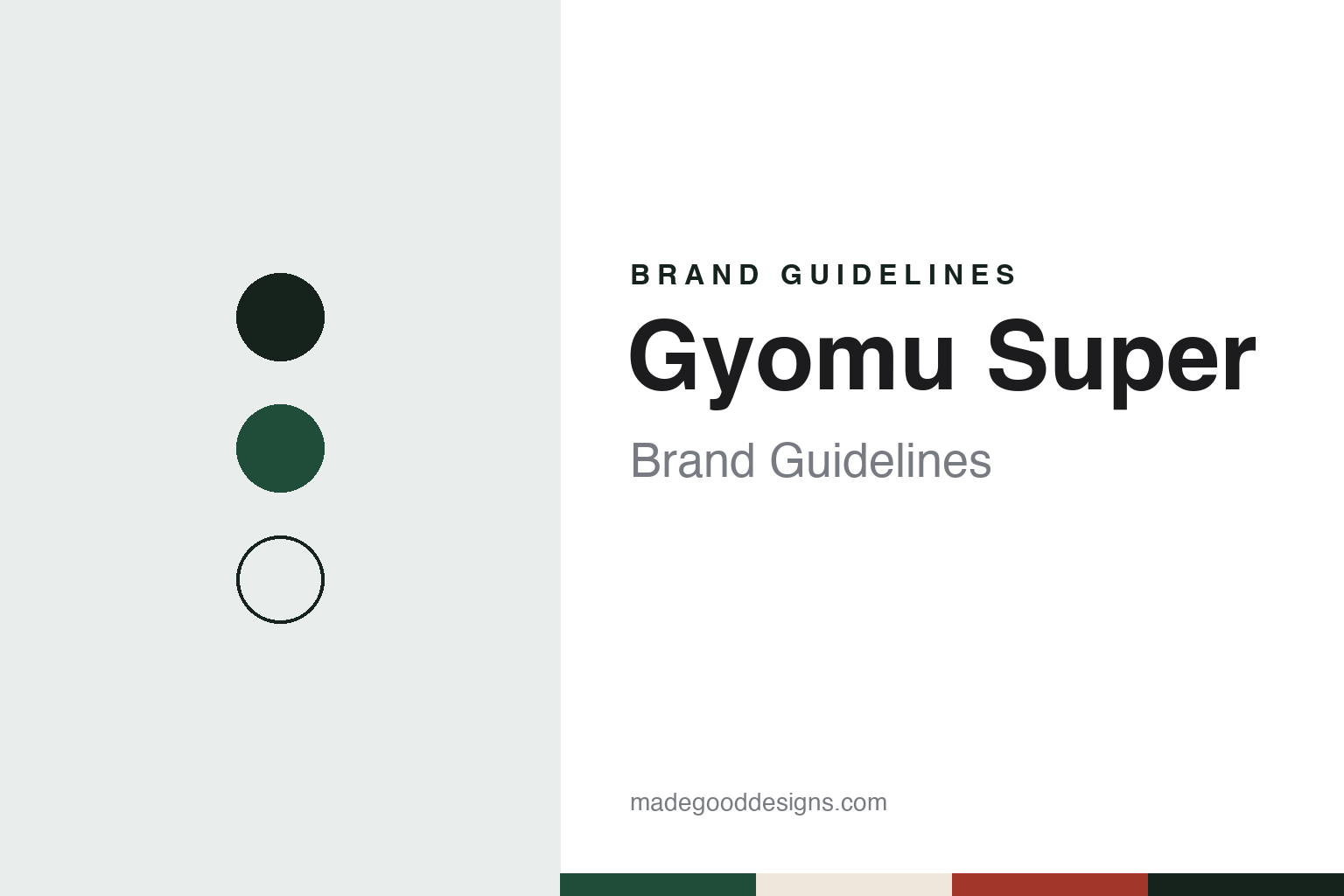
Gyomu Super Brand Guidelines
Kobe Bussan’s 2000 franchise chain and its boxed aisles.
Aa
Two constants: a Gyomu Super green, red and kraft palette and a Plain Gothic sans register. Abstract homage — not a Gyomu Super product or mark; no sign, logo or package is reproduced.
Fresh Ishimori
A small Kakogawa grocer that became a franchisor.
Gyomu Super is the supermarket chain of Kobe Bussan Co., Ltd., a company with its head office in Kakogawa, in Hyogo Prefecture, west of Kobe. The name is Japanese: the chain’s English website explains that “Gyomu” means wholesale for professionals and “Super” means supermarket, and adds that ordinary shoppers are welcome too. Shoppers shorten it to “Gyo-Su”, the magazine FRIDAY DIGITAL reported in December 2024.
The business is older than the chain. Japanese Wikipedia says its founder, Shoji Numata, who had worked in the kimono department of the Mitsukoshi store in Kobe and later for a Kakogawa catering company, opened a small food supermarket called Fresh Ishimori in Kakogawa in April 1981. The company behind it was set up on 6 November 1985, the date Kobe Bussan gives as its founding on its own company profile. Further shops followed in Kobe’s Nishi ward in 1986 and in Inami in 1988, Japanese Wikipedia says.
The turn towards making food came in the 1990s. In July 1992 the company set up a food plant in Dalian, in north-east China, according to Japanese Wikipedia, which also names the plant among the group’s overseas companies today, alongside companies in Hong Kong, Egypt and Myanmar. In March 2000 it began franchising and opened the first Gyomu Super under a franchise contract in Miki, Hyogo. The trade name followed: the company filed the name “業務スーパー” as a trademark in July 2001, and in October 2001 Fresh Ishimori absorbed an earlier company called Kobe Bussan and took its name, Japanese Wikipedia says.
Kobe Bussan listed its shares on the Osaka Securities Exchange in June 2006 and moved to the first section of the Tokyo Stock Exchange in July 2013. In February 2012 the founder handed the presidency to his son, Hirokazu Numata, who is named as president and representative director on the company profile.
Colour
Franchise stores, own plants and cardboard boxes.
Gyomu Super is almost entirely a franchise network. Kobe Bussan describes itself as a direct operator, a master franchisor and a regional master franchisor; Japanese Wikipedia says that at the end of October 2022 only three of the 1,007 stores were run by the company itself. In some regions other retailers hold area licences for the chain, among them Ocean System in Niigata and neighbouring prefectures, Every in Hiroshima, Okayama and Kagawa, and Makiya in Shizuoka and Yamanashi, the encyclopaedia lists.
The network spread steadily. Japanese Wikipedia records 800 stores in March 2018, a store in Miyazaki in February 2021 that put Gyomu Super in all 47 prefectures, and a store in Hakodate in October 2022 that took the count to 1,000; Kobe Bussan’s president gives the 2021 and 2022 milestones in his message on the company website. FRIDAY DIGITAL counted 1,077 franchise stores across Japan as of September 2024.
The stores look different from a conventional supermarket because of how goods are shown. Japanese Wikipedia describes the practice of “hakochin”, displaying fast-selling goods in the cardboard boxes they arrive in so that staff restock less often; Kobe Bussan says its stores use freezers of its own design to cut the work of filling shelves. The range leans on frozen and long-life foods, and the company sells its own goods made in its group plants in Japan, which it numbers at 28, together with goods imported from partner factories in about 50 countries, figures it gives as of October 2025.
Kobe Bussan says the chain does without day-of-the-week specials and heavy promotions. Its own products include chicken sold under the “Kibi Kogen” and “Joshu Kogen” names, from farms linked to its processing plants. Japanese Wikipedia notes that fresh produce is not, in principle, part of the Gyomu Super range, but that some franchise owners buy it through other channels, so the fresh offer varies from store to store.
Typography
Signs, own labels and store networks.
Supermarket and convenience chains across East and South-East Asia present themselves through a few fixed things: the name on the sign, the colours of the fascia and the carrier bag, the layout of the shop floor and the names of their own-label ranges. In Japan, Kobe Bussan’s Gyomu Super has built a recognisable store out of logistics, stacking fast-selling goods in the cardboard boxes they arrive in, a practice Japanese Wikipedia calls “hakochin”.
Names and signs do not always travel unchanged. FRIDAY DIGITAL reported in December 2024 that Gyomu Super stores are called “Gyomu Super” in Hong Kong but “GYOMU Japan” in Vietnam and Malaysia, where Japanese text cannot be shown on the sign. Chains in Korea, Indonesia, Thailand, Hong Kong, Malaysia and Singapore make similar choices about script, language and lettering, and this guide describes them as each company or a dated source shows them.
Ownership is often layered. Some chains are run directly by a listed retail group; others are franchised, licensed to local partners or held inside a larger conglomerate with interests far beyond food. Gyomu Super, for example, is almost entirely a franchise network: Japanese Wikipedia says that only three of its 1,007 stores were company-run at the end of October 2022. Where a chain has changed hands, this guide gives the buyer and the date from a dated source, and describes any deal not completed as pending.
Store counts, formats and own-label ranges are given in the companies’ own terms and with their dates, because networks change quickly. Founders, owners and retail groups are named as the companies’ corporate pages and the press record them. Colours and typefaces are treated as an unofficial interpretation unless a source documents them, and no sign, logo or package is reproduced.
Aa
A plain Gothic sans — the name in Japanese and in Latin letters. (Specimen set in Zen Kaku Gothic New, a sans STAND-IN; NOT the Gyomu Super logo.)
Gyomu Super
One name, two scripts.
The chain’s name has been registered more than once. Japanese Wikipedia says the plain name was registered in August 2001; that in August 2017 the company applied for a logo mark that sets the name with the Latin-letter line “GYOUMU Japan”, granted in April 2018; and that in October 2018 it applied for a Japanese logotype, granted in October 2019. The same encyclopaedia warns of a similar name: a Hiroshima company runs stores called “業務用食品スーパー” in the Setouchi region in the same format, and the two businesses are unrelated.
Abroad, the name changes with the rules. FRIDAY DIGITAL reported in December 2024 that overseas stores are run by local partners under licensing agreements rather than franchises, with 14 stores in Hanoi, Da Nang and Ho Chi Minh City and two each in Hong Kong and Malaysia; the stores are called “Gyomu Super” in Hong Kong and “GYOMU Japan” in Vietnam and Malaysia, where Japanese text cannot be shown on the sign. The magazine dated the first overseas Gyomu Super to Vietnam in 2019, while Japanese Wikipedia lists a first overseas “Gyomu Japan” store in Singapore in April 2016. Overseas, most goods sit on shelves rather than in boxes, the magazine said, though stores still hang banners and ceiling displays as in Japan; its top sellers there included frozen Sanuki udon and a sesame dressing made in the group’s Japanese plants.
In Malaysia, The Rakyat Post reported in August 2022 on a new Gyomu Super in the Pinnacle PJ building in Petaling Jaya: stock was stacked in its shipping boxes in small islands, items carried stickers marking them as halal, pork-free or non-halal, and pork had its own section. The reporter found a shop for cooking ingredients rather than ready meals.
At home, Kobe Bussan has added food-service formats beside its stores. The trade paper Nihon Shokuryo Shimbun reported in October 2026 that its Chisouna delicatessens numbered 166 at the end of July 2026, that a bakery format was opening alongside Gyomu Super stores, and that the group had developed a Korean pub format, Hansan, in Kobe’s Sannomiya district. The company also runs the Kobe Cook World Buffet and Premium Karubi restaurants.
For a design guide, Gyomu Super shows how a store can make its identity out of logistics: a plain name, the same sign at home and abroad, and the shipping box as the shelf. Compare Don Quijote, another Japanese retailer, and Lopia, a Japanese supermarket chain. For this guide we use a freezer green, a brick red and a kraft brown with a sans, an unofficial interpretation; no product or logo is reproduced.
Explore & save
Keep Gyomu Super’s identity on hand — save it to a board in the Made Good inspiration library.
Gyomu Super identity set
Pin the Gyomu Super green, red and kraft palette and the Plain Gothic sans register to your own board.
Source & notes
Frequently Asked Questions
What font can I use to match the Gyomu Super look?
This guide describes Gyomu Super’s type as “A plain Gothic sans — the name in Japanese and in Latin letters”. Its type specimen is set in Zen Kaku Gothic New from Google Fonts as a stand-in; Zen Kaku Gothic New is not Gyomu Super’s own lettering.
What colours are in the Gyomu Super palette?
This guide’s Gyomu Super palette is Freezer green #1F4D3A, Brick red #A3362B, Kraft brown #B98E5A, Ink #16231C and Paper #F7F4EE. The tones are the guide’s own unofficial interpretation, not official Gyomu Super hex codes.
Who owns Gyomu Super?
Gyomu Super is owned by Kobe Bussan Co., Ltd. (Kakogawa, Hyogo).