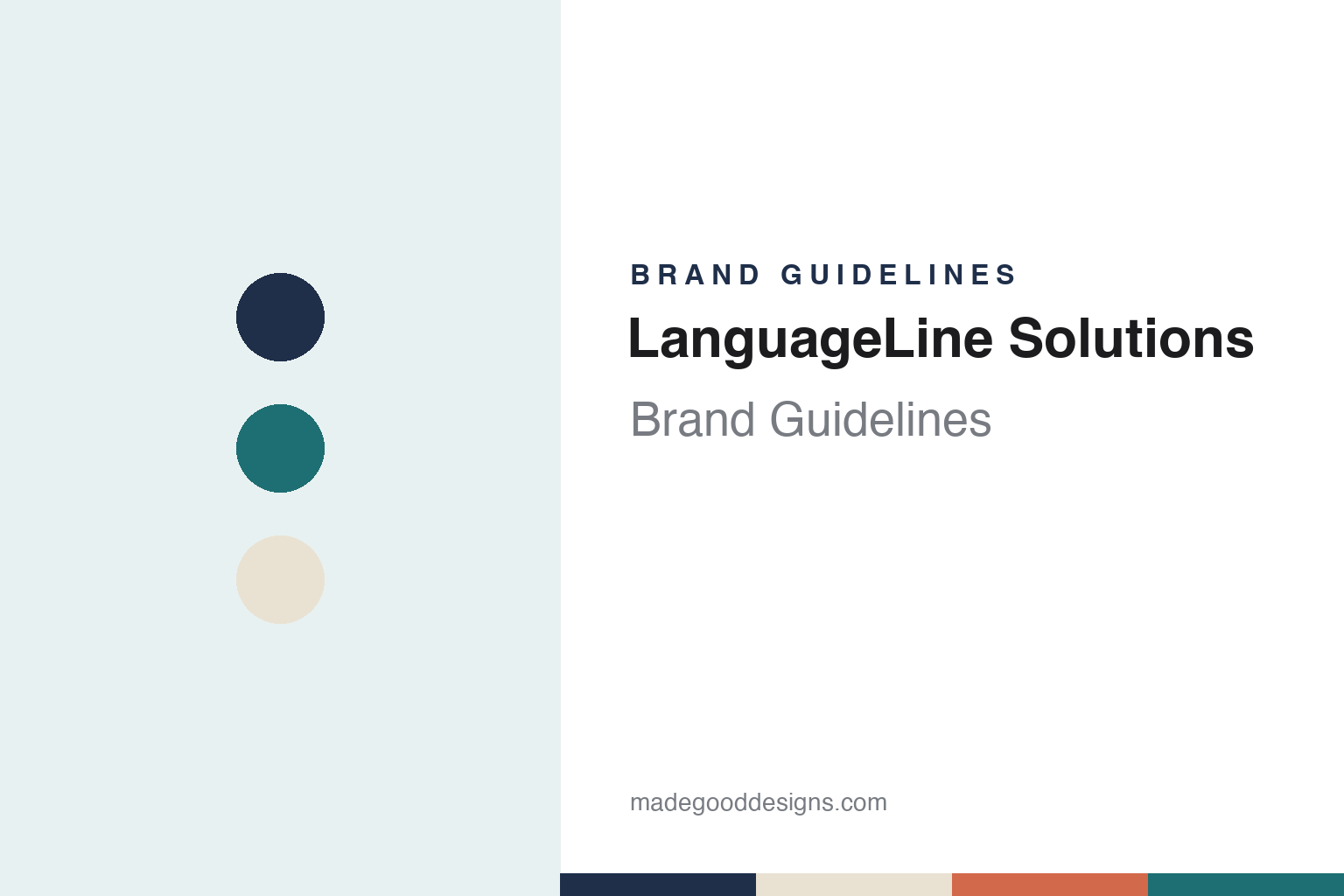
LanguageLine Solutions Brand Guidelines
A Monterey interpreting company that began as a phone line in 1982.
Aa
Two constants: an ink blue, teal and sand palette and a humanist sans register. Abstract homage — not a LanguageLine Solutions product or mark; no logo or app screen is reproduced.
From CALL to AT&T
A volunteer phone line that a telephone company bought.
LanguageLine Solutions is a telephone, video and onsite interpreting company based in Monterey, California. Its own timeline dates its start to 1982, when a volunteer phone interpreting service was set up in San Jose to help people communicate with newly arrived Vietnamese refugees. English Wikipedia names the founders as Jeff Munks and Michael McFerrin and gives the early name as CALL, short for Communication And Language Line; the company’s timeline says CALL began operations in 1984.
The next owner was a telephone company. LanguageLine’s timeline says AT&T acquired CALL in 1989 and renamed it AT&T Language Line Services; English Wikipedia dates the purchase to 14 February 1990 and describes the unit as a strategic business unit of AT&T. The two sources agree on what followed. The company says it added translation and localisation services in 1992 and received its first patent, for on-demand interpretation within a telecommunications system, in 1995. English Wikipedia says that during the AT&T decade the business invested in technology and interpreter quality and helped set standards for the young telephone interpreting trade.
English Wikipedia says the company became independent of AT&T in 1999. In 2006 it bought Language Line in the United Kingdom, a separate business that English Wikipedia says was founded in 1995 by the social entrepreneur Michael Young and was then the largest telephone interpreting business in Europe. That purchase explains why the group runs offices in London alongside its California base, and why the same name appears on both sides of the Atlantic.
The company’s account of itself leans on that early start. Its 2026 “Who we are” page says it founded the phone interpreting industry in 1982 and remains its largest service provider, and its timeline counts patents as milestones: a fifteenth in 2015 and a twenty-third in 2019.
Colour
Phone, video, onsite, then software.
The company’s own timeline reads as a list of new channels. Its first global interpretation centre opened in 2000. Video interpreting arrived in 2004 and in-person interpreting, under the OnSite name, in 2009. In 2012 Language Line Services became LanguageLine Solutions, closing the two words of the old name into one; the timeline calls this a rebrand. In 2013 it bought two onsite interpreting firms, Pacific Interpreters and Fluent Language Solutions.
Software followed. The LanguageLine App for iPhone and a virtual call-centre platform called TeamLink launched in 2014, and InSight Video Interpreting was added to the app in 2016. In 2018 an in-house unit, LanguageLine Labs, released TrueSound, an enclosure that amplifies an iPad’s speaker without wires or batteries. A translation workflow system, the LanguageLine Mercury Tech Stack, came in 2022, and the 2026 website lists an AI Translation App and AI interpreting services beside its human interpreters, as well as language proficiency testing and interpreter training.
Scale figures come from the company. Its “Who we are” page in 2026 claims more than 35,000 linguists, more than 30,000 clients, more than 87 million interactions a year and more than 290 languages, and a press release of October 2026 gives more than 36,000 interpreters. In the same month LanguageLine said its AI Translation App had received an Innovative Technology designation from Vizient, an American healthcare performance-improvement company, after Vizient provider groups evaluated it following an exhibition in Las Vegas in September 2026.
The company also cites outside rankings and workplace surveys. Its October 2026 releases say Nimdzi and Slator ranked it first for interpretation services in their 2026 assessments, and that it had been certified as a Great Place to Work for a seventh consecutive year, based on feedback from employees in six countries. The timeline puts the first of those certifications in 2019.
Typography
How language companies present themselves.
Translation and localisation companies sell a service that is hard to picture, so their public material tends to lean on numbers and names. RWS describes a network of more than 250,000 data specialists and language experts in its regulatory announcements, and TransPerfect’s standard press-release text, as used in 2026, lists offices in more than 150 cities on six continents and services in more than 200 languages. For a designer, those counts work as a kind of map: the reach of the company is shown through cities, countries and languages rather than through a product on a shelf.
Platform names carry much of the identity. RWS keeps Trados, a translation-memory tool it gained through its 2020 merger with SDL, as a product brand, and in March 2026 added Language Weaver Pro, an AI translation model it says was built with Cohere. TransPerfect gathers its software under GlobalLink, with GlobalLink Media for subtitling and dubbing. This guide describes them only as their makers do.
The companies also explain themselves through their structure. RWS sorts its reports into three named segments, Generate, Transform and Protect, while TransPerfect runs divisions such as TransPerfect Media, TransPerfect Gaming and TransPerfect Legal Solutions under one compound name. Acquired businesses can be renamed into these families: Moravia, bought by RWS in 2017, became RWS Moravia in 2018, and RWS completed its purchase of Acolad’s parent company in November 2026.
Corporate pages on owners and offices are part of the same picture. A listed company such as RWS publishes its headquarters, market and deals through regulatory announcements; a private one such as TransPerfect states its global and regional headquarters in its press releases. This guide follows those documents, and marks plainly what rests on a company’s own word.
Aa
A humanist sans for a name written as one word. (Specimen set in Work Sans, a sans STAND-IN; NOT the LanguageLine Solutions logo.)
LanguageLine
A Teleperformance company since 2016.
Ownership changed again in 2016. English Wikipedia says the French outsourcing group Teleperformance, now known as TP, agreed in August 2016 to buy LanguageLine from the private-equity firm Abry Partners and completed the purchase in September 2016, and that Teleperformance said LanguageLine would continue as a stand-alone business headquartered in Monterey. Scott W. Klein had been named chief executive in 2012, English Wikipedia says; by October 2026 the company’s press releases named Simon Yoxon-Grant as president and chief executive.
The group kept growing in Britain. On 10 November 2022 Capita plc announced that it had agreed to sell Capita Translation and Interpreting, a UK-based provider of specialised language services, to LanguageLine, subject to certain consents, and described the buyer as having more than 10,000 employees and 40 years of history. Capita said the business’s senior managers and staff would move with it, and LanguageLine’s timeline lists the acquisition under 2022.
The words the company uses about itself are consistent. The 2026 company page opens with the line “Enabling Total Understanding One Encounter at a Time”, and the “Who we are” page lists five core values: innovation, commitment, respect, integrity and professionalism. The registered sign follows the name in page headings, and the services menu is split into interpreting, translation and localisation, and testing and training.
For a design guide, LanguageLine Solutions shows how a service company with no physical product carries its name: a single compound word since 2012, written on its own site with a registered-trademark sign, and a website organised by channel (phone, video and onsite) rather than by language. Compare Lionbridge, another American language-services company, and Welocalize. For this guide we use ink blue, signal teal and warm sand with a humanist sans, an unofficial interpretation; no product or logo is reproduced.
Explore & save
Keep LanguageLine Solutions’s identity on hand — save it to a board in the Made Good inspiration library.
LanguageLine Solutions identity set
Pin the ink blue, teal and sand palette and the humanist sans register to your own board.