Magazine Luiza Brand Guidelines
The Franca gift shop that became a Brazilian retail platform.
Aa
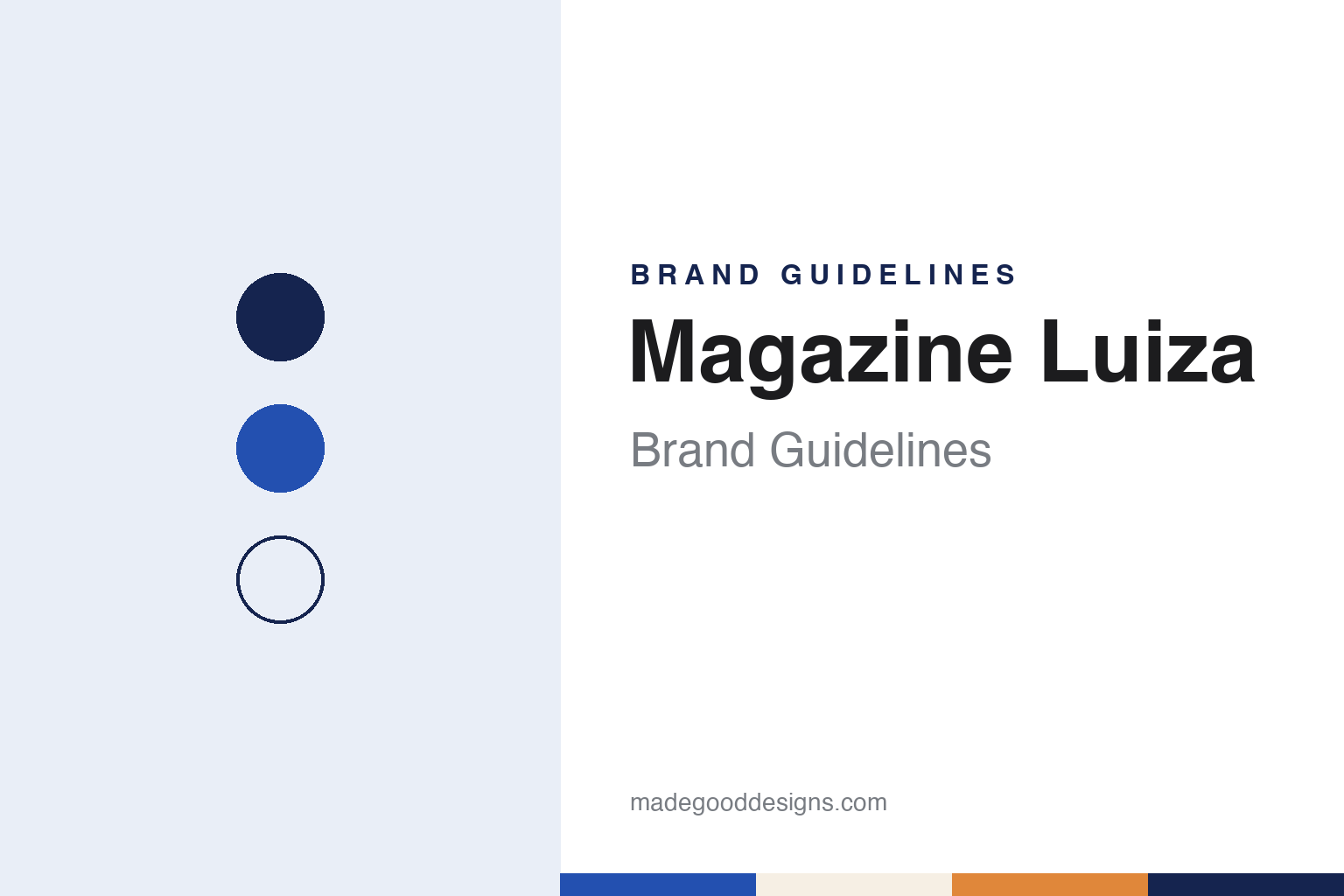
Two constants: a bright blue, deep blue and cream palette and a friendly sans register. Abstract homage — not a Magazine Luiza product or mark; no logo, avatar, sign or app screen is reproduced.
A Cristaleira
A gift shop renamed by a radio contest.
Magazine Luiza began in Franca, a town in the interior of São Paulo state, in 1957. Portuguese Wikipedia says the couple Pelegrino José Donato, a travelling salesman, and Luiza Trajano Donato, a shop assistant already known in the town, bought a small gift shop called A Cristaleira that year. The new name came from the town itself: Luiza Trajano Donato ran a contest on the local radio station, and listeners chose Magazine Luiza.
Growth stayed in the interior of São Paulo for years. Portuguese Wikipedia records new branches in towns such as Barretos and Igarapava, more shops in Franca, the arrival of other family members in the business, and, in 1974, the company’s first department store, with more than 5,000 square metres. Twenty years after it opened, the chain had 30 shops. Luiza Helena Trajano, the founder’s niece, joined the business at 18 and became its superintendent in 1991, the same source says.
Expansion after that came largely by buying regional chains. Portuguese Wikipedia lists Casas Felipe in Paraná in 1996, Basimac and Líder in São Paulo state in 2003, Lojas Arno in Rio Grande do Sul in 2004, three Santa Catarina chains in 2005, Lojas Maia of João Pessoa, with about 150 shops in the north-east, in 2010, and 121 stores of the Baú da Felicidade chain in 2011. In 2008 the company entered the city of São Paulo by opening 44 shops at once. It reached 1,000 stores in August 2019, according to the same source.
The company has been listed on the São Paulo stock exchange, now the B3, since May 2011. In January 2016 Frederico Trajano, Luiza Helena Trajano’s son, became chief executive, with his mother moving to chair the board; English Wikipedia names the same two in those roles.
Colour
Virtual stores, a marketplace and a virtual saleswoman.
Magazine Luiza tried selling without stock early. English Wikipedia says that in 1992 it opened its first “virtual” stores: physical shops with multimedia ordering terminals in place of goods on shelves. Portuguese Wikipedia adds that deliveries arrived 48 hours after purchase, that the format let the chain reach towns it had not served, and that in 2016 more than a hundred of its 800 points of sale were virtual, with phones and tablets replacing the old terminals. The same source credits Luiza Helena Trajano with the Liquidação Fantástica, a one-day January clearance sale first held in 1993.
Much of the brand’s public face is a character. Portuguese Wikipedia says the company launched Lu, an electronic sales assistant shown as an avatar, in 2003, to give tips and explain how to use connected products. Portuguese Wikipedia’s article on the character dates her first YouTube appearance to 2009, and records a new avatar, built in the Unreal game engine with artificial-intelligence features, shown at the Magalu Expo on 21 August 2024. Lu now fronts product videos, unboxings and app tips, the same article says.
Digital selling grew alongside the shops. Portuguese Wikipedia dates the company’s innovation lab, Luizalabs, to 2012; its shopping app and the arming of all sales staff with smartphones to 2015; and the opening of a marketplace to mid-2016, when products from about 200 outside sellers were added to the site and app. English Wikipedia gives Magalu as the company’s other name, and it is the one used for the group’s cloud, expo and megastore.
A run of purchases followed. Portuguese Wikipedia records the sports e-commerce site Netshoes, announced on 29 April 2019 and confirmed that June; the used-book marketplace Estante Virtual, bought at an auction in January 2020; and the delivery app Aiqfome in 2020. Tecnoblog reported on 20 October 2021 that Brazil’s competition authority, CADE, had approved without restrictions the purchase of KaBuM!, the computer and gaming retailer agreed that July. The paper counted it as the company’s 22nd acquisition in eighteen months, to sit alongside the Jovem Nerd site bought in April 2021 and the tech-news site Canaltech, bought in August 2020.
Typography
How Brazilian retailers present themselves.
Brazilian retailers present themselves first through the shop. Many national chains grew by buying regional ones and then putting their own name over the door, so a single shop name, painted on façades in towns across the country, often carries decades of mergers behind it. Shop names are usually plain: a founder’s first name, a family name or, in the case of Casas Bahia, a tribute to the customers the business first served.
Characters do much of the talking. Several chains use a mascot or spokes-character in television advertising, on social media and in their apps. Magazine Luiza’s Lu began as a virtual sales assistant in 2003, according to Portuguese Wikipedia, and now appears in product videos; Casas Bahia’s Baianinho, a cartoon boy, was redrawn as a teenager in 2020 and restored to his classic look in 2026, trade press reported. Such characters can change with the company, and their redesigns are often discussed in public.
Screens now sit beside the shop. Apps and websites carry the same name and colours as the stores, and many retailers run marketplaces that sell goods from outside sellers under the retailer’s own banner. Television campaigns, seasonal sales events with their own names and printed or online catalogues complete the picture, as the companies publish them on their own channels.
Behind the shop fronts sit corporate pages. These usually give a founding story, name founders and owners, and, for listed companies, link to investor pages with filings on the B3, the São Paulo stock exchange. Restructurings, renamings and changes of control appear there as dated notices, which is often the clearest record of how a shop name has passed from one owner to the next.
Aa
A friendly, rounded sans for a shop-floor register. (Specimen set in Nunito Sans, a sans STAND-IN; NOT the Magazine Luiza logo.)
Magalu
One retailer, several shop names.
The group now trades under several names at once. The shops, site and app carry Magazine Luiza and Magalu, while bought businesses keep their own names. Mercado & Consumo, the São Paulo retail trade publication, reported on 26 October 2026 that KaBuM! and Netshoes already ran spaces inside the Magalu megastore on the Marginal Tietê in São Paulo. The same report covered a new identity for Época Cosméticos, the group’s perfume and beauty retailer, then 20 years old, drawn by Ogilvy with FutureBrand and Estúdio Fabio Haag: the eyelashes that once decorated its logotype were replaced by a single dot. Portuguese Wikipedia dates the group’s purchase of Época Cosméticos to 2013.
The company’s home town still matters to its story. Portuguese Wikipedia, describing the network in 2019, places the business office in the city of São Paulo, with further offices in Franca and in João Pessoa, Paraíba, and lists distribution centres across eight states. In December 2023, the same source says, the company launched Magalu Cloud, a cloud-computing platform built with its Luizalabs team.
For a design guide, Magazine Luiza shows a retailer whose public face rests on a shop name chosen by radio listeners, a friendly virtual saleswoman and a family of separately named brands under one shopping app. Compare it with Casas Bahia, a rival chain in furniture and appliances, and with Mercado Libre, the Latin American marketplace. For this guide we use a bright blue, a deep blue, cream and warm terracotta with a rounded sans, an unofficial interpretation; no product or logo is reproduced.
Explore & save
Keep Magazine Luiza’s identity on hand — save it to a board in the Made Good inspiration library.
Magazine Luiza identity set
Pin the Magazine Luiza blue, deep blue and cream palette and the friendly sans register to your own board.